Part VIII · Camping Together
Where Should a Dog Sleep When Camping?
Four Paws at the Campfire
How do you camp with a dog?
Check the rules before booking (dogs are welcome at most campgrounds and banned from most national park trails: the single biggest surprise in dog camping), pack the dog kit (leash plus stake-out, bed, bowls, food storage, first-aid add-ons), run the readiness test honestly, and operate on three constants: leashed always, watered always, never left alone. A prepared dog is a genuine trip upgrade; an unprepared one is a full-time job with fur.
The honest framing this chapter runs on: dogs don't automatically love camping: they love their people and their routines, and camping delivers the people while demolishing the routines. The dogs who thrive outdoors were prepared for it (the backyard rehearsal works on quadrupeds too), and the section below sorts readiness honestly, because the kindest call for some dogs, some trips, is the excellent boarding kennel and a guilt-free weekend.
The etiquette stake is worth naming early: dogs are camping's most contested guests, and every out-of-control campground dog writes policy for the rest (the "no dogs" rules multiplying across parks were earned one incident at a time). The bar this chapter sets (quiet, leashed, waste-managed, unbothered and unbothering) is what keeps gates open, and it's entirely achievable by ordinary dogs with prepared owners.
Is your dog ready? The honest test
The readiness screen, taken without wishful thinking: recall under distraction (comes when called past a squirrel: not perfect, but real), settle on command (can lie down and stay down at your feet for an hour: the campfire skill), non-reactivity baseline (other dogs, kids, and strangers passing within twenty feet without eruption: the campground is all three, constantly), crate or tether tolerance (the stake-out below assumes it), and the bark question answered honestly (a dog that barks at passing footsteps will bark at a campground all weekend, and quiet hours have no dog exemption).
The prep program for gaps: the backyard campout (tent up, dog in, same rehearsal as Chapter 2's), day trips to busy parks (the campground simulator), and the settle-on-a-mat training that pays off at every fire circle for the rest of the dog's life. Gaps that don't close with practice (genuine reactivity, separation panic, the dedicated barker) are honest boarding-kennel verdicts, at least until the training does.
The vet layer, non-negotiable before the season: vaccines current (rabies proof travels with you; campgrounds can ask), tick and heartworm prevention running (Chapter 46's tick country doesn't exempt fur, and the daily tick check below assumes the preventive is aboard), and the microchip-and-tag audit (the tag with your cell number, not your landline, plus a temporary tag with the campground name for the weekend: the found-dog's fastest ride home).
The rules layer: where dogs can actually go
The map, in descending welcome: national forests and BLM land (the most dog-friendly: trails and dispersed camping generally open, leash rules in developed areas), state parks (mostly welcoming with leash laws, cabin-area exclusions, and occasional beach bans), private campgrounds (usually yes, sometimes with breed or count limits: read the listing), and national parks (the heartbreaker: dogs typically allowed in campgrounds and on roads but banned from most trails and all backcountry: the B.A.R.K. ranger program at many parks marks the exceptions, and planning a hiking-centric park trip around a dog usually means the forest next door instead).
The universal baseline wherever you land: the 6-foot leash law (standard across public lands, enforced unevenly and owed universally: retractables at full sail don't comply and tangle everything they meet), waste rules (below), and the never-unattended rule (no dog tied alone at a site, no dog in a car beyond minutes: the heat section makes the second one blunt).
Booking tactics: filter for "pet-friendly" (the aggregators from Chapter 3 all carry the toggle), read recent reviews for dog-reality (some "pet-friendly" campgrounds are a gravel dog-run behind the dumpsters; others have swim beaches and trail systems), and book the site edge (corner and end sites reduce the passing-traffic stimulus that runs reactive engines).
The dog kit
The packing list, by system per Chapter 6's logic: restraint (the 6-foot leash, a backup leash, and the stake-out: a corkscrew anchor or tree-strap cable runner, 15–20 feet, the single most valuable item in dog camping), comfort (a dedicated camp bed or pad: insulation physics apply to dogs per Chapter 10, plus the familiar-smelling blanket that carries home along), food and water (the trip's kibble plus a day's margin, sealed in a hard container that stores under Chapter 45's law, collapsible bowls, and water always: dogs drink more outdoors), health (the Chapter 47 kit's dog annex: the tick tweezers already there, vet wrap, paw balm, styptic powder, dog-safe antihistamine with the vet-confirmed dose written down, and any meds), visibility (a light-up or reflective collar for the dusk hours: the guyline field is hard enough on two legs), and weather (cooling options for heat per below; the insulated coat question for thin-coated dogs in shoulder seasons: unglamorous and real).
Booties, honestly: most dogs on most trips don't need them and hate them, and the two real cases (hot rock and desert surfaces per Chapter 59, abrasive snow and ice per Chapter 55) reward conditioning the dog to them at home first, because the high-stepping bootie dance is only funny the first time.
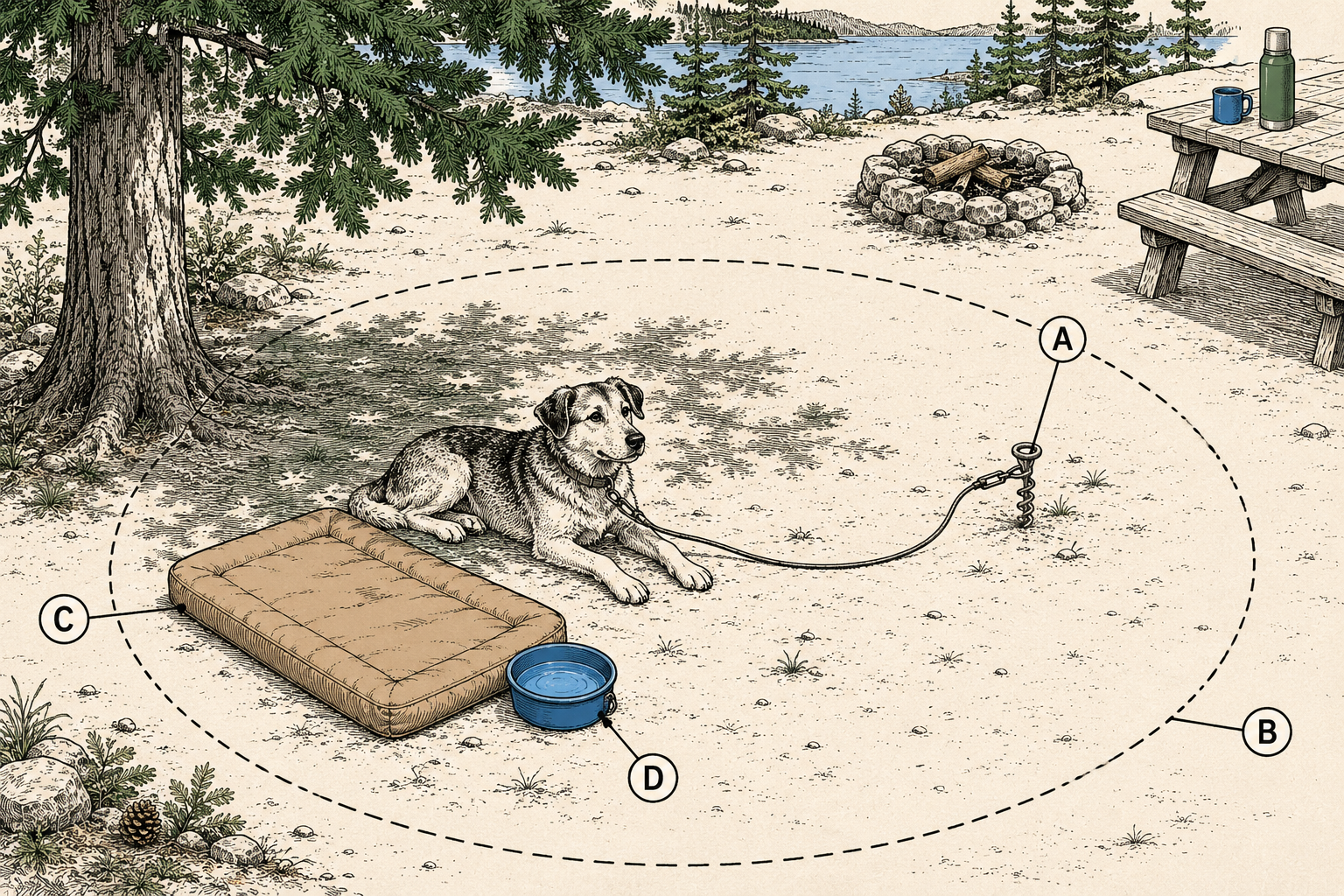
Camp setup with a dog
The dog's camp works like the kid boundary (Chapter 51): an address, not a patrol. The stake-out goes in first (shade across the cable's whole arc as the sun moves, water and bed inside it, the arc cleared of fire ring, kitchen, guylines, and the neighbor's sightline where possible), the dog gets introduced to it calmly with a chew, and the address rule runs the weekend: at camp, the dog is on the cable, at your feet on lead, or in the tent: never loose, including "just while we set up," which is when the squirrel launches every escape story.
The management notes that keep the peace: feed on home schedule (routine is the anti-stress drug), exercise before the fire circle (a walked dog settles; a bored one patrols), station the dog away from the passing-traffic sightline if barking is the risk, and the zero-unattended rule without exceptions: a dog alone at a site is a bark machine with abandonment anxiety, a theft risk, and a rules violation at most campgrounds, and the trip plans around it (the store run takes the dog or splits the adults; the dog-banned trail waits for another trip).
Wildlife interface, from Chapter 45's preview: the leash is the bear plan (the loose dog that finds a bear brings it back), the food bowl stores like human food (empty and cleaned after meals; the kibble bag is bear bait with a mascot), and the dusk chorus (coyotes especially) is the hour the cable earns its keep: even solid recalls dissolve when the wild dogs start singing.
On the trail
Trail rules, layered on Chapter 39's etiquette: leashed (the 6-foot law, plus the practical truth that the leashed dog meets fewer porcupines, ticks fewer tick zones, and never becomes the Chapter 45 story), yielding (dog pulled in and sat for horses always, for passing hikers as a courtesy: half the people you meet love your dog, half are afraid of it, and manners serve both), paw checks at every break (pads read like Chapter 26's feet: hot spots, splits, and the between-toes burr audit), and the dog's own turnaround math: heat, age, and conditioning set a real limit, dogs hide fatigue behind enthusiasm exactly like kids hide cold, and the flopping-in-every-shade-patch dog announced its turnaround two miles ago.
Water and load: dogs drink more than owners expect (offer at every human water break, per Chapter 39's cadence: a dog panting hard drinks now, not at the lake), giardia applies to dogs too (treated water for everyone in ambitious country), and the dog-pack question is honest: healthy adult dogs can carry their own food and bowls (starting light, fitted like Chapter 11 cares about fit), seniors and puppies carry nothing, and the vet weighs in before the pack does.
The regional hazard tour, briefly: foxtails (the barbed grass seeds of the West: ears, nose, and paws audited daily in season), cactus country (Chapter 59: booties and a comb for cholla), snakes (the leash again, plus rattlesnake-avoidance training where it's endemic), and blue-green algae blooms (the posted warnings apply doubly to the swimming dog that drinks its pool).
Heat: the blunt section
Dogs cool by panting, wear fur coats, and defer to their people past their own limits, which makes heat the dog's most dangerous camping condition. The rules: shade and water always (the stake-out arc's shade audit as the sun moves), exercise at the day's edges (Chapter 27's siesta schedule applies at full force: midday trail miles in summer are for dawn's memory), surface checks (the seven-second hand test on rock, sand, and asphalt: too hot for your palm is too hot for pads), the cooling kit in real heat (wet bandana or cooling vest, the shade tarp, the kiddie-pool trick for basecamps), and never, ever the closed car: Chapter 16's oven math (30–40°F above ambient) kills dogs in minutes, and "just running to the camp store" is the sentence that precedes it.
The warning signs, learned before the trip: heavy panting that doesn't settle with rest and shade, thick drool, brick-red gums, wobbling, vomiting: that's heat exhaustion tipping toward heatstroke, and the response is Chapter 49's aggressively-cool doctrine in dog form: shade, cool (not ice) water over the body especially belly and paws, air movement, small drinks, and a vet as fast as the situation allows. Prevention was the whole section above it.
Cold gets its fair paragraph: thin-coated, small, senior, and lean dogs genuinely need the coat and an insulated bed in shoulder seasons (the ground steals dog heat by Chapter 10's same physics), the dog sleeping in the tent (below) solves most of it, and shivering, curling tight, and reluctance to leave the bag-pile are the dog's umbles.
Night, noise, and where the dog sleeps
The dog sleeps in the tent. It's the answer to warmth, security, wildlife, weather, and the bark question all at once, and the logistics are simple: a pad or the dedicated bed for insulation (floor-scratching is what the Chapter 8 footprint and a nail trim are for), paws toweled at the door (the vestibule mat earns its keep), and the familiar blanket as the settle cue. The alternatives rank behind: the vehicle (fine in mild weather with ventilation, lonely), the tied-outside option (no: weather, wildlife, and the bark machine at 3 a.m.), and the RV (its own climate rules; never unattended with climate control as the only safeguard).
The bark management program, because quiet hours judge dogs hardest: the tired dog (the day's exercise is the night's silence), the address system (a dog with a defined den alerts less than a perimeter patroller), the interruption protocol agreed between adults (who gets up, what the cue is: fumbling wakes the loop; a practiced "enough, settle" plus a hand on the shoulder resolves most), and the honest escalation: a dog that barks sustained at night despite all of it is telling you it's not ready yet, and the neighbors' weekend outranks the experiment's continuation.
The waste rule closes the chapter where every dog walk ends: bag it and bin it, everywhere, every time: campground, trail, and backcountry (pack it out or, where regulations explicitly allow, cathole it to Chapter 35's spec: the bag-left-on-the-trailside-to-grab-later is litter with a handle and the single most-cited dog complaint on public lands). The dog can't do this part. That's why it brought you.
Trailhead Takeaways
- Rules first: forests welcome dogs, national parks ban them from most trails. Book pet-friendly edges; carry rabies proof.
- The readiness screen is honest or it's useless: recall, settle, non-reactivity, tether tolerance, and the bark question. Gaps train or the kennel wins.
- The stake-out is the trip's best item: shade across the arc, water and bed inside it, fire and guylines outside it. An address, not a patrol.
- Leashed always (6 feet, not retractable-at-sail), watered always, unattended never. The leash is also the bear plan.
- Heat is the dog's killer condition: dawn-and-dusk exercise, the palm test on surfaces, cooling kit, and never the closed car. Learn the heatstroke signs before the trip.
- Paw checks at every break; foxtails, cactus, and algae blooms audited by region; the dog's turnaround comes before its enthusiasm fails.
- The dog sleeps in the tent, on insulation, tired from the day. Quiet hours have no dog exemption.
- Bag it and bin it, everywhere. No trailside bags "for later."
Where Trips Go Sideways
- The optimism screen. "He'll be fine" met a campground of dogs, kids, and passing traffic, and he wasn't, loudly, until Sunday. The readiness test existed to be taken honestly at home, where the answer costs a training plan instead of a weekend.
- Loose "just for setup." The squirrel launched at minute two, the recall dissolved at the property line, and camp setup became a two-hour search. The stake-out goes in first: it's the tent-pitch of dog camping.
- The trailhead surprise. A park trip planned around three famous hikes, all posted no-dogs at the trailhead, and a weekend of shuttle negotiations. The rules layer was one search away at booking time: parks for the views, forests for the dog.
- The camp-store run. Twenty minutes, windows cracked, mild-seeming day: the math never works, and this one fills the worst folder in every ranger's memory. The dog goes along or an adult stays. There is no third arrangement.
- The 3 a.m. perimeter guard. Tied outside "because he likes the air," the dog worked the night shift: every rustle announced, every neighbor's opinion of dogs revised downward. The tent was the answer to five problems, this loudest one included.
Frequently asked
Where should a dog sleep when camping?
In the tent, on a pad or dedicated bed (ground insulation applies to dogs too), with paws toweled at the door and the familiar home blanket as the settle cue. It solves warmth, security, wildlife, and barking at once. Tied outside overnight is the wrong answer to all four.
Is camping stressful for dogs?
It can be: camping keeps the people and demolishes the routines, which is the actual stressor. The fixes are rehearsal (a backyard campout, busy-park day trips), home-schedule feeding, real exercise, and the stake-out address that gives the dog a defined den. Prepared dogs mostly love it; unprepared ones mostly cope, and the honest readiness screen at home is what tells you which trip you're about to take.
What is the 7-7-7 rule for dogs?
A socialization guideline for puppies (seven new places, people, surfaces, and so on by seven weeks, in popular versions) that dog campers borrow as prep wisdom: expose the dog gradually to camping's novelties (tent, stake-out, fire circle, passing strangers) before asking for a whole weekend of them at once.
What do I need for camping with a dog?
The kit: 6-foot leash plus backup, stake-out cable, camp bed, collapsible bowls, food sealed in a hard container (it stores under bear rules), rabies proof and current tick/heartworm prevention, the first-aid annex (vet wrap, paw balm, dog-dose antihistamine), a light-up collar, and waste bags in every pocket.