Part V · Getting There and Making Camp
Where to Put a Tent at a Campsite
Reading the Ground
How do you set up a campsite?
Read before you unpack: five minutes assessing drainage, slope, wind, sun, and overhead hazards, then lay the camp out in zones (tent upwind and uphill of the kitchen, fire in its ring downwind of both, food storage per local rules) before the first bag opens. Camps that start with the walk-around run clean all weekend; camps that start with unloading get organized by accident.
The five-minute read matters at a developed campground (which pad corner, which tent orientation, where the kitchen faces) and matters triple at a dispersed site, where nobody graded anything and every choice is yours. Either way, the sequence never changes: read the ground, place the zones, then run Chapter 2's setup order (shelter, sleep, kitchen, comfort) inside the plan you just made.
This chapter is the read. Chapter 31 pitches the tent inside it, Chapters 32–33 run the fire, and Chapter 45 tightens the whole layout for bear country. What you're learning here is the oldest camping skill there is: looking at a piece of ground and seeing the night that will happen on it.
The five-minute site read
Walk the site with five questions. Where does water go? Look for channels, silt lines, flattened-grass fans, and low spots; tonight's rain will follow yesterday's paths, and the lush green hollow is lush because it floods. What's the slope? Nearly flat with a slight grade beats pancake-flat (drainage) and beats real slope (everything rolls; sleepers migrate). Where will wind come from? Evening breeze usually runs downslope and down-valley; note the calm and exposed corners. Where's morning sun? An east-facing opening dries dew and warms breakfast; deep shade holds condensation till noon. What's overhead and underfoot? The look-up (next section), plus anthills, poison ivy (Chapter 46's leaflets-three), game trails, and yellow-jacket ground nests along the site's edges.
The read converts directly to placement decisions, and it takes actual minutes, which is why people skip it, which is why 2 a.m. discoveries exist. The tent that went up in the pretty hollow learns about drainage; the kitchen that faced the wind learns about stove physics (Chapter 14); the bag laid on the slope's fall line spends the night sliding to the footbox. Every one of those was visible at 5 p.m. to anyone looking.
Water: close enough to use, far enough to respect
Camp 200 feet (about 70 adult paces) from lakes, streams, and springs (the standard from Chapter 3, now applied), and never, in any season, in a dry wash, arroyo, or drainage bottom in flash-flood country: a storm you can't see, miles upstream, delivers water at freight speed to exactly where the sand looks flattest and most inviting. Deserts (Chapter 59) enforce this with fatalities; the rule is national anyway.
The 200-foot standard protects the water (Chapter 5's rules), the wildlife corridors (animals commute to water at dawn and dusk; a tent on the path is a checkpoint), and your own sleep (waterside camps run colder, damper, and buggier than the bench 200 feet up; cold air pools along water, and mosquitoes hold their conventions there). The best site is usually the slightly elevated bench with water access below: view, breeze, drainage, and a dry tent, all from one contour line's worth of judgment.
Riverside campgrounds handle the setback for you; dispersed camping hands it back. When in doubt at a dispersed site, take the higher, more boring option. Morning-you consistently endorses it.
Wind and sun: orienting the day
Use the read's wind-and-sun notes to aim the camp: tent door away from the prevailing breeze (Chapter 2's rule, now with reasons: a door into the wind loads the tent like a sail and delivers dust with every entry), kitchen downwind of the tent (smoke, sparks, and food smells travel; you want them leaving camp, not moving in), and the morning-sun opening reserved for the breakfast table and the dew-drying line.
Two refinements campers learn their second season. Afternoon shade is a placement decision in summer (Chapter 27's west-side trees), and it's worth taking the tent out of the western sun even at the cost of a less scenic pitch: a tent that bakes from 3 p.m. is an oven at bedtime. And wind is a schedule, not a constant: valley breezes typically run upslope midday and downslope after sunset, so the "calm" corner at 2 p.m. may funnel at 9; the site's bent grass and the trees' wind-flagged shapes testify about what's normal here better than any single moment's air.
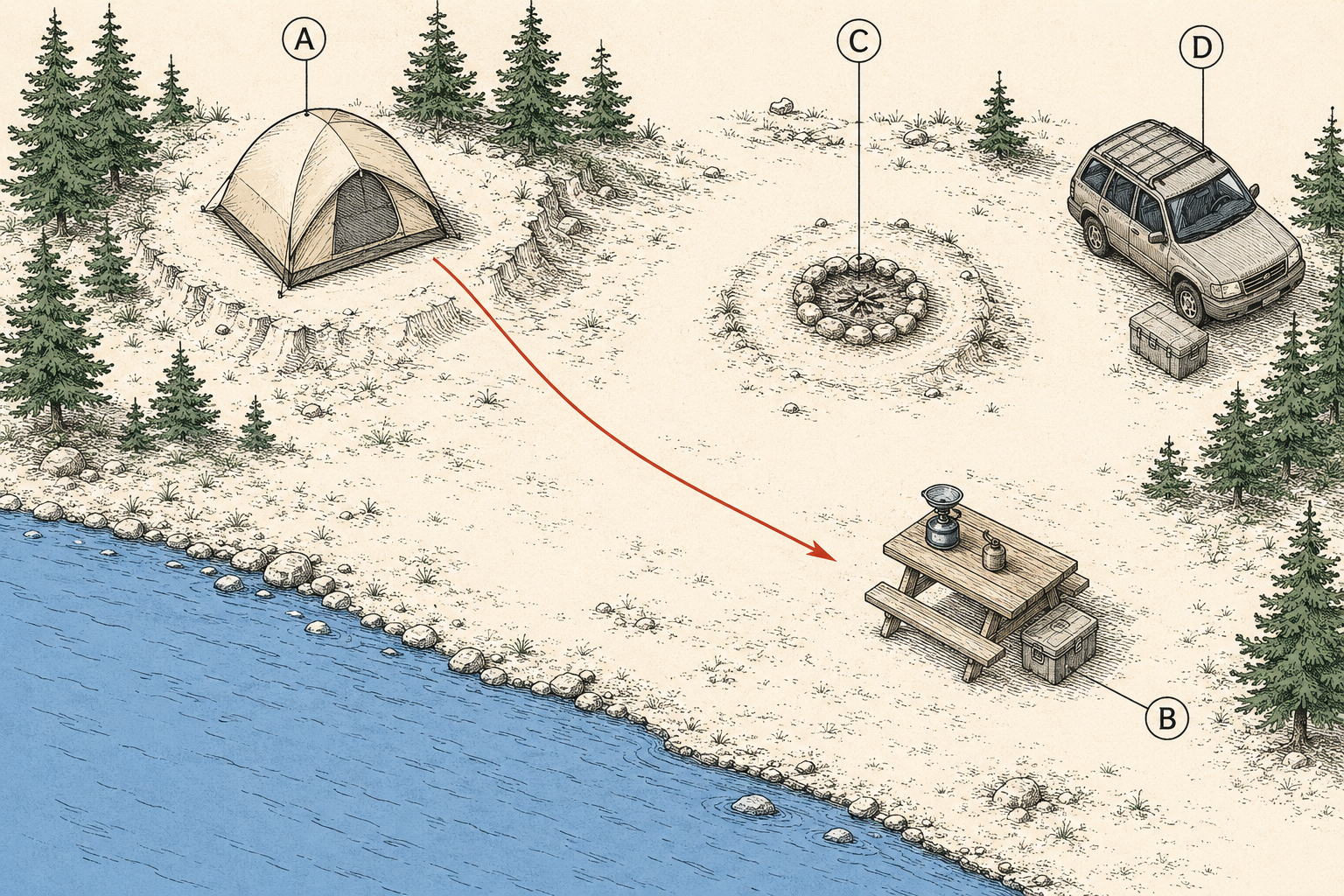
The zone layout
Camps run on three zones plus storage: the sleep zone (tent on the best ground, upwind, uphill), the kitchen zone (table, stove, wash station per Chapter 15, downwind of sleep), the fire zone (the ring, clear of overhead branches by triple its flame height, reachable by neither tent guylines nor chair sprawl), and food storage (the vehicle, locker, or canister at the site's edge, never the tent, ever). Standard campgrounds compress the zones onto one pad-and-table site; the geometry still applies at small scale, and dispersed sites let it breathe.
Why zones instead of a heap: each zone's mess stays in its zone (kitchen smells and spills never visit the sleeping bags), night navigation gets simple (the path from tent door to the bathroom route runs clear of guylines and firewood piles, which matters at 2 a.m. exactly as much as you'd think), and the whole camp closes down in Chapter 2's checklist order because everything has an address. Bear country (Chapter 45) stretches the same map to its serious version: cooking and food storage well away from sleep, sometimes 100 yards of separation at backcountry sites.
The traffic-flow detail that makes camps pleasant: identify the site's natural paths (to the water, to the toilets, to the neighbors' hellos) and put nothing across them. Guylines crossing the main path collect shins nightly; reflective line (Chapter 8) helps, and routing helps more.
Placing the tent itself
Inside the sleep zone, the tent wants: the most level spot that drains (a barely-perceptible grade is ideal; sleep with heads uphill), ground cleared of the sharp and the lumpy (a 60-second sweep by hand beats a night on a pinecone; leave the duff layer itself, which is padding), no hollows (they're puddles on deposit), and the door aimed per the wind plan with the vestibule's workspace in mind. On campground pads, position within the pad still matters: the high corner, the drainage path around it, the door away from the neighbors' lantern line.
The lie-down test settles arguments the eye can't: before staking anything, lay on the footprint where the tent will go, in your sleeping position. Thirty seconds finds the root, the slope's true direction, and the answer to "flat enough," and it's the cheapest quality check in camping. Kids consider it a job (Chapter 51 assigns it).
What you're not doing: trenching around the tent (an old practice that scars ground and marks you as a museum piece; modern bathtub floors plus site choice replaced it), moving rocks and logs wholesale (that's habitat, and Chapter 60 wants the site left as found), or pitching on vegetation when bare ground exists (Chapter 5's durable-surface hierarchy, at tent scale).
Dispersed sites: the full exam
Dispersed camping runs the same read at higher stakes and adds four checks: legality first (the MVUM and distance rules from Chapter 5, confirmed before you fall in love with the spot), existing site preferred (the bare patch with the ring; Chapter 5's argument), escape logic (how does the vehicle leave in rain? The two-track that was firm at 6 p.m. can be grease by morning; park aimed out on firm ground), and total self-sufficiency staged (water, waste, trash systems all present, because nothing is provided and nothing is monitored).
The higher stakes deserve respect without drama: nobody graded the ground (drainage is entirely your read), nobody removed the snag (the look-up is entirely your rule), and nobody's coming by at 10 p.m. to enforce quiet hours or anything else, which is most of the appeal and all of the responsibility. The five-minute read becomes a ten-minute read, done with daylight to spare per Chapter 3's scouting-margin rule.
The reward for the exam, stated once: the best campsites of your life are dispersed sites you read correctly. The bench above the creek, the breeze holding the bugs off, morning sun on the coffee, nobody for a mile. That site was always there. The read is how you get to keep it.
Trailhead Takeaways
- Five minutes, five questions before unpacking: water's path, slope, wind, morning sun, overhead and underfoot hazards.
- Look up. No camp within a tree's height of snags or hanging dead limbs. This rule doesn't negotiate.
- 200 feet from water; never in washes or drainage bottoms. The elevated bench beats the waterside hollow every time.
- Zones: tent upwind/uphill, kitchen downwind, fire ring clear of everything, food storage at the edge and never in the tent.
- Door away from wind, kitchen smells leaving camp, tent out of the western sun, paths kept clear of guylines.
- The lie-down test before staking: thirty seconds finds what the eye misses.
- Dispersed adds legality, the existing-site rule, rain-escape parking, and full self-sufficiency. Read longer, with daylight.
Where Trips Go Sideways
- The pretty hollow. Sheltered, green, soft: every one of those adjectives was the drainage talking. The 2 a.m. rain agreed, and the bathtub floor got a live demonstration. Water's path was written in silt lines the walk-around would have read.
- The widow-maker's shade. The dead limb hung quiet all afternoon, and the wind arrived with the dark. This mistake writes obituaries, not anecdotes, and the look-up that prevents it costs less than a minute.
- Camp on the game trail. A flattened path to the lake ran right past the tent, and the night shift used it as designed: deer at midnight, something heavier at three. Animals commute to water. Don't pitch a tollbooth.
- Kitchen upwind. Every dinner's smoke and smell drifted across the tent for two days, seasoning the sleeping bags for whatever noses passed later. The breeze was steady and knowable. The zones exist because it usually is.
- The two-track exit, after rain. Parked nose-in on grass, rain overnight, and the morning's project was mud archaeology with floor mats for traction. Park aimed out, on the firm stuff, before the sky decides.
Frequently asked
Where is the best place to put a tent at a campsite?
The most level, best-drained spot with nothing dead overhead: slightly elevated beats hollow, a whisper of grade beats pancake-flat, heads uphill, door away from the wind, out of the western sun in summer. Run the lie-down test before staking; your back finds what your eyes miss, and thirty seconds on the footprint is the cheapest quality check in camping.
How far should a tent be from a fire?
Far enough that no ember can reach it: at minimum 15–20 feet upwind, more in any real breeze, and never downwind where sparks travel. Tent fabric melts and burns enthusiastically. The fire ring also stays clear of overhead branches by at least triple its flame height.
What makes a bad campsite?
The recognizable villains: low spots and washes (flooding), snags and hanging limbs overhead (the deadly one), game trails and waterside corridors (traffic), the western-sun bake, ant nests and poison ivy underfoot, and any dispersed spot whose legality you can't confirm. Every one is visible in a five-minute walk-around.
Should you put a tarp under your tent?
On gravel pads, slickrock, and stubbled ground, yes: a footprint cut 2 inches smaller than the floor (Chapter 8's rule) extends floor life and adds a moisture barrier. On clean duff or grass it's optional. Oversized ground tarps funnel rain beneath the tent, which is worse than nothing.