Part V · Getting There and Making Camp
What Size Power Station for Camping?
Light and Power, Off the Grid
What light and power do you need for camping?
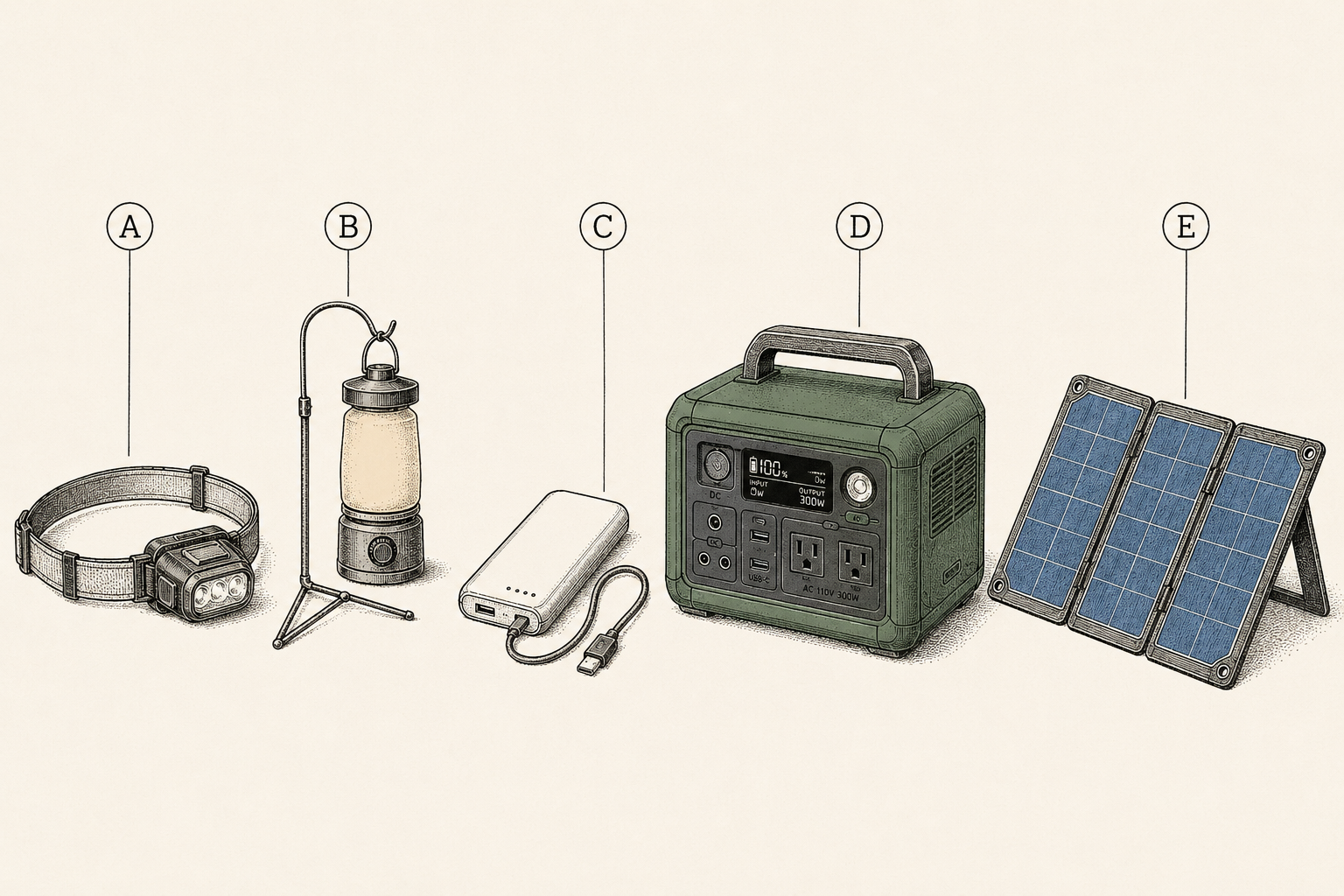
Light: one headlamp per person plus one lantern per site (Chapter 6's trio, now with specs). Power: a 10,000–20,000 mAh power bank per couple covers phones for a weekend; a 300–500 Wh power station enters the picture for family basecamps, medical devices, and camera fleets; solar panels are the range extender, not the source. Everything past that is wants dressed as needs, which this chapter will happily help you shop for anyway. Do the math first.
The framing that saves money: camp power is arithmetic, not vibes. Every device has a consumption number, every battery has a capacity number, and dividing one by the other answers "how big" better than any review's feelings. The chapter runs that math at each tier, and the recurring finding is that most campers' actual needs are smaller than the marketing's suggestion by about half.
The exception that owns its full paragraph later: CPAP users and anyone with powered medical equipment, for whom power sizing is a safety calculation done with margins, not averages.
Headlamps: the specs that matter
A camping headlamp needs: 200–400 real lumens on high (more is marketing; you'll live at 50–150), a red-light mode (night vision preserved, tentmates unblinded), a tilting body, USB rechargeability (with the cable the Chapter 6 kit already carries), a lockout mode (so it doesn't burn its battery on inside a duffel), and an honest run-time spec at medium, which is the number to compare since high-mode claims are sprint figures.
The red mode earns evangelism: white light at night resets your dark adaptation for twenty-plus minutes per blast, and a camp running red after quiet hours sees stars, keeps neighbors friendly, and finds its way around fine. Teach the household the button sequence before the trip (every model hides it differently), and make red the default after dinner.
Fleet logistics from the Chapters 6 and 12 systems: one per person without exception (the shared-light family is one bathroom trip from proving why), staged with the sleep kit at dusk, charged as part of the packing ritual, and one spare (or the backup battery) riding in the essentials pack. Kids get their own at age three-ish; ownership beats borrowing on both responsibility and battery-discipline grounds, and Chapter 51 makes the headlamp the first gear a kid owns.
Lanterns: the social light
The lantern's job is a pool of diffuse, table-height light that everyone can sit around without anyone staring into a point source: 200–600 lumens, diffused (frosted globe or bounce), dimmable, with run time measured in evenings. LED won this category completely: gas lanterns survive as nostalgia items with mantles, fuel logistics, heat, and CO character flaws that Chapter 14's rules already indicted for enclosed spaces.
Placement is half the lantern's performance (Chapter 15 staged it): hung at or above head height at the kitchen's center, it lights work surfaces and no retinas; set on the table, it blinds the person opposite and moths the whole crew. The two-lantern camp (kitchen + table or bathroom trail) out-lights the one-mega-lantern camp at lower total lumens, which is the layered-lighting principle every home already uses, brought outside.
String lights get their honest verdict: genuinely useful (low, diffuse, cheerful, and they mark guylines and tent doors), USB-powered sets sip from the power bank, and the dark-sky courtesy rules apply: down-aimed, warm-toned, off at quiet hours. The campground light show that runs all night is a Chapter 5 etiquette violation with better production values.
Power banks: the weekend answer
The pocket math: phones hold roughly 3,500–5,000 mAh, so a 10,000 mAh bank delivers about two full charges (conversion losses eat 20–30%; the printed capacity is optimistic by design), and a 20,000 mAh bank runs a couple's phones for a long weekend with margin. Chapter 6's sizing rule (two full charges per person) lands most households at one 20,000 mAh bank plus cables, at a weight and price that make the decision boring.
Consumption discipline doubles any battery: airplane mode or low-power mode the moment coverage dies (a phone hunting for signal drains itself twice as fast doing nothing), downloads done at home (Chapters 3 and 29), screen brightness down, and the camera's the only radio-free heavy user left. A phone managed this way sips 15–25% a day as camera-and-map; a phone left hunting signal is dead by Saturday dinner, which is the origin story of most "camping killed my phone" complaints. Airplane mode. Trailhead. Always.
Cold note for shoulder seasons: lithium batteries sag hard near freezing and recover warm. Phones and banks sleep in the bag's footbox on cold nights (the electronics annex of Chapter 36's hot-bottle district), and the "dead" phone in a cold pocket usually revives against a warm body.
Power stations: the basecamp battery
A power station is a big lithium battery with AC outlets, USB ports, and a 12V socket, sized in watt-hours (Wh). The consumption table does the sizing: a phone charge ~15 Wh, a headlamp recharge ~5 Wh, a string-light evening ~10–20 Wh, a 12V fridge ~300–600 Wh per day depending on model and heat, a CPAP ~30–90 Wh per night (humidifier off vs. on). Add your trip's real list, multiply by days, add a third for margin, and the number that comes out is your size.
Run the math for the common cases: a phones-lights-and-cameras family weekend totals under 200 Wh, which a 300 Wh station covers with room (and a big power bank nearly covers for far less money). Add a 12V fridge (the cooler-replacement trend with real merits: no ice, no melt, Chapter 16's rules simplified) and you're a 500–1,000 Wh household with a solar panel in your future. The CPAP case: nightly need times nights, margin doubled because this one's medical, humidifier off to halve the draw, and the DC adapter for your machine instead of the AC inverter (inverters waste 10–15% converting power the machine converts right back).
"Is it worth buying": yes for the fridge-and-CPAP tiers, the frequent family basecamper, and anyone whose trips double as remote work; no for the couple whose real load is two phones, where a $40 bank does the job of a $300 station. The station also moonlights as home outage insurance, which is how half of them get justified and honestly fine.
Solar: what panels honestly deliver
Portable solar panels are rated at laboratory sun; real campsites deliver 50–70% of the sticker in good conditions and far less under trees, haze, or bad aim. The honest planning number: a 100W folding panel in decent sun yields roughly 300–500 Wh across a full day of tending, which recharges the family's 500 Wh station most of the way and utterly dwarfs what any panel does propped behind a windshield at noon for an hour.
Technique is most of solar's yield: aim square at the sun and re-aim every hour or two (the lazy flat panel loses a third), keep it cool-adjacent (panels lose efficiency hot, so flat-on-the-black-tailgate is worse than propped in the breeze), chase the shade line as it moves, and pair panel to battery, never panel to phone directly (clouds make panel output spiky; the battery buffers it, and phones charged directly cook in the sun besides).
Sizing pairs follow the math section: the weekend bank camper doesn't need solar at all (charge at home; the car tops up in transit). The station-plus-fridge basecamp wants 100–200W of panel for stays past three days. Backpackers eyeing 10W trickle panels should usually buy a second power bank instead; the weight math almost never favors the panel below week-length trips.
The car as power plant (carefully)
The vehicle charges devices while driving without a second thought (that's the Chapter 29 top-up), and at camp it's a bounded resource: 12V accessory use with the engine off draws the same starting battery that gets you home, so the rules are short. Phones and banks, fine (an hour of phone charging is a trivial draw). Fridges and inverters off the starting battery, no, not overnight, not "it'll be fine": that's the classic dead-battery-at-the-trailhead origin, and it's why the fridge crowd owns power stations (or dual-battery setups, which are the RV-adjacent deep end).
The jump-pack from Chapter 28's permanent car kit is the insurance policy for the whole section, and idling to charge is the worst version of everything: loud (quiet hours), inefficient, against many campground rules, and hard on the engine. Drive-day charging plus battery storage covers every legitimate need. The engine stays off.
Trailhead Takeaways
- Headlamp per person (200–400 lumens, red mode, lockout, USB), lantern per site (200–600 lumens, diffused, hung high). Red after dinner.
- Layered modest lights beat one mega-lantern. Aim down, warm tones, off at quiet hours.
- Power is division, not vibes: printed mAh loses ~25% in conversion; a 20,000 mAh bank runs a couple's weekend.
- Airplane mode when coverage dies. A signal-hunting phone drains twice as fast doing nothing.
- Stations size by Wh arithmetic: real device list × days × 1.33. Fridge and CPAP households: 500+ Wh and a 100W panel. Phone households: a bank.
- Solar delivers half its sticker, aimed and tended, into a battery, never directly into a phone.
- The starting battery is for starting. Fridges get stations; the jump pack rides always; nothing lithium bakes in a closed car.
Where Trips Go Sideways
- One headlamp, four people. The bathroom trip took the light, the dishes stopped, and the kid tripped over the guyline in the dark. The rule was always per-person. It costs less than the pizza on the drive home.
- The thousand-lumen table sun. Set proudly at eye level mid-table, it blinded six people all evening while moths held a festival. Hang it high, diffuse it, dim it. Light the table, not the retinas.
- The signal-hunting brick. Full battery Friday, dead Saturday noon, zero photos taken: the phone spent its life shouting at a canyon with no towers. Airplane mode at the trailhead is the whole fix.
- The fridge on the starting battery. "Just overnight" met a 6 a.m. click-click-click twelve miles up a forest road. The jump pack saved it; the power station would have prevented it. The starting battery has one job.
- The heater-on-a-station plan. A 1,500W heater versus a 500 Wh station: twenty minutes of warmth, then a dead station and a cold tent. The Wh division was always public information. Insulation wins again.
Frequently asked
How big of a portable power station do I need for camping?
List your real devices, multiply by days, add a third: phones and lights alone rarely top 200 Wh a weekend (a 300 Wh station or a big bank covers it), a 12V fridge pushes you to 500–1,000 Wh plus solar, and CPAP users size nightly draw times nights with doubled margin and the DC adapter.
Is it worth buying a portable power station?
For fridge campers, CPAP users, long basecamps, and remote workers: yes, it changes what trips can be. For phone-and-lights weekenders: usually no; a 20,000 mAh power bank does the job at a tenth the price. The tiebreaker many buyers use honestly: the station doubles as home power-outage insurance.
How long will a 300W power station last?
Assuming ~300 Wh capacity: about 20 phone charges, or several evenings of lights and small devices, or a 12V fridge for roughly half a day to a day, or a CPAP (humidifier off, DC adapter) for 3–6 nights. Divide the watt-hours by your device's draw and subtract a bit for conversion losses, and remember the label's watts and the battery's watt-hours are different numbers doing different jobs.
How do you charge your phone while camping?
Layered: airplane mode to slash the drain, a power bank sized at two full charges per person, drive-time topping via the car, and for long stays, a solar panel feeding a battery (never the phone directly). Cold nights, the electronics sleep in the bag's footbox; lithium sulks near freezing.