Part V · Getting There and Making Camp
How Deep Should a Cathole Be?
The Backcountry Bathroom
How do you poop in the woods?
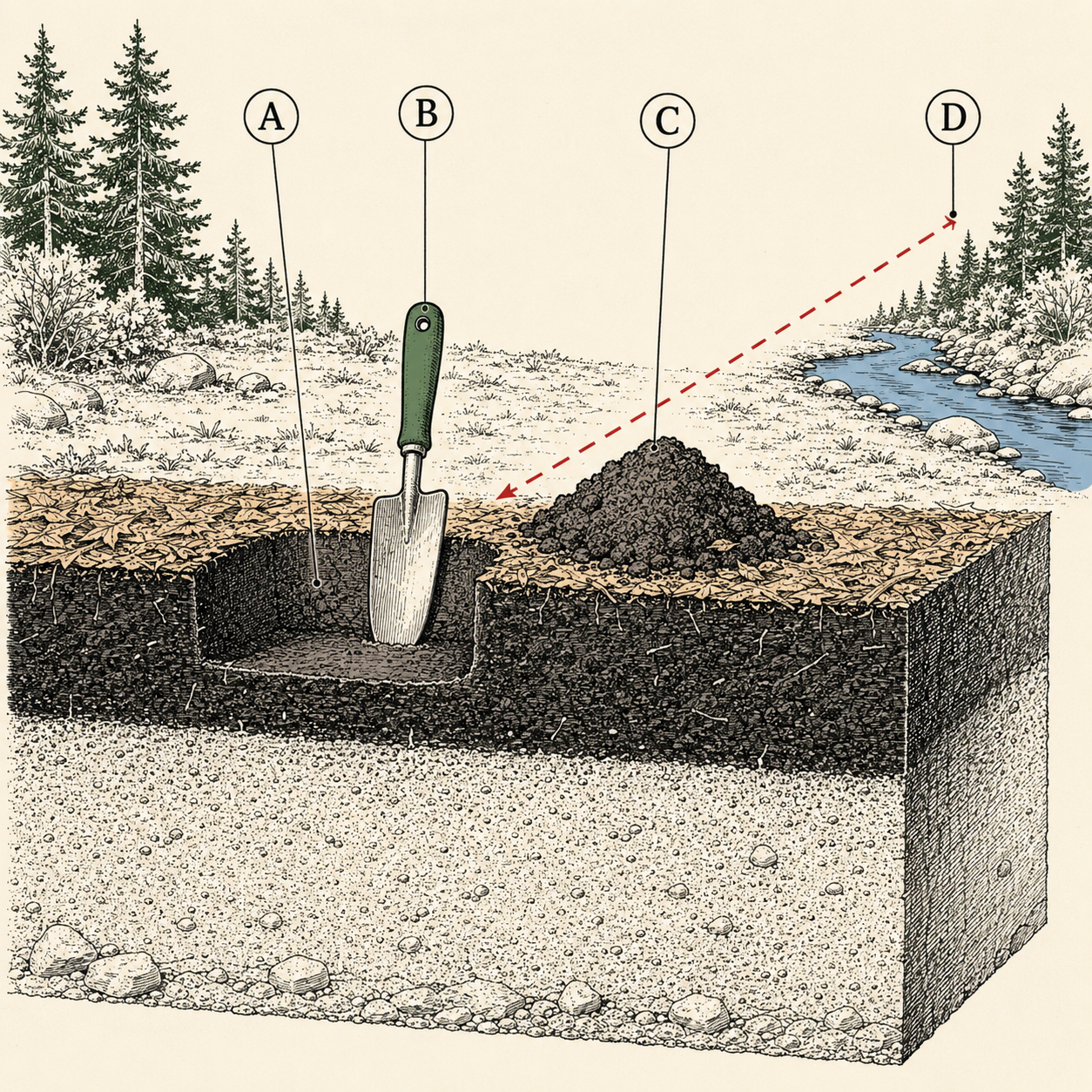
Dig a cathole: 6–8 inches deep, 4–6 inches wide, at least 200 feet (about 70 adult paces) from water, trails, and camp, in soil with organic activity where possible. Do your business, stir in a little soil, backfill completely, and disguise the site. Toilet paper gets packed out in a zip bag (the modern default) or buried deep only where local rules explicitly allow; wet wipes get packed out everywhere, always, no exceptions, including the "biodegradable" ones.
Nobody loves this chapter and everybody needs it, so let's set the tone early: managing human waste outdoors is a solved problem with clear specs, and campers who learn them stop thinking about the whole subject, which is the goal. The stakes are real but unglamorous: waste near water spreads exactly the illnesses Chapter 17 treats water against, unburied waste is the fastest way a beloved dispersed area earns new regulations or a closure, and the difference between doing it right and wrong is about four minutes of technique.
The kit is minimal and lives in a dedicated zip bag in the daypack or bathroom bin: a lightweight trowel, toilet paper flattened in its own bag, a pack-out bag for used paper (opaque, doubled), and hand sanitizer clipped where it gets used (Chapter 6's religion, restated at its home altar).
The cathole, step by step
- Pick the spot: 200 feet-plus from any water, trail, or campsite (count the 70 paces the first few times; people underestimate badly), off the paths people walk, in soil that digs (dark, organic, diggable dirt beats sand or gravel for decomposition), with some privacy and, connoisseurs note, a view.
- Dig to spec: 6–8 inches deep, 4–6 inches wide, the excavated soil piled neatly beside. The trowel makes this a two-minute job; a boot heel and a stick make it a ten-minute argument, which is why the trowel exists.
- Do your business over the hole. Squatting is stable with feet flat and apart; holding a tree adds confidence; the fallen-log-as-bench technique (hole dug on the far side) is the luxury option.
- Stir and fill: a stick stirs a little soil into the deposit (accelerates decomposition meaningfully), then backfill completely, tamp, and scatter duff or a rock over the site so it reads as undisturbed.
- Sanitize hands, immediately, every time. This step is where camp GI illness actually gets prevented; the hole was for the land, the sanitizer is for your crew.
Depth is the spec that matters most: 6–8 inches sits waste in the biologically active soil layer where decomposition runs fastest, deep enough that animals don't excavate it and rain doesn't exhume it. Shallower fails both tests, and deeper drops below the active layer and slows everything down. The trowel's blade is usually about the right length, a built-in ruler.
Paper, wipes, and the pack-out default
Toilet paper policy has moved, and the book states the modern standard plainly: pack it out. Used paper goes in the doubled opaque zip bag (a strip of duct tape over a clear bag works; commercial odor-proof bags work better), and the bag leaves with your trash. Burial of plain unscented paper deep in a proper cathole remains legal and defensible in many forests; it's also how every "TP flower" you've ever seen next to a trail got started, because burial done lazily is the norm, and animals dig up the rest. The pack-out habit is barely harder and always right.
Wipes are a separate, harder rule: no wipe is buriable, ever, anywhere, regardless of the packaging's claims. "Flushable" and "biodegradable" wipes persist in soil for years, and they are the single most common piece of gross litter in heavily used areas. Pack out every wipe, and if that changes which products you bring, it was supposed to.
The bidet option earns its modern mention: a squeeze-bottle backcountry bidet (or a repurposed sports-cap bottle) plus a small dedicated towel cuts paper use to nearly zero, feels cleaner, and simplifies the whole pack-out question. Half the long-trail world has quietly converted. Water for it counts against the Chapter 17 supply, and hands still get sanitized after.
Peeing is gloriously simpler: 200 feet from water and camp, on durable surfaces (rock, bare soil) rather than vegetation where practical (in some alpine and desert areas, salt-craving wildlife dig up urine-soaked plants), and that's the whole rulebook. A dedicated pee cloth (a snap-on quick-dry square, rinsed and sun-dried) has become standard kit for many women; it works, it's sanitary, and it beats drip-drying or hauling extra paper.
Pack-out zones: WAG bags and where the cathole is illegal
Some environments can't process buried waste, and their rules say so: deep deserts (too dry to decompose; Chapter 59), alpine zones above soil (nothing but rock and snow), river corridors (everything drains to the water; rafters have packed out for decades), narrow canyons, and heavily used areas from big-wall bases to certain summit trails. The tool is the WAG bag (a double-bag kit with gelling powder and puncture-resistant outer), used like a very rustic toilet, sealed, packed out, and disposed of in regular trash (they're landfill-legal by design).
The etiquette of the WAG bag is honestly easier than the cathole (no digging, no siting), and the mental hurdle is the whole cost. Carry one per person per day in pack-out country, plus a dry bag or hard container for transport (rafters call it the groover, and the name is a story you can look up). Check the land unit's rules before the trip; "are catholes legal here" is a five-minute search that heavily used areas answer loudly.
Snow country gets its own line: waste buried in snow isn't buried, it's scheduled for spring publication. Winter trips (Chapter 55) run WAG bags or established facilities, full stop.
Portable toilets: car camping's quiet upgrade
For car camping, especially with kids, the portable toilet converts the worst part of dispersed trips into a non-event. The honest tiers: the bucket system (a 5-gallon bucket, snap-on seat lid, and heavy compostable or WAG-style liner bags with absorbent; cheap, effective, zero moving parts), the collapsible commode (same idea, folds flat, nicer to pack), and the cassette toilet (a real flushing seat over a sealed tank, emptied at dump stations; the family-basecamp luxury).
Operating rules are short: it gets a dedicated private spot (a pop-up privacy shelter or a tarp-and-tree arrangement; downwind, naturally), liners get sealed and packed out with trash (bucket and commode) or tanks get emptied at real dump stations only (cassette; never a vault toilet unless posted as permitted, and never, obviously, the woods), and the hand-sanitizer station lives beside it, non-negotiable.
The developed-campground corollary: vault toilets (the standard brown building) are better than their reputation when used right: lid down after use (controls odor and flies for everyone), nothing thrown in but human waste and TP (every "do not throw trash" sign marks a maintenance worker's bad week), and your own TP stash along for the visit, per Chapter 6's zip-bag rule.
Washing: showers, swims, and the soap laws
Camp bathing runs three tiers. The swim (soap-free rinse in the lake; refreshing, legal, and fine as long as it's actually soap-free). The solar shower (a black 5-gallon bag filled in the morning, cooked in the sun all afternoon, hung from a branch or the roof rack at dusk: genuinely hot water in summer, and the best morale-per-dollar object in car camping). The pump or battery shower (a rechargeable pump in a bucket of stove-warmed water; faster, less sun-dependent, the shoulder-season answer).
The soap laws apply to every tier and repeat Chapter 15's dishes doctrine because the chemistry is identical: no soap in or near open water, biodegradable or otherwise; lather and rinse happen 200 feet from water, with the rinse water broadcast over ground. The practical setup: the shower hangs at a designated wash spot away from the water and the kitchen, a bath mat or flat rock keeps feet out of the resulting mud, and a quick-dry towel per person hangs on the Chapter 8 ridgeline.
The daily minimum when full showers aren't happening (and they usually aren't): face, hands, feet, and anywhere that chafes, with a washcloth and warm water at dusk. That five-minute ritual, plus dry sleep clothes, is 90% of feeling human on a week-long trip, and feet inspected nightly are feet that finish the trip (Chapter 26 lurks in this sentence).
Period care outdoors, plainly: everything used packs out (tampons, pads, cup contents buried like waste in a cathole where legal, or packed out in pack-out zones), the doubled opaque bag works exactly as for paper, and the persistent campfire myth that menstruation attracts bears has been studied and debunked; Chapter 45's food-storage rules cover scented products the same as toothpaste, and that's the entire special handling required.
The camp handwash station
The hardest-working hygiene object in camp costs nothing: a water jug with a spigot (already at the kitchen per Chapter 17), a bar of soap in a mesh bag hung on the jug, and a nail-brush if you're fancy, stationed where the bathroom trail meets camp. Wash before cooking, after the bathroom, and before eating, and the camp's GI-illness risk drops to background levels.
The reason to build the station rather than rely on virtue: visible, convenient infrastructure gets used, and pumping sanitizer from a buried bin does not. Kids especially wash when the station is a fixture with its own spot (Chapter 51 makes it a camp job: station monitor). Sanitizer remains the trail and cathole companion; soap-and-water remains the camp standard, because sanitizer struggles with visibly dirty hands and norovirus, which is exactly the pair camping serves up.
Trailhead Takeaways
- Cathole spec: 6–8 inches deep, 4–6 wide, 200 feet (70 paces) from water, trails, and camp, in dark living soil. Stir, backfill, disguise.
- Pack out toilet paper as the default; bury plain TP deep only where rules allow. Wipes pack out everywhere, forever, no exceptions.
- Deserts, alpine rock, river corridors, snow, and posted areas mean WAG bags. Sealed, packed out, landfill-legal.
- The bucket toilet upgrades every family dispersed trip for $30. Liners seal and pack out; cassettes empty at dump stations only.
- No soap in or near open water, ever. Lather and broadcast rinse water 200 feet out; the solar shower hangs at the wash spot, not the shore.
- The handwash station (jug, soap on a rope, fixed spot) prevents more camp illness than any other object.
- Sanitize after every bathroom trip. That's the step that protects the crew.
Where Trips Go Sideways
- The six-inch shortfall. Dug "deep enough" with a boot heel, which meant three inches, which meant a dog and a horror story by Sunday. The trowel weighs two ounces and its blade is the ruler. Dig to the spec.
- The TP flower garden. Paper buried shallow, exhumed by rain, decorating a beloved overlook. Pack-out bags weigh nothing and end the genre. Wipes were never buriable at all.
- Fifty feet felt like two hundred. The convenient spot behind camp was a third of the legal distance, uphill of the creek everyone filtered from. Count the 70 paces the first few times; everyone's eyeball estimate is short.
- Soap at the shoreline. A well-meaning lake bath with "biodegradable" soap, a film on the cove, and Chapter 15's law broken at bath scale. Biodegradable means soil, not water. The wash spot is 200 feet inland by design.
- The unwashed cook. One skipped handwash between cathole and quesadillas took three campers out of commission. The illness got blamed on "something we ate," which was technically accurate. Build the station. Use the station.
Frequently asked
How long does poop take to decompose in the woods?
In a to-spec cathole in biologically active soil: months to about a year, climate depending. In desert sand, alpine gravel, or shallow burials: years, which is why dry and rocky environments mandate pack-out instead. The 6–8 inch depth targets the dark soil layer where decomposition actually runs, which is exactly why the trowel's blade doubles as the measuring stick.
What is the 7-second poop trick?
Internet shorthand for having everything staged before you squat: spot picked, hole dug, paper and bag in reach, so the awkward part takes seconds. The real version of the trick is this chapter's kit bag and a dug-in-advance hole when timing is predictable. Preparation, not biology.
Where do you go to the bathroom when car camping?
Developed campgrounds provide vault or flush toilets, which solve it. Dispersed car camping runs either the full cathole protocol or, better for groups and kids, a bucket or cassette portable toilet with a privacy shelter: liners sealed and packed out with the trash, cassettes emptied only at dump stations.
How do you shower while camping?
Summer: a black solar shower bag filled in the morning and hung at dusk delivers genuinely hot water free. Cooler seasons: a rechargeable pump shower in stove-warmed water. Both operate at a wash spot 200 feet from any water, because soap of every kind stays out of lakes and streams. Swims stay soap-free.