Part VII · Trouble: Prevention and Response
Do Bears Attack Campers in Tents?
Bear Country Manners
How do you camp safely in bear country?
Store everything scented in something bears can't open (locker, canister, or hard-sided vehicle), every night and every absence, without one exception all season; keep a clean camp with cooking separated from sleeping; make human noise on trails; and carry bear spray where grizzlies live. Storage is 90% of bear safety, and it's the 90% entirely under your control.
The reassurance first, because bear anxiety cancels more trips than bears do: attacks are genuinely rare, campground incidents are overwhelmingly property crimes (a cooler pried open, a pack shredded), and virtually every bad bear story starts with accessible food, which means virtually every bad bear story is preventable at the level of putting things in a box. Bears are smart, food-driven, and mostly conflict-averse; the rules exist because a bear that gets human food once becomes a repeat customer, escalates, and is eventually killed for behavior humans taught it. "A fed bear is a dead bear" is the ranger phrase, and it's literal.
So this chapter's tone is house rules, not horror: the storage law, the clean camp, the encounter scripts (different for black bears and grizzlies, and worth learning cold), and the spray. Follow the first two and you'll likely never need the last two.
Know your bear
North America's two camping bears: the black bear (the continent-wide default: forests from Florida to Alaska, most of the Lower 48's bear country) and the grizzly/brown bear (the Northern Rockies, parts of the Mountain West, Alaska, western Canada). The protocols differ, so identification matters, and color is useless: black bears run black, brown, cinnamon, and blond; grizzlies run dark to pale.
The real field marks: grizzlies carry a prominent shoulder hump (a muscle mass black bears lack), a dished (concave) face profile versus the black bear's straight Roman nose, short rounded ears versus tall pointed ones, and long, visible front claws built for digging. Range does most of the work in practice: in the majority of American camping country there are no grizzlies, and the local bear conversation is a black bear conversation; where both live (check the land unit's page, which will tell you loudly), assume grizzly rules.
The behavioral note that frames everything: nearly all close encounters are a bear wanting food or startled at close range, not predation. The scripts below sort by what the bear is doing, and "calmly leaving" is the overwhelmingly common bear response to noticing you.
The storage law: everything scented, every time
The list is longer than food: coolers (full or empty; bears know the shape), all food and drinks, trash and recycling, toiletries (toothpaste, sunscreen, lip balm, deodorant, soap), bug spray, the dog's food and bowls, dishes and stoves with residue, the clothes you fried fish in (Chapter 22 warned), gum in the tent pocket, and the toddler's car-seat crumbs within reason. Where it goes, in order of preference: the campground's bear locker, a bear canister, or a hard-sided vehicle with everything out of sight and windows fully closed (where vehicles are permitted storage; some parks with bold bears say lockers only, and their bears have opened car doors).
The timing is the discipline: locked away whenever unattended and always overnight, which in practice means the Chapter 2 kitchen-close ritual runs before dark, every night, tired or not. Nothing scented enters the tent, ever, including the midnight snack instinct: the tent smells like sleeping bags or it smells like a vending machine, and you choose nightly. (Chapter 21 already sentenced the granola bar in the kid's sleeping bag; here's the court it answers to.)
Canisters, lockers, and the declining art of the bear hang
The bear canister (the hard plastic barrel that fits in a pack) is the modern backcountry standard: required outright in a growing list of heavily used areas (the High Sierra, parts of the Rockies and Adirondacks, and more; check your unit before every backpacking trip, because "required" means rangers check). It's heavy, bombproof, doubles as a camp stool, and stores 50 feet or more from the tent, not near cliffs or water a frustrated bear could roll it into.
The bear hang (food bag hoisted on a line between trees) is the traditional alternative, and honesty requires its modern report card: done to spec it defeats most bears; done as usually done it's a piñata, and enough bears have learned line-cutting and branch-breaking that many agencies stopped accepting hangs at all. The spec, where hangs are legal and trees allow: the bag hangs at least 12 feet up and 6 feet out from any trunk or branch, achieved with the counterbalance or PCT method (the line over a high branch, the bag hoisted, the line secured so nothing runnable connects bag to ground). Chapter 34's rope skills make it feasible; the geometry makes it hard, which is the point and the reason canisters are winning.
The practical decision tree: car camping, use the locker or vehicle. Backpacking where canisters are required, carry one (rentals exist at ranger stations and gear shops). Backpacking where they're optional, carry one anyway is this book's recommendation: the hang's failure modes (no good trees, dark arrivals, tired geometry) all vanish, and sleep improves accordingly.
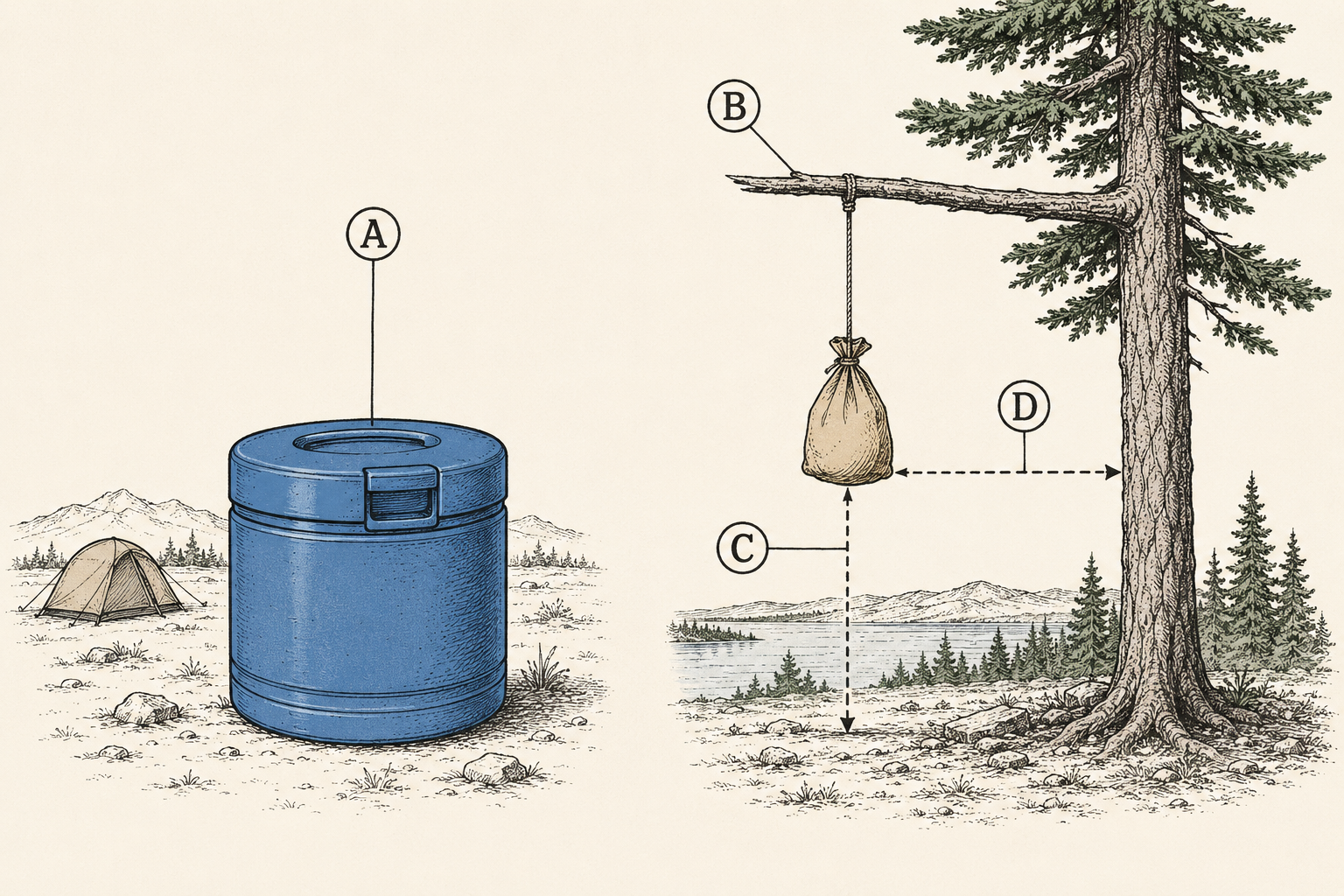
The bear-country camp layout
Backcountry sites in bear country stretch Chapter 30's zones into the triangle: sleeping area, cooking-and-eating area, and food storage each 100 yards (about 90 meters) apart where terrain allows, with cooking downwind of the tent. Front-country campgrounds compress this to the practical version: cook at the table, store in the locker, keep the tent free of everything scented, and wipe the table down after meals.
The clean-camp habits that complete the layout: dishwater strained and broadcast per Chapter 15 (food scraps packed out with trash, never scattered or burned; half-burned food in a fire ring is bear bait with a smoky garnish), the grill grate scraped, wrappers policed off the ground at kid height, and the day's fish-and-bacon clothing stored with the food rather than worn to bed in ambitious country. None of this is fear; it's the same logic as not leaving pie on the porch.
Dogs in bear country get their Chapter 54 preview: leashed absolutely (a loose dog finds a bear, then brings it back to you at speed), fed on the same schedule and storage rules as humans, and counted as a reason for more noise and more caution, not less.
Encounters: the black bear script
A black bear that notices you and stays calm: stop, group up, talk in a firm normal voice, and back away slowly, leaving it a clear exit. Never run (running flips a chase switch in every bear; they hit 30+ mph and you don't), never approach for photos, and never get between any bear and cubs or food.
A black bear that approaches, follows, or works your camp: escalate. Stand tall, group tight, get loud (yell, bang pots, the air horn some campgrounds sell), throw things near it, look big and expensive. Black bears bluff rarely and back down from confident humans routinely; the species' whole conflict style is testing for easy, and your job is being difficult. If the extraordinary happens and a black bear makes contact: fight back with everything, targeting the face and nose. Playing dead is wrong for black bears, full stop.
At night in camp: the pot-banging and yelling script runs from beside the tent, lights on, group together. The bear that visits camps is after the food it can smell (which the storage law already secured, right?), and departs unpaid visits quickly. Report camp-working bears to the host or ranger in the morning: managers track exactly this.
Encounters: the grizzly script
Grizzly country's baseline changes: travel in groups (parties of three-plus almost never get attacked), make noise on trails constantly (the human voice outperforms bells; "hey bear" around blind corners and berry patches and streams), have spray on the belt, not in the pack, and read the land for fresh sign (diggings, scat, carcass smell means leave the area entirely, now).
A grizzly that notices you calmly: same as the black bear script: group, talk firmly, back away slowly, no running, spray in hand with the safety off if it's close. A grizzly that charges: stand your ground and deploy spray at 30 feet (charges are usually bluffs that veer off; running turns bluffs real). If a defensive grizzly (surprised, with cubs, on a carcass) makes contact: play dead: face down, hands laced over the neck, elbows and legs wide to resist flipping, pack on as armor, and stay down until the bear is long gone (defensive bears stop when the threat stops). The rare predatory approach (a bear that stalks deliberately, or works a tent at night): fight back with everything, same as black bears; playing dead answers defense, never predation.
The scripts compress to a card: black bear contact = fight. Grizzly defensive contact = play dead. Anything predatory = fight. Everything before contact = calm, grouped, backing away, spray ready. Read it twice; the moments it's for don't allow review.
Bear spray: the tool and the technique
Bear spray is a capsaicin fog canister that stops charges better than firearms in the incident record, and it works only within its rules: on the belt or chest, never in the pack (a charge gives you 2–3 seconds; count them), safety clip thumbed off as the situation develops, deployed at about 30 feet in a 2–3 second sweeping blast aimed slightly down (the cloud rises; the bear runs into it), repeated as needed, and then you leave the area promptly (spray residue eventually attracts curiosity, and the bear may return).
The details that matter before the moment: check the expiration (propellant fades), know your wind (a headwind sprays you; angle accordingly and accept that some cloud beats no cloud), practice the draw-and-clip motion until it's thoughtless (inert practice canisters exist and are worth one afternoon), and never test-fire "a little" into the campsite air (it's a contaminant; Chapter 48 treats capsaicin exposure with time, air, and water). Airlines prohibit it entirely; buy at the destination for fly-in trips.
And its limits, honestly: spray is an emergency brake, not a force field or a repellent (never applied to gear or tents like bug spray, a real and terrible misunderstanding), and it's the second line behind the actual defenses: storage, noise, groups, and attention. In heavy grizzly country it's non-negotiable equipment; in ordinary black bear country it's a reasonable comfort that the storage law mostly obsoletes.
Trailhead Takeaways
- Storage is 90%: everything scented in a locker, canister, or hard-sided vehicle, every absence, every night, zero exceptions. A fed bear is a dead bear.
- ID by hump, face, and ears, never color. No grizzlies in most US camping country; where they are, the land unit says so loudly.
- Canisters beat hangs: required in many areas, foolproof everywhere. Hangs count only at 12 feet up, 6 feet out, counterbalanced.
- Backcountry triangle: sleep, cook, store, 100 yards apart. Front country: locker, clean table, nothing scented in the tent.
- Calm bear: group, talk, back away, never run. Bold black bear: get big and loud. Contact: fight a black bear, play dead only for a defensive grizzly, fight anything predatory.
- Spray on the belt at 30 feet, sweeping and low, then leave. Practice the draw. Check the date. Never in the pack.
- Groups of three-plus and constant human noise are grizzly country's real armor.
Where Trips Go Sideways
- The cooler on the table, "just during the hike." Two hours unattended, one educated bear, zero cooler, and a citation to frame the story. The locker was eight feet away. Unattended means locked, always.
- The tent pantry. Toothpaste in the door pocket, a granola bar in the kid's bag, and a 2 a.m. investigation by something that could smell both through nylon. The tent is a bedroom, not a cupboard, and the rule has no small exceptions.
- The piñata hang. Eight feet up, two feet from the trunk, tied off at nose height: every spec missed, and breakfast left with the bear it trained. To spec or the canister; there's no partial credit in this subject.
- Running. The bear was ambling away until the camper sprinted, and 30 mph of chase reflex explained the rest of the lesson gently, as bluffs usually do. Nothing that happens around a bear is improved by running. Nothing.
- Spray in the pack's side pocket. The charge took three seconds; the zipper took six. Belt or chest, clip rehearsed, or it's ballast with a safety seal.
Frequently asked
What keeps bears away while camping?
Nothing "keeps bears away"; what works is giving them no reason to come: flawless scented-item storage, a clean kitchen, trash locked up, and human noise. Repellents, mothballs, and perimeter folk remedies don't work, and bear spray is a charge-stopper, never a spread-it-around deterrent. The locker or canister does more than every gadget combined, and it works on the bear you never see, which is nearly all of them.
Do bears attack campers in tents?
Vanishingly rarely, and the incidents that exist almost always trace to food or scented items in or near the tent, or to camps in known problem areas. A scent-free tent in a clean camp with proper storage is about as safe as sleeping gets outdoors. The storage law is the tent's real wall.
Do you have to worry about bears when camping?
Attention, yes; worry, no. Most American camping country hosts only black bears, whose incidents are overwhelmingly property raids on unsecured food. Run the storage law, keep the kitchen clean, learn the encounter script once, and bear country becomes a place you camp rather than a thing you fear.
Should I carry bear spray?
In grizzly country: yes, on your belt, without debate, alongside groups and noise. In ordinary black bear country: optional; storage discipline does the heavy lifting, and spray is a reasonable comfort for the remote or the nervous. Wherever you carry it, practice the draw and respect the expiration date.