Part VII · Trouble: Prevention and Response
How to Treat a Blister While Hiking
Patch-Ups
What do you do first when someone gets hurt at camp?
Assess before you treat: scene safe (the hazard that got them can get you: traffic, current, the still-hot grate), response and breathing (unresponsive-and-not-breathing-normally means send for help and start CPR now, everything else waits), serious bleeding (controlled with direct pressure before any cleaning or splinting), then the injury itself, methodically. The sequence exists because helpers who skip it treat the loud injury while missing the quiet emergency.
This chapter and the next are the field protocols the Chapter 47 kit assumes, written to current wilderness-medicine teaching and honest about their limits: this is first aid, the bridge between incident and care, not a substitute for the WFA course (which teaches hands what pages can't) or for medical help (which the Chapter 42 messenger summons). The front-matter disclaimer applies here at full strength.
The camp reality check that sets the tone: the actual casualty list runs blisters, scrapes, splinters, stings, sunburn, and sprains, and a camper fluent in this chapter handles all of it with the kit and a calm voice. The dramatic sections (snakebite, anaphylaxis) are here because being ready is cheap and the folklore is expensive.
Cuts and scrapes: irrigation is the treatment
The protocol: stop the bleeding (direct pressure with the cleanest thing available, minutes of it, elevated if convenient; nearly all camp bleeding stops with patient pressure), then clean by irrigation: the Chapter 47 syringe firing treated water (Chapter 17's supply) across and into the wound until visible dirt is gone, which takes more water and more nerve than feels polite (half a liter for a real scrape is normal; this step is the infection prevention, and antiseptic wipes around, never in, the wound finish the job), then close and dress: closure strips pulling clean edges together for gaping cuts, antibiotic ointment, non-stick pad, tape, checked and re-dressed daily.
The gaps-and-edges call: a cut whose edges gape open when the limb moves, or anything on a face or across a joint, earns closure strips now and a same-trip medical visit for the stitches conversation (closure windows run hours, not days). Deep punctures (the tent stake, the fishhook past the barb) get irrigation without heroics, no deep scrubbing, and a lower threshold for professional care plus the tetanus-status question everyone answers with "uh."
The infection watch that follows every wound home: increasing redness, warmth, swelling, pus, red streaking, or fever in the days after means medical care promptly. Write the wound's birthday on the Chapter 47 card; "how long has it looked like this" wants a real answer.
Burns: cool water, long, and nothing else
The treatment is the one from Chapter 33's kid section, now in full: cool running water for 10–20 minutes, immediately, which feels excessive and is the entire therapy (it halts the burn's progression through tissue; a burn keeps cooking after the heat source leaves). No ice (freezes damaged tissue), no butter, oil, or folk pastes (they seal heat in and gift the ER a cleaning job), no popping blisters (Chapter 26's roof rule, thermal edition). After cooling: ointment-free non-stick dressing, loose, and pain relievers from the kit.
The severity sort: superficial (red, painful, sunburn-class): cooling, aloe, done. Partial thickness (blisters): cool fully, dress loosely, and size it honestly: blistered burns bigger than the patient's palm, or on face, hands, feet, or groin, or circling a limb, are medical-care burns, today. Anything deeper (painless white or charred patches), any airway involvement (Chapter 46's smoke warning), and any electrical burn: emergency, evacuate, SOS as needed.
The camp-specific preventions got their chapters (the glove rule at fires, the boiling-pot handle turned inward, the kid perimeter), and the treatment's speed is why the water jug lives at the kitchen: the burn clock starts at contact, and the 10–20 minutes work best started within seconds.
Sprains and strains: the walk-out problem
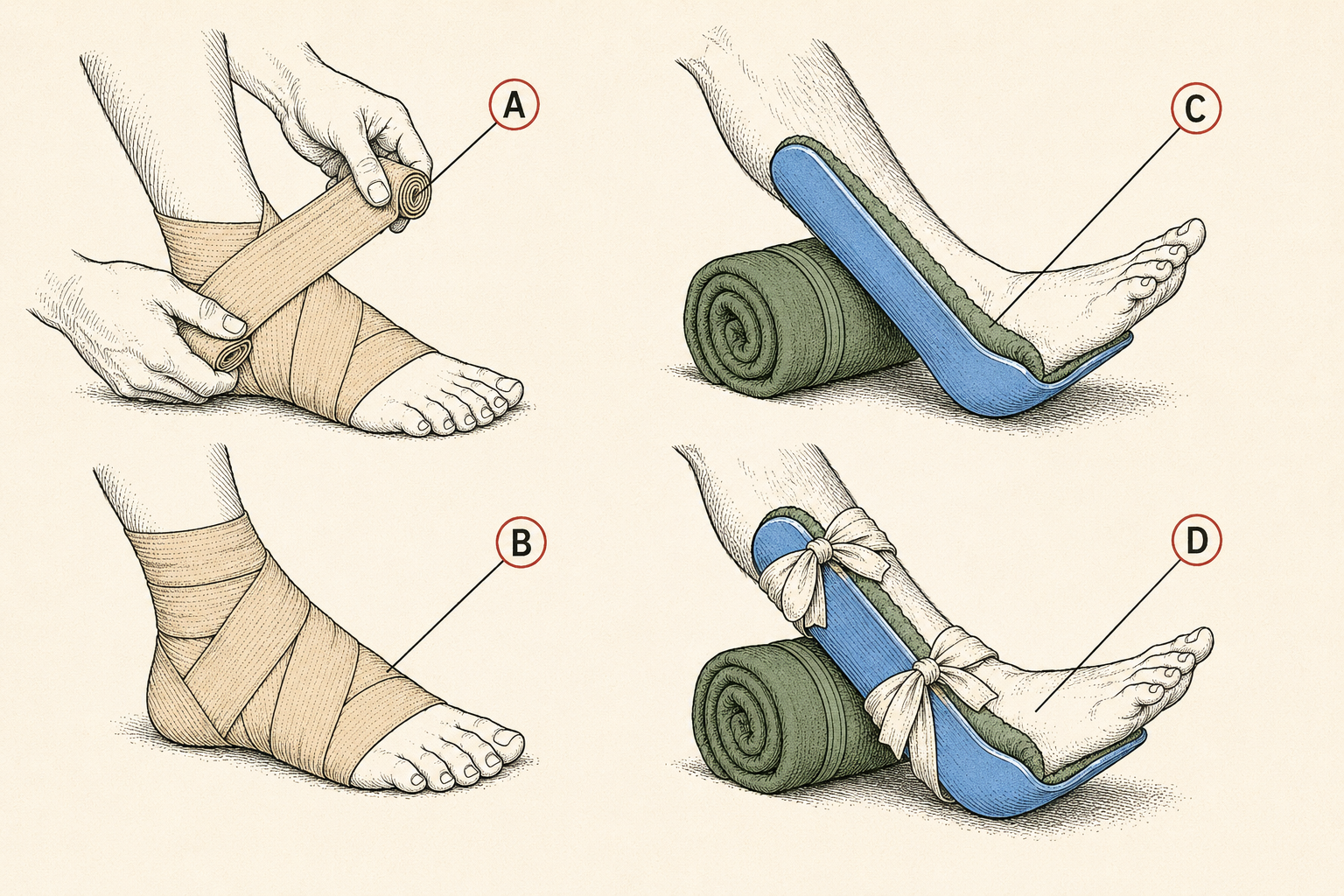
Current care for the classic rolled ankle: relative rest (stop, assess, don't "walk it off" on adrenaline), compression (the elastic wrap, snug not strangling, toes staying pink and warm), elevation when stationary, and cold where available (the creek, the cooler's ice in a cloth, 15–20 minutes at a time, for pain control in the early hours). The old ice-everything doctrine has softened: cold is for comfort, movement-as-tolerated is the recovery, and gentle early motion beats total immobilization for simple sprains.
The field decision is fracture-or-sprain, and the honest screen: can they bear weight and take four steps? Plus: is there deformity, is the pain pinpoint on bone (especially the ankle's knobs or the midfoot), did anyone hear the crack? Weight-bearing with sore-but-working function suggests sprain (wrap it, tape it per Chapter 26's cousin skills, and walk out slow with poles); can't-bear-weight, deformity, or bone-point tenderness gets treated as a fracture: splint and evacuate.
The walk-out package for the sprain that's walking: boot stays on (it's a splint you're wearing; swelling may not let it back on if removed), wrap over it if needed, poles deployed (Chapter 39 bought them for this), pack redistributed to teammates, and pace cut to the injury's honest speed with the turnaround math re-run. Pride is not load-bearing.
Splinting: borrow the rules, not the drama
The principles, which improvise into any material: immobilize the joint above and the joint below the injury, pad everything (clothing, the sleeping pad's corner), splint in the position found or the position of comfort (field re-alignment is a trained skill; without training, stabilize as-is), check circulation before and after (pink, warm, feeling, wiggling beyond the splint), and re-check on the move (swelling tightens everything; a splint that was snug at noon strangles at two).
The kit's SAM splint molds to forearms and ankles in seconds (practice once at home; it's origami with one fold that matters: the structural curve), and the improvisation bench runs deep: trekking poles, foam pad strips, the triangular bandage as sling, a buddy's shoulder as the best crutch in the woods. Fingers and toes buddy-tape to their neighbors with padding between.
What splinting is for, plainly: making a suspected break transportable and less painful while you evacuate. It fixes nothing, and every splint's second job is the trip to imaging.
Snakebite: the corrected protocol
The modern protocol is short and mostly restraint: move away from the snake (out of strike range; no revenge expedition, no capture: a phone photo from distance helps ID and nothing else does), keep the patient calm and still (panic speeds circulation; venom rides it), remove rings, watches, and tight things from the bitten limb before swelling makes them tourniquets, immobilize the limb at heart level, mark the swelling's edge with a pen and the time (repeat; it's the progression record medicine wants), and evacuate to a hospital, walking calmly if that's the only way, carried or met by rescue if the messenger can arrange it. Antivenom is the treatment, hospitals have it, and time-to-hospital is the variable that matters.
The banished list, explicitly, because the folklore refuses to die: no cutting, no suction (by mouth or by the suction kits, which remove approximately nothing and add wounds: the kits are firmly discouraged by every current authority), no tourniquets (trading a limb for venom math that doesn't work that way in North America), no ice, no alcohol, no electric anything. Every one of those has worsened real outcomes; calm, still, marked, and moving toward antivenom is the whole art.
Prevention got planted through earlier chapters and gathers here: watch hands and feet (never reach or step where you can't see: the woodpile rule, the log's far side stepped onto not over), give every snake the trail's width, and know that dry bites and non-venomous species are common, which the hospital confirms better than optimism does. Chapter 59 adds the desert's specifics.
Stings and anaphylaxis: the two-speed response
Ordinary stings run the slow protocol: scrape the stinger out sideways if it's a honeybee's (a card or fingernail; pinching squeezes the venom sac), cold from the cooler for the swelling, the kit's hydrocortisone and an oral antihistamine for the itch, and reassurance scaled to the patient's age. Local swelling, even impressive local swelling, is ordinary; the watch is for the fast protocol's signs.
Anaphylaxis is the fast protocol and it runs on epinephrine, immediately: hives spreading beyond the sting, swelling of lips, tongue, or throat, wheezing or trouble breathing, vomiting, dizziness, or collapse, in the minutes after a sting (or a food exposure). The steps: inject epinephrine into the outer thigh (through clothing works; hold the count the trainer taught), call for help/SOS now (epinephrine buys time, 10–20 minutes of it; it is not the cure and symptoms rebound), position (lying flat, legs raised; sitting up if breathing is the struggle; recovery position if vomiting), second dose after 5–15 minutes if symptoms persist and a second injector exists, and antihistamines as the supporting act only after the epinephrine, never instead.
The big three, in one paragraph each
Unresponsive and not breathing normally: send for help (the messenger's SOS, the campground host, the loudest voice), start hands-only CPR (hard, fast, center of chest, 100–120 per minute, the depth that feels like too much), swap rescuers every two minutes, and continue until help or an AED arrives (some campgrounds have them; the office knows). Lightning's victims (Chapter 44) are this protocol's best save rate; the CPR course from Chapter 47 is where these sentences become a skill.
Choking: the universal sign gets the universal response: encourage coughing while they can cough, and when they can't (no air, no sound), abdominal thrusts (the Heimlich you learned in that same course), repeated until it clears or they lose consciousness, which converts the scene to CPR with a look-in-the-mouth between sets.
Suspected heart attack (chest pressure, arm/jaw radiation, sweat, dread, "probably just heartburn" said by a gray-faced adult): call/SOS immediately, the kit's aspirin chewed (Chapter 47 packed it for this sentence) unless allergic or told otherwise, rest in whatever position breathes easiest, and no driving-themselves, no "seeing how it feels after dinner." Camp is a bad place to be wrong quietly.
Evacuate or treat: the decision framework
The field sorting, honestly simplified: treat and stay (the everyday list: blisters, small wounds, simple sprains, ordinary stings, mild burns) when function returns and vitals are boring; treat and walk out today (gaping cuts wanting stitches, can't-bear-weight limbs, palm-sized blistered burns, any snakebite, head blows with brief confusion that fully clears but bought a precautionary exit, the sick-and-not-improving) under your own logistics while daylight and capability allow; SOS now (anaphylaxis, CPR-territory anything, uncontrolled bleeding, altered consciousness, breathing trouble, suspected spine, the deteriorating-anything) per Chapter 42's rules, with the two-way dialogue sizing the response.
The tiebreaker doctrine for the middle cases: evacuate early beats evacuate dramatically. The party that walks out at 2 p.m. on a maybe writes off an afternoon; the one that waits to be sure walks out at dusk with a worse patient and Chapter 39's math against them. Remote-ness multiplies everything (the same ankle is a shrug at the campground and a helicopter question ten miles in), which is why the framework got set at the trailhead, per the trip plan, when everyone was bored and rational.
And the closing habit that ties the two chapters: after any real incident, the debrief: what happened, what worked, what the kit lacked, written on the incident sheet while it's fresh. Camp medicine improves the way camp cooking does: honestly reviewed, trip over trip.
Trailhead Takeaways
- Scene, response, breathing, bleeding: the assessment order exists because the loud injury hides the quiet emergency.
- Wounds are cleaned by irrigation, closed by strips when edges gape, and watched for the redness-warmth-streaking trio.
- Burns get 10–20 real minutes of cool water and nothing from folklore. Palm-sized blistered, or face/hands/feet: medical care today.
- Sprains: compression, elevation, cold for comfort, and the four-step weight test. Fails, deformity, or bone-point pain = splint and evacuate.
- Snakebite: calm, still, rings off, limb at heart level, swelling marked with times, hospital. No cut, no suck, no tourniquet, no ice.
- Systemic sting signs = epinephrine into the thigh now, SOS second, antihistamines a distant third. Hesitation is the killer.
- Hands-only CPR at 100–120; aspirin chewed for the suspected heart attack; the course makes both real.
- Evacuate early beats evacuate dramatically. The framework was agreed at the trailhead for exactly this reason.
Where Trips Go Sideways
- The dab-and-bandage wound. A gravel scrape wiped with one antiseptic towelette, sealed under a bandage, and reopened three days later by the infection the irrigation would have prevented. Half a liter of clean water under pressure was the actual medicine.
- Butter on the burn. The folk remedy sealed the heat in, the ER cleaned it out, and the 20 minutes of creek water that would have been the whole treatment ran past the campsite the entire time.
- Walking it off. The ankle got taped by adrenaline and "walked off" for two miles, converting a moderate sprain into a bad one plus a carried pack. The four-step test takes thirty seconds and doesn't lie.
- The suction kit. Purchased in good faith, deployed per its packaging, removing nothing measurable while the clock that mattered (time to antivenom) ran unwatched. The kits persist on shelves; the guidance retired them years ago.
- Antihistamines first. Lips swelling, wheeze starting, and the response was two pink tablets and watchful waiting while the injector sat in a pocket. Epinephrine is the first move for systemic signs, not the escalation. The apology for over-treating is easy to live with.
Frequently asked
How do you treat a blister while hiking?
Catch it at hot-spot stage if possible (Chapter 26's 60-second rule: stop, tape, fix the cause). Formed and intact: moleskin donut around, cover, hike on. Tense and certain to rupture: sterilized needle, low edge puncture, roof preserved, ointment and donut. Torn open: clean it with irrigation, trim loose dead skin, and treat it as the open wound it now is, checked daily.
What should you do for a snake bite?
Move out of strike range, keep the person calm and still, strip rings and tight items from the limb, keep it at heart level, mark the swelling's edge with times, and get to a hospital, calmly walking out or summoning rescue. No cutting, suction, tourniquets, or ice; antivenom and time are the treatment.
How do you treat a burn while camping?
Cool running water for 10–20 minutes, started immediately, which is the entire early treatment. Then a loose non-stick dressing and pain relievers. No ice, butter, or pastes, and no popping blisters. Blistered burns larger than the palm, or on face, hands, feet, or joints, mean medical care the same day.
When should you end a trip for an injury?
Same-day walk-out: wounds needing stitches, limbs failing the weight test, sizable blistered burns, any snakebite, and anyone sick-and-not-improving. SOS immediately: breathing trouble, anaphylaxis, altered consciousness, uncontrolled bleeding. For the maybes, leave early rather than dramatically; the afternoon costs less than the dusk carry, and remoteness multiplies every hour of delay into logistics.