Part I · Deciding to Go
The 3-3-3, 2-2-2 and 4-4-4 Camping Rules
Your First Night Out
What should a first camping trip look like?
A first trip should be one night, at an established campground within an hour of home, in a mild forecast, with borrowed or rented gear. Every one of those choices exists to make failure cheap and success easy.
This chapter is a template, not a suggestion box. Follow it as written for trip one, then break its rules deliberately once you know which ones you've outgrown. The template's logic is margin. One night means a bad trip costs you a single evening. An hour from home means bailing is always on the table, which paradoxically makes you braver about everything else. A campground means water, toilets, and neighbors. Mild weather means your gear's weaknesses stay theoretical.
You'll notice what's missing: scenery. For trip one, the view is nearly irrelevant. You're not going out to see something. You're going out to run the machine once, end to end, so that every trip after this one runs on experience instead of nerves. The pretty trips come next, and they'll be better because this one was boring.
Picking the night and the place
Book a Friday or Saturday night 1–3 weeks out, at a drive-in campground under an hour away, and let the 10-day forecast make the final call. Aim for overnight lows above 45°F (7°C) and no more than a stray shower in the forecast.
The temperature line matters more than beginners expect. Most borrowed sleeping bags handle a 45°F night fine; many handle 35°F badly, and a cold night is the single most common reason first-timers don't go back. Wind is the sneaky second factor. Sustained wind past 20 mph turns tent setup into a wrestling match and makes an otherwise mild evening feel raw, so treat a windy forecast as a reschedule, not a challenge.
As for the place: pick the boring-close campground over the spectacular-far one, every time. What you want from trip one is a flat tent pad, a water spigot, and a vault toilet or better. State parks are consistently strong first picks, and Chapter 3 covers how to find and book them. If reservations are scarce, a Sunday night is the quiet back door: most weekenders leave that morning.
Gear for one night: borrow first, buy later
You need eleven things for a comfortable summer night, and you can borrow at least eight of them: tent, sleeping bag, sleeping pad, headlamp, camp chair, cooler, water jug, stove or a no-cook menu, lighter, trash bags, and a first-aid kit. The full master checklist lives in Chapter 6; this is the trimmed first-night version.
Borrowing isn't a budget compromise, it's the strategy. Every borrowed item is a free trial of a purchase you'd otherwise be guessing at, and gear owners love lending to first-timers (you're validating their hobby). Outdoor retailers and many university outdoor programs rent complete kits if your borrowing network comes up empty.
Three items reward attention even on trip one. The sleeping pad does more for warmth than the bag does, so borrow the thickest one on offer, or bring the guest-room air mattress if you're car camping; it's heavy, cheap, and gloriously comfortable (Chapter 10 explains R-value later). A headlamp beats a flashlight because camp chores need both hands; one per person, always. And bring more warm layers than the forecast justifies. A packed hoodie you never wear costs nothing. A missing one at midnight costs the whole trip.
Food for one night: the no-fail menu
Plan one dinner, one breakfast, and double the snacks you think you need, and make dinner something that survives your inattention. The reliable first-night formula: something grilled or one-pot for dinner, something no-cook for breakfast, and a cooler that stays mostly shut.
Trip one is a bad time to learn camp cooking and campfire management simultaneously, so don't. Bratwurst or foil-packet dinners tolerate a beginner's fire; a one-pot pasta tolerates a borrowed stove; a deli rotisserie chicken and good bread tolerate anything, including total fire failure. Breakfast wants zero skill at all: overnight oats, pastries, fruit, and coffee. If coffee matters to you (it matters to everyone at 6:40 a.m. in a campground), test your method at home first. Instant has gotten genuinely good; a French press travels well; pour-over cones weigh nothing.
Two logistics notes finish the job. Prep at home: chop, marinate, and portion in the kitchen, then camp cooking becomes assembly. And ice math is real: a cooler opened constantly on a hot afternoon is warm by morning, so freeze your water bottles and use them as ice blocks, pack meat frozen, and keep the cooler in shade with the lid latched. Chapter 16 turns this into a science; for one night, shade and discipline are enough.
The timeline: leaving home to lights out
Work backward from sunset. You want camp fully set before dark, which means arriving 2–3 hours before sunset, which sets your departure time. Everything else hangs off that one calculation.
- Morning: stage everything by the door. Pull every item from the Chapter 6 list into one pile. Check the tent bag for poles and stakes now, at home, where the missing ones live.
- Load the car with reverse logic. First-needed loads last: tent and headlamps by the tailgate, cooler accessible, bags and clothes deep.
- Leave on time like it's a flight. "Arrive 2–3 hours before sunset" is the trip's one hard appointment. Look up sunset for the campground, not for home.
- Check in and read the site for five minutes. Find the water spigot, the toilets, and the bear or food-storage rules on the campground board before unpacking anything.
- Pitch shelter first, always. Tent up, pads and bags inside, before any other camp job. Weather doesn't wait for you to finish arranging chairs.
- Build the kitchen second. Table wiped, stove or fire prepped, cooler in shade, water jug filled. Dinner starts while there's ample light.
- Eat early, clean up completely. Every scrap of food and trash, every scented item (toothpaste, sunscreen, the dog's treats) back into the car or the site's storage locker before you sit down by the fire. This is non-negotiable in bear country and good practice everywhere; mice and raccoons run their own night shift at every campground on earth.
- Stage the night kit before dark. Headlamp, water bottle, and warm layer into the tent now, so bedtime needs no scavenger hunt.
The first time through, this list takes about 90 minutes from parking to sitting down. That's normal. By trip three it's under an hour and you'll have stopped consulting the list.
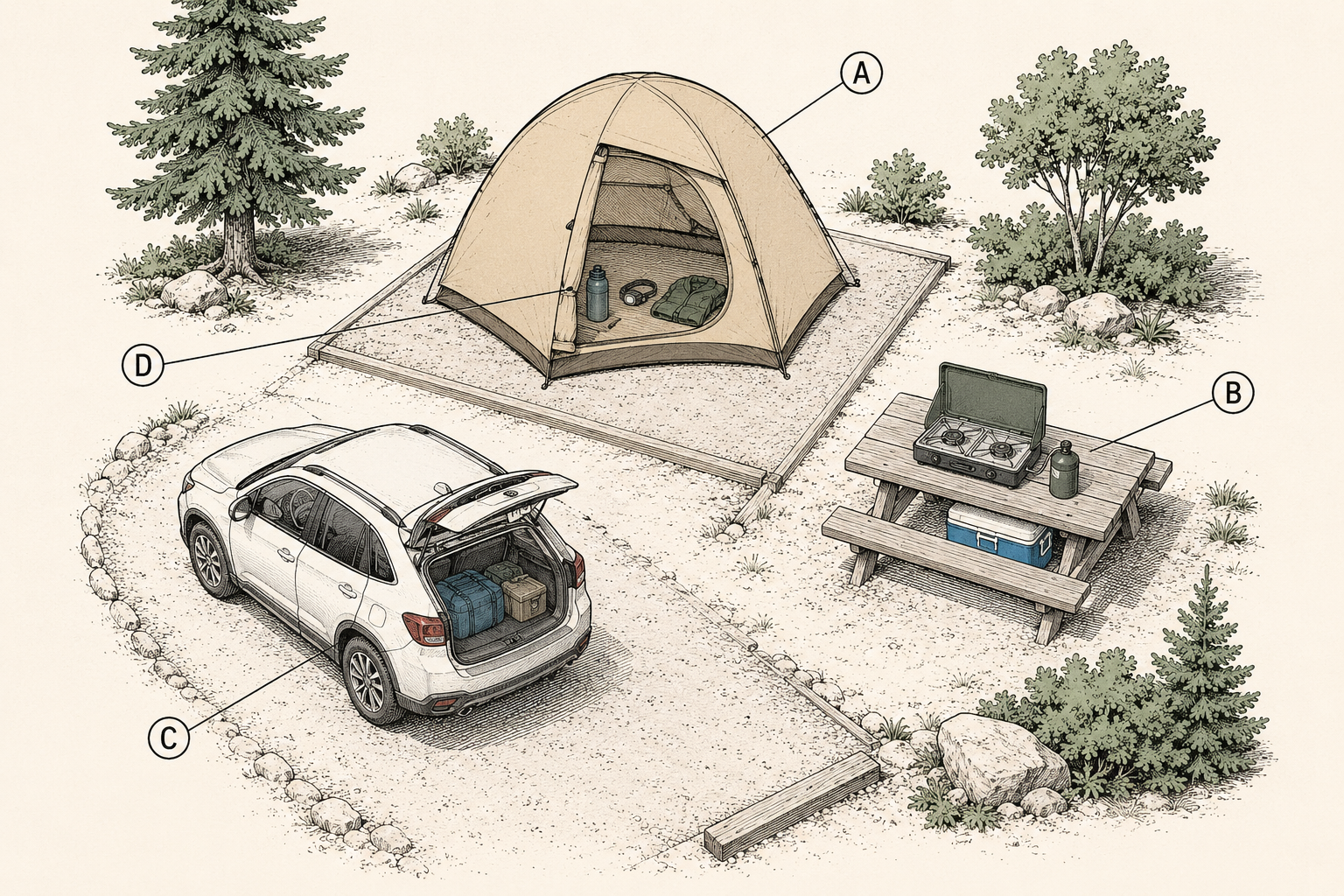
Setting up camp in the right order
Shelter, sleep system, kitchen, comfort: that's the order, and it never changes. Each layer protects the one after it, and the order only matters on the day it matters, which is exactly the day you can't predict.
Here's the scenario that teaches it. You pull in at 6:20 on a July evening, ninety minutes of light left, and the sky to the west has gone the color of a bruise. If the chairs and the string lights come out first, you're pitching a tent in sideways rain at 7:05. If the tent went up at 6:30 and the bags went in at 6:40, the same squall is fifteen minutes of sitting in the car listening to rain, followed by a dry evening. Same weather. Different order. Entirely different trip.
Pitching itself gets a full chapter (Chapter 31), but trip one needs just three rules. Pitch on the designated pad, which is graded and drains better than anywhere else on the site. Point a door away from the wind. And stake every corner even on a calm evening, because "it wasn't windy when we went to bed" is the first line of every flattened-tent story ever told.
Your first campfire, the short version
Check whether fires are currently allowed, buy firewood locally, keep the fire inside the ring and modest, and put it dead out with water before bed. That's the entire first-night fire policy; Chapters 32 and 33 teach the craft properly.
Two of those clauses carry legal weight, so they get their own paragraph. Fire rules change with conditions: the campground board, the reservation confirmation email, or the ranger at check-in will state the current restriction level, and "the ring is right there" does not mean fires are legal this week. And firewood must be bought near the campground (many areas say within 10 miles, some within 50), not hauled from home, because moving firewood moves invasive insects that kill forests. Camp stores and roadside stands exist for exactly this.
For the fire itself, keep ambition low: a couple of fist-sized splits at a time, flames below knee height, started with a purpose-made firestarter rather than pride (they cost little and remove the entire frustration curve). A modest fire cooks marshmallows better than a big one anyway. The coals do the work, not the flames.
Getting through the night
Expect to sleep worse than at home, and plan around the three things that actually wake beginners: cold, sounds, and the 2 a.m. bathroom trip. All three have simple fixes you set up before bed.
Cold is fixed at bedtime, not at 2 a.m. Go to bed slightly warm: add the hat and the dry socks before you feel cold, because a sleeping bag holds heat you generate and can't create any. A snack before bed genuinely helps; digestion runs your furnace. If you wake cold anyway, put on the layer you staged, eat something, and know that the coldest hour is the one just before dawn. It ends.
Sounds are fixed with information. That heavy crunching outside at midnight is a deer roughly 95% of the time, and the rest of the odds are split among raccoons, skunks, and someone's loose cooler lid. Animals investigating campgrounds want unsecured food, not tents, which is why step 7 of the timeline (food locked away) buys quiet nights. If sounds keep you up regardless, earplugs weigh nothing. No shame in them. Half the experienced campers you'll ever meet carry them.
The bathroom trip is fixed by surrender. Don't lie there negotiating with your bladder for an hour; you'll lose, and you'll be colder for the delay. Headlamp's at your shoulder, shoes are by the door, the toilet is where you scouted it at check-in. Ninety seconds of cold air beats an hour of denial, and the stars at 2 a.m. are, honestly, the best thing you'll see all trip.
The morning after
Coffee first, then breakfast, then break camp in reverse setup order, and aim to leave the site cleaner than you found it. Checkout is typically 11 a.m. or noon, which is more time than you'll need.
Morning has one hidden job: the damp-gear audit. The tent's underside and fly will likely carry dew or condensation, and packing them soaked is fine for the drive but fatal for storage. If they're wet, drape them over the car in the morning sun while you eat; ten minutes does most of the drying. Whatever's still damp gets fully dried at home within a day or two, because a tent stored wet grows mildew that no product removes. Same rule for the bags if the night was humid.
The leave-cleaner rule is cheap goodwill: a two-minute sweep for micro-trash (twist ties, bottle caps, the corner of the chip bag) plus any predecessor's litter in the fire ring. Pour no food waste in the bushes, not even "biodegradable" orange peels; animals that learn campsites feed them get bold, then get destroyed. The full ethics framework is Chapter 60, but the morning sweep is 80% of it in practice.
The dry run: your backyard is a campground
If any part of the trip has you nervous, run the whole system one night in the yard, on the deck, or even in the living room. Pitch the tent, cook the dinner outside, sleep in the bag. Same gear, zero stakes.
A dry run converts unknowns into settings. You learn that the borrowed pad loses air by morning (bring the repair kit, or a different pad), that the stove's simmer is really a roar (adjust the menu), that you sleep cold at 55°F in that bag (add the fleece liner). Every discovery migrates from "surprise at the campground" to "note on the packing list," which is the cheapest trade in camping.
It also works as the kid preview. A four-year-old who has slept in the tent twice in the yard treats the campground tent as home turf instead of a strange dark box. Chapter 51 leans on this trick hard.
Trailhead Takeaways
- One night, under an hour from home, established campground, lows above 45°F (7°C), borrowed gear. The template is margin, not timidity.
- Arrive 2–3 hours before sunset. It's the trip's only hard appointment.
- Setup order never changes: shelter, sleep system, kitchen, comfort.
- All food, trash, and scented items are locked away before you sit down for the evening. Everywhere, bear country or not.
- Fires: legal this week, wood bought locally, modest flames, drowned dead out.
- Fix the night before it starts: layers staged, headlamp at your shoulder, shoes by the door.
- Dry gear at home within two days, or mildew ends its career.
Where Trips Go Sideways
- Arriving at dusk. The single most common first-trip wrecker. Every task doubles in difficulty by headlamp, dinner slides to 9 p.m., and the tent gets pitched on the site's worst spot because nobody could see the good one. Sunset minus three hours. Put it in the navigation app.
- Skipping the at-home tent check. The borrowed tent that's missing four stakes and one pole section reveals this at the campground, never in the garage. Open the bag at home. Count poles, stakes, and the fly.
- A cooler treated like a kitchen cabinet. Opened forty times before sunset, parked in the sun, and by morning the milk is a health question. Shade, discipline, frozen water bottles.
- First-night menu ambition. The three-pot meal that needed a home kitchen's counter space, attempted on a picnic table at dusk with one borrowed stove. Rotisserie chicken has saved more first trips than any tent ever has.
- Negotiating with the 2 a.m. bathroom trip. An hour of cold, sleepless bargaining instead of ninety brisk seconds. Go. The stars are worth it anyway.
Frequently asked
What is the 3-3-3 rule for camping?
It's a trip-planning guideline borrowed from RV travelers: drive no more than 300 miles a day, arrive by 3 p.m., and stay 3 nights. For tent campers the spirit matters more than the numbers: short drives, early arrivals, and enough nights to justify the setup effort. Notice that all three rules protect the same thing, which is daylight at the campsite on arrival day, the hours this chapter's timeline spends.
What is the 444 rule for camping?
A variant of the same idea: no more than 4 hours of driving, arrive by 4 p.m., stay 4 nights. These rules all encode one lesson, which is that arriving late and leaving early makes trips feel like work. Protect daylight on arrival day above everything else.
What is the 2 2 2 rule for camping?
Two hundred miles of driving, arrive by 2 p.m., camp 2 nights. It's the gentlest pacing rule and the closest to this chapter's template. For a first trip, cut it further: under an hour's drive and one night is plenty.
How long should a first camping trip be?
One night. A single night tests every system (shelter, sleep, food, morning) at the lowest possible cost, and a great one-nighter builds more enthusiasm than a mediocre week. Add the second night on trip two or three, once your gear list has survived contact with reality. If the night goes badly you're home for breakfast; if it goes well you'll book the next one before unpacking.
Is sleeping in a tent safe?
Statistically, very. Campground risks are mundane: cold, dehydration, tripping over guylines in the dark, and untended fires. Wildlife incidents at established campgrounds are rare and almost always food-related, which is why locking food away is this chapter's firmest rule. Manage the boring risks and the exotic ones mostly manage themselves.