Part III · The Camp Kitchen
How Long to Boil Water to Purify It
Water You Can Trust
Do you need to treat water when camping?
Treat all backcountry water, every time, no matter how clear, cold, or high the source. Campground spigots marked potable are the exception; everything flowing, standing, or seeping is not. The clearest alpine stream can carry the same microscopic freight as a farm pond, because the deer upstream don't check the scenery.
The freight comes in three sizes, and the sizes are the entire technology story of this chapter: protozoa (Giardia and Cryptosporidium, the big, common, gut-wrecking ones), bacteria (E. coli and friends, mid-sized), and viruses (tiny, rare in North American backcountry, common where human sewage reaches water). Every treatment method is a claim about which of the three it handles, and the vocabulary is standardized: a filter physically strains out protozoa and bacteria; a purifier also defeats viruses (by finer filtration, chemicals, or UV). In North America, a filter is almost always enough. International travel and downstream-of-people water want the purifier claim.
Getting this wrong is rarely fatal and reliably miserable: giardiasis incubates one to three weeks and then rearranges your month. Treatment, meanwhile, has never been lighter, cheaper, or faster. This is the easiest risk in camping to simply delete.
Hollow-fiber squeeze filters: the modern default
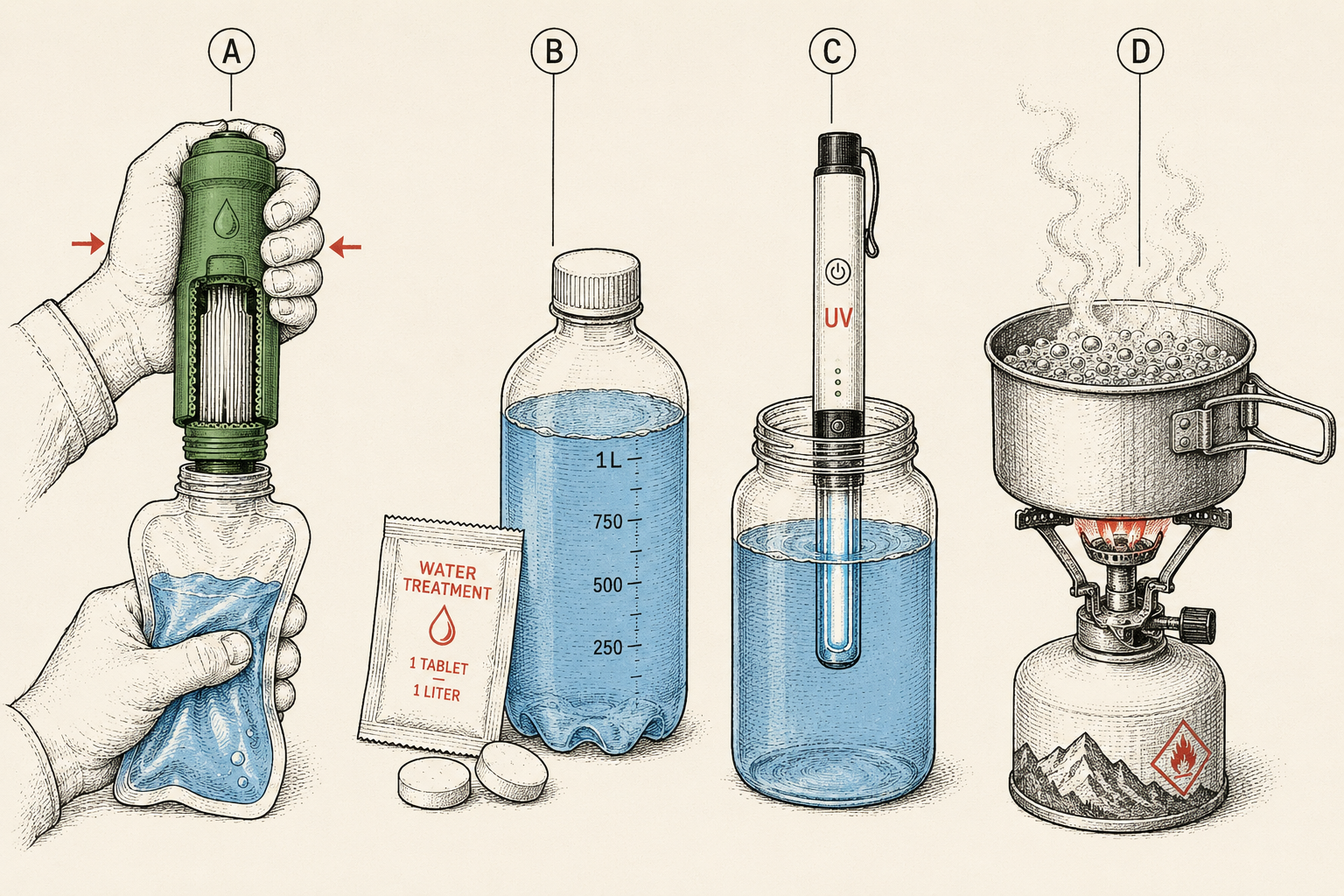
The hollow-fiber squeeze filter (a palm-sized cartridge of straw-like membranes, threaded to a soft bottle you squeeze) is the recommended treatment for most campers and backpackers: a couple of ounces, filters protozoa and bacteria completely, works instantly, costs little, and lasts for thousands of liters with basic care. This one product category made iodine's cloudy heritage obsolete.
How it works matters because the care rules come from it: water squeezes through membrane pores around 0.1–0.2 microns, which pass water molecules and block everything protozoa-and-bacteria sized. Two failure modes follow. Clogging (the pores plug with sediment; flow slows) is fixed by backflushing per the maker's routine (push clean water backward through) and prevented by choosing the clearest available source and letting silty water settle first. Freezing is the killer: ice expands inside the fibers and cracks them invisibly, after which the filter looks fine and protects nothing. A filter that has frozen, or might have, is retired without appeal.
The daily practice: fill the dirty bottle from the cleanest moving water available, keep "dirty" and "clean" containers religiously separated (mark them; cross-threading a dirty bottle onto your clean one undoes everything), squeeze, drink. Gravity setups (a hung dirty bag dripping through the same cartridge) scale the identical filter to camp-sized volumes while you cook.
Pumps, gravity rigs, and who still wants them
Pump filters (the hand-cranked classic) still earn their place at two jobs: pulling from awful sources (shallow seeps, puddles, the last inches of a drying pond, where a squeeze bottle can't fill) and long trips where mechanical serviceability beats grams. Gravity systems (paired hang bags through a hollow-fiber cartridge) are the group and basecamp answer: four liters filter themselves while dinner cooks, no squeezing labor, no moving parts.
The honest matrix: solo and duo backpackers, squeeze. Families and groups at camp, gravity. Desert trips with marginal sources, pump (the intake hose with a float and pre-filter reaches water squeeze bottles can't). Paddlers, gravity or pump, since the water's always beside the boat. None of these choices is wrong so much as mis-sized: the sad camper is the one pumping 12 liters by hand at a family basecamp while the gravity bag sits unsold at the store.
Every mechanical option shares the hollow-fiber care sheet: backflush on schedule, guard from freezing, and dry before storage (Chapter 13's mildew law applies to filter housings too).
Chemical treatment: chlorine dioxide, and what happened to iodine
Chlorine dioxide (tablets or drops) is the chemical treatment that matters now: effective against bacteria, viruses, and Giardia in 30 minutes, and against stubborn Cryptosporidium with an extended 4-hour wait. It weighs nothing, costs little, never clogs or cracks, and is the standard backup and the ultralight purist's whole system.
Its role in most kits is the second layer: a strip of tablets rides with the Chapter 12 essentials and behind every filter, covering the day the filter clogs, freezes, or stays home. The taste is faintly chlorinated and fades; the wait is the real cost, and the crypto wait is the fine print worth respecting when the source is downstream of grazing (crypto's classic habitat).
Iodine, the seed of every old camping kit, has left the stage: weak against Cryptosporidium, off-limits for pregnant campers and thyroid conditions, banned from sale for water treatment in the EU, and thoroughly outclassed by chlorine dioxide on every axis but nostalgia. If a vintage bottle of it lives in your inherited gear, thank it for its service and recycle the kit.
Plain unscented household bleach is the emergency-improvisation entry: 2 drops per liter (roughly 8 per gallon), doubled for cloudy water, 30 minutes' wait. It's a real disaster-preparedness skill and a last resort outdoors, not a plan.
UV purifiers and boiling: the electric and the eternal
UV purifier pens scramble the DNA of everything (protozoa, bacteria, viruses) in a 90-second stir of a liter, making them true purifiers in clear water. Their fine print: clear water only (UV can't reach through silt; pre-filter cloudy sources), batteries (the failure mode is a dead pen three days out; carry the chemical backup), and no residual protection. They shine for international travel and as a fast virus layer over a filter.
Boiling is the eternal method: a rolling boil for 1 minute kills everything at any altitude campers reach (the CDC adds a 3-minute margin above about 6,500 feet, which costs nothing to honor). No gear beyond the stove, no expiry, no freeze vulnerability, total effectiveness. Its costs are fuel (Chapter 14's math: pasta-pot volumes of it), time, and hot water when you wanted cold. In practice boiling is the method you're already using every time you cook, the backup that can't break, and the primary system nobody carries fuel enough to live on.
The pairing logic across the whole toolkit: every kit runs a primary (usually the squeeze filter) plus a chemical backup, and knows that dinner's boil is treating that water for free.
Choosing a treatment for your actual trips
| Trip | Primary | Backup | Why |
|---|---|---|---|
| Car camping, developed campground | The spigot | Tablets in the crate | Potable taps; backup covers outages |
| Weekend backpacking, temperate | Squeeze filter | Chlorine dioxide tablets | Light, instant, crypto-proof pairing |
| Family basecamp, lake or river | Gravity system | Boil at dinner | Volume without labor |
| Desert, marginal sources | Pump with pre-filter | Tablets + settling | Reaches and survives bad water |
| International travel | Purifier claim (UV or purifier-rated filter) | Chlorine dioxide | Viruses join the threat list |
| Winter | Boil (snowmelt) | Tablets | Filters freeze; stoves don't care |
Two rows carry the biggest surprises for beginners. Developed campgrounds: the spigot is treated municipal-grade water and the whole apparatus stays home, though the tablet strip in the crate covers the posted "boil water" advisory that occasionally visits small water systems. Winter: the beloved filter is the wrong tool entirely (freeze death), and melting snow (Chapter 55) makes boiling the default anyway.
Carrying water: capacity is a safety spec
Treatment gets the attention; capacity does the daily work. The planning numbers: drink 2–3 liters per person per hiking day (more in heat, Chapter 49), budget 5+ gallons per family weekend at camp for cooking and washing (the Chapter 6 jug), and carry capacity for one dry stretch more than the map promises. Sources fail: the "reliable" creek runs dry in September, the spigot is winterized, the lake is a quarter-mile of mud flat.
At camp, the 5–7 gallon rigid or collapsible jug with a spigot is the kitchen's plumbing: filled at the campground tap (or filtered in bulk by the gravity rig), parked at the table's wash end, and treated as the tap it is. On trail, the standard rig is one liter accessible while walking plus one to two in the pack, scaled by the day's source map, which you actually read before leaving (guidebooks and recent trip reports carry water beta; deserts make it the whole plan, per Chapter 59).
Dehydration previews arrive as headache, crankiness, and dark urine, in that order, usually mid-afternoon; Chapter 49 handles the serious end. The camp-level fix is structural: water within arm's reach all day, drunk before thirst files a complaint, and refilled before the jug echoes.
Trailhead Takeaways
- Treat everything that isn't a potable tap. Clear and cold means nothing at 0.1 microns.
- Threats come in three sizes: protozoa, bacteria (filters stop both), viruses (purifiers, chemicals, UV, or boiling). North America: filter suffices almost always.
- The hollow-fiber squeeze filter is the default: backflush it, pick clear sources, and never, ever let it freeze. Frozen-maybe means retired.
- Chlorine dioxide tablets are the universal backup: 30 minutes standard, 4 hours for crypto. Iodine is history.
- Boiling kills everything: rolling boil 1 minute (3 above ~6,500 ft). It's also how dinner already treats its own water.
- Match tool to trip: squeeze solo, gravity for groups, pump for puddles, purifier claims for travel, boil for winter.
- Capacity is safety: 2–3 L per hiking day, 5+ gallons per family weekend, one dry stretch of margin always.
Where Trips Go Sideways
- "It's coming straight off the glacier." The prettiest water in the hemisphere, one beaver pond upstream of the trail, three weeks incubation, one ruined month. Nobody has ever identified Giardia by looking. Squeeze the bottle.
- The filter that rode in the trunk in November. It froze, thawed, and filtered beautifully-looking water all next season through cracked fibers. No symptom traced itself back. Freeze history unknown equals filter retired; the replacement costs less than one urgent-care copay.
- Dirty bottle, clean threads. One absent-minded swap of caps at a murky source and the whole system's integrity went with it. Mark the dirty bottle with tape and a fat X, and let the marking do the thinking at day's end.
- The UV pen's dead batteries, day three. The purifier worked flawlessly until electronics did what electronics do. The tablet strip weighs eight grams and has no opinions about batteries. It rides along, always.
- Ten liters of "the creek will be running." September, the creek wasn't, camp was dry, and the evening became a driving errand. Sources are seasonal. Recent reports beat map symbols, and margin beats both.
Frequently asked
Which is better, a water purifier or a filter?
Match the claim to the threat: in North American backcountry, viruses are rare, so a filter (protozoa and bacteria) covers it lighter and cheaper. Purifiers earn their premium for international travel, water downstream of people and sewage, and anywhere the virus question can't be dismissed. Many filters also accept a virus-rated add-on stage, which splits the difference for the occasional traveler.
Do water filters stop norovirus?
Standard hollow-fiber filters, no: norovirus and other viruses are smaller than the 0.1–0.2 micron pores. Virus coverage comes from purifier-rated devices, chlorine dioxide (30-minute wait), UV in clear water, or boiling. Filter-plus-tablets is the classic two-layer answer when viruses are plausible.
Do I need a water filter for hiking?
For any hike where you'll drink from natural sources, yes, or a treatment alternative: a modern squeeze filter weighs about as much as a granola bar. Day hikes fully supplied by carried water need only the emergency tablets in the Chapter 12 pack, which cover a bigger-than-planned day.
How long should you boil water to purify it?
Bring it to a full rolling boil and hold one minute; above roughly 6,500 feet, hold three. That kills protozoa, bacteria, and viruses at any campground altitude. Cloudy water gets settled or strained first for taste, though boiling defeats the biology either way.