Part V · Getting There and Making Camp
How to Pitch a Tent Alone, in Rain or Wind
Four Minutes to Shelter
How do you pitch a tent?
Stake the corners before you clip the poles. A staked floor can't skate across the site while you assemble the rest, and everything downstream (pole seating, fly alignment, tension) goes easier against a floor that's square and anchored. Corners, poles, fly, guylines: that order, every pitch, every weather.
The order is this chapter's one commandment because it's the one beginners reliably invert: poles first looks natural (the tent takes shape immediately, which feels like progress), and it produces the signature beginner scene, a half-built kite lurching across the site with a camper attached. Staked corners delete the whole genre. The floor squared and pinned is 60% of a good pitch before anything stands up.
Time expectations, honestly: a familiar two-person dome runs about four minutes in calm weather once the order is habit; a family cabin runs 15–20 solo (Chapter 7 made you time it). The first pitch of any tent runs triple, which is why it happens at home. All of this assumes Chapter 30 already chose and read the ground; a great pitch on a bad spot is a well-built mistake.
The standard pitch, step by step
- Footprint down, tent body on top, door aimed per the site read (wind at the back or side of the door, vestibule workspace where you want it).
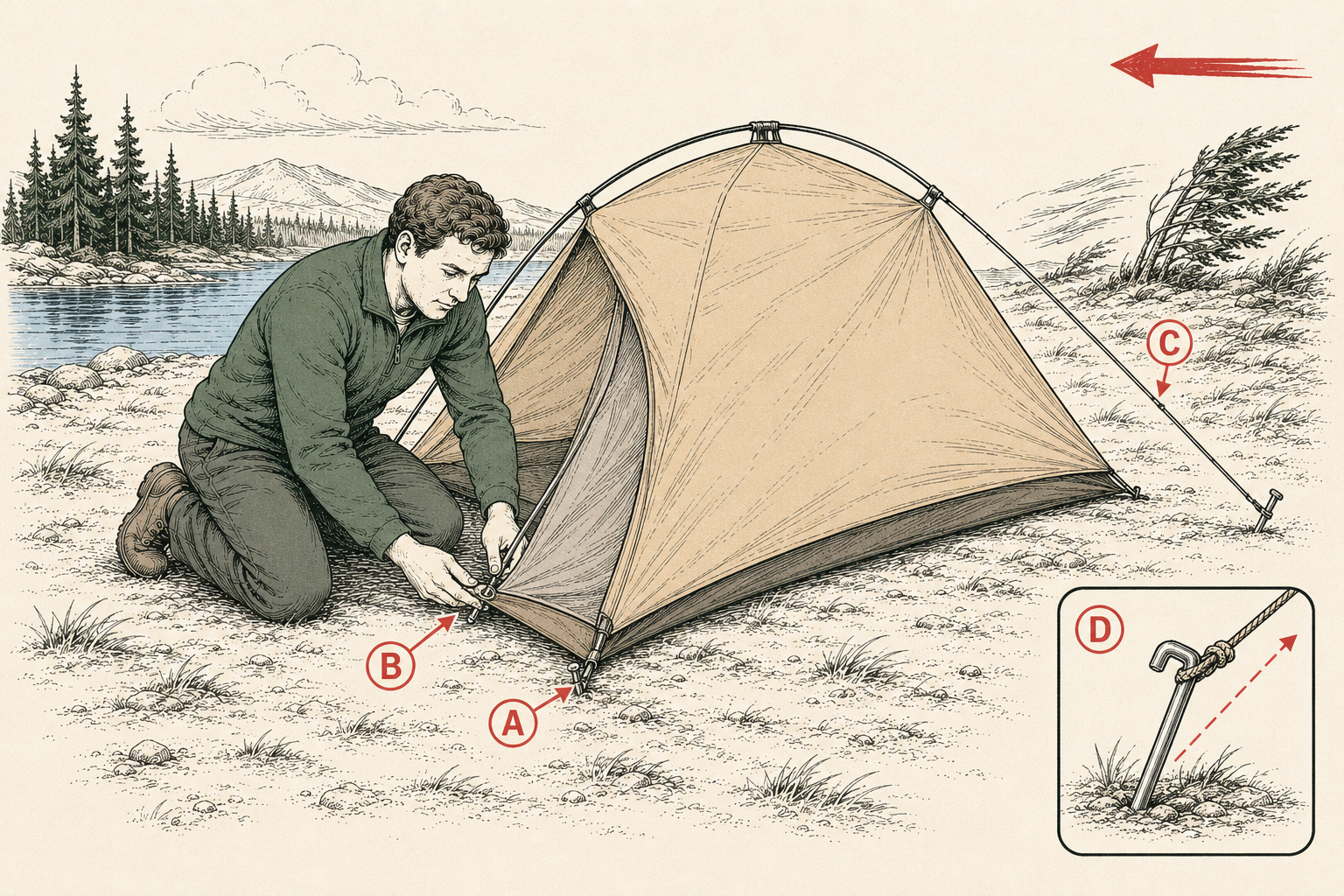
- Square the floor and stake all four corners, pulling each corner taut from its diagonal before staking. Stakes go in at 45 degrees, hooks out, buried to the hook. In soft ground, full depth; in hard ground, angle matters more than depth.
- Assemble poles fully (each ferrule seated, per Chapter 13's break-prevention rule), lay them across the tent, and seat the ends in their grommets or clips corner by corner.
- Raise and clip: the tent takes shape as poles flex into place; clip the body to the poles from the bottom up.
- Fly on, matched to doors, attached at corners, then tensioned evenly: the fly should sit taut with an air gap everywhere, touching the inner mesh nowhere.
- Guy out what the weather requires (next sections), tension the fly's adjusters, and give the whole tent the shake test: grab the pole crown and shake; a good pitch moves as one object and returns to shape.
That's the whole craft in calm conditions, and the six steps compress with practice into something close to muscle memory. The two quality checks worth keeping forever: the fly-to-mesh air gap (condensation management, below) and stake angles (a vertical stake is a lever the wind will use).
Pitching solo
Solo pitching is the same sequence with two adjustments: stake the corners even more religiously (the floor is your second pair of hands), and manage the fly in wind by staking its windward edge to the ground first, then lifting the rest over the tent, so the wind pins it for you instead of kiting it. Freestanding domes pitch solo without drama; big cabin tents want their pole spines assembled flat, then walked upright hinge-style, which is a known technique, not a struggle.
The solo camper's real enemy is the step skipped because nobody's watching: the diagonal pull before staking, the last two clips, the guylines "for later." The tent doesn't know you're alone. Wind doesn't either. Run the sequence complete, and solo pitches come out identical to crewed ones, four minutes and all.
Pitching in rain
Rain pitching has one goal (a dry interior) and four tools: speed through sequence (the practiced order is now a race you've already trained for), the fly-priority mindset (some tents pitch fly-first or all-at-once with the fly pre-attached at home; if yours can, learn it in the yard, because the inner never sees sky), the tarp option (Chapter 8's ridgeline rig thrown up first makes a dry garage to pitch under; ten extra minutes that pay in every following hour), and vestibule discipline once up (wet gear strips and lives in the vestibule; the inner door opens only for dry people and dry bags).
The pre-attached fly trick deserves its paragraph: most domes will pack with the fly clipped on and poles removed, so the whole tent unrolls, stakes, and raises with the fly already deployed, inner dry throughout. Practice it once at home in sunshine and the technique is yours in weather. It also speeds calm pitches, which is why plenty of campers pack that way permanently.
Camp-in-rain flow finishes the job: the dry-entry ritual (shell off and shaken under the vestibule, boots off at the threshold, in), towel staged at the door (the Chapter 6 pack knew), and the wet-dry line held all night. A tent stays dry in a week of rain if the doorway discipline holds, and gets damp in one careless evening if it doesn't.
Pitching in wind
Wind rewrites the order's emphasis: stake the windward side first and let the tent lean on it. Body windward-corners staked before anything else, poles assembled low (never stand a flexed pole up into a gust), fly wrestled on windward-edge-first and staked before the leeward side gets attention, and every guyline the tent owns deployed, windward lines first, to fat stakes at full depth.
Orientation is the pre-fight decision: aim the tent's lowest, narrowest profile into the wind (for most domes, an end, not a door or broadside), and take the site's windbreaks where Chapter 30 found them (the leeward side of boulders and dense brush, never the leeward side of the snag). Past roughly 20 mph sustained (Chapter 4's line), the honest moves are a sheltered plan B site or the reschedule the bail criteria already authorized; tents survive more than campers enjoy.
Guylines get their promotion in wind from optional to structural: they're the tent's rigging, they carry load the poles otherwise eat, and a fully guyed dome handles weather a naked one folds under. Reflective line, tensioners pre-rigged (Chapter 8), fat stakes at 45 degrees, and the trucker's hitch when hardware runs out (Chapter 34 is next-door).
Condensation or leak? The morning diagnosis
Interior moisture has two sources and one question sorts them: is the wetness evenly coated on the inside of the fly (condensation) or localized and traceable to a seam, a wound, or a contact point (leak)? Condensation is physics (a tent full of breathing sleepers exhales a liter of water into cold night air; it lands on the coldest surface, which is the fly), and its fixes are ventilation and the air gap: vents open even in rain, the fly taut and touching no mesh, and the tent sited per Chapter 30 away from the water's cold pooling air.
Leaks trace: a wet line at a seam wants seam sealer (Chapter 13, at home), a wet spot under a fly contact point wants re-tensioning (the fly sagging onto the mesh wicks condensation through, masquerading as a leak), and a wet floor corner wants the footprint check (oversized ground cloth funneling, Chapter 8's classic) before it wants a patch.
The practical winter of this knowledge: a damp-walled tent in the morning is normal, not broken. Wipe it (the door towel moonlights), vent it, dry the fly at the morning-sun opening Chapter 30 reserved, and adjust tonight's ventilation. New campers replace a lot of tents that were performing perfectly.
Takedown and packing
Takedown reverses the pitch with three rules: dry before packed (the morning fly-drying is a schedule item, and a wet-packed tent gets fully dried at home within two days, Chapter 2's mildew law), poles pushed not pulled (pulling shock-corded poles apart at the middle separates sections and stresses cord; push from one end, fold section by section), and shake the floor empty (sand and duff packed into the tent grind the floor coating; the freestanding flip-and-shake takes ten seconds).
Stuff or roll: for most modern tents, stuffing the body and fly loosely into the sack (poles and stakes bagged separately alongside) is faster, gentler on coatings than sharp repeated fold-creases, and objectively fine, whatever the fold-perfectionists at the next site think. Rolling wins for bulky cabin tents whose bags allow no slack. Either way, stakes get counted back into their bag (grass eats stakes, Chapter 6 warned), and the door gets zipped before packing so the zipper isn't chewing fabric at the next pitch.
At home: the two-day full dry when needed, then storage loose or loosely bagged in the dry gear closet, per every storage rule this book has issued. Tents die of mildew and UV, almost never of camping.
Trailhead Takeaways
- Corners, poles, fly, guylines. Stake the floor square before anything stands up, every pitch, all weather.
- Stakes at 45 degrees, hooks out, to the hook. The shake test certifies the pitch: one object, returns to shape.
- Solo: the staked floor is your second pair of hands; the sequence doesn't change.
- Rain: pre-attached fly or tarp-garage first, then vestibule discipline holds the wet-dry line all night.
- Wind: windward stakes first, work low, narrow end to the gusts, every guyline deployed. Past 20 mph sustained, re-plan.
- Even interior damp is condensation (vent, tension the air gap); traceable wet is a leak (seal, re-tension, or check the footprint).
- Dry before packed, push poles apart, shake the floor, count the stakes. Stuffing is fine; mildew isn't.
Where Trips Go Sideways
- Poles first, breeze second. The half-built tent went kiting at the exact moment both hands were full of pole. The four corner stakes were still in the bag, which is the whole story.
- The vertical stake. Driven straight down like a nail, it levered out at the first real gust and took the fly's corner with it. Forty-five degrees, hook out. The angle is the anchor.
- The saggy fly verdict: "this tent leaks." The fly lay against the mesh all night, condensation wicked through, and a working tent got sentenced on circumstantial evidence. Taut fly, air gap, vents open: the tent was innocent.
- Sealed shut against the storm. Every vent closed to "keep the rain out," and the interior rained anyway, from the inside, off four sleepers' breath. Vents open in rain. The fly keeps water out; the air keeps water moving.
- Packed wet Sunday, opened moldy Friday. Five days sealed in a hot trunk did what five months of camping couldn't. The two-day drying rule has no exceptions clause.
Frequently asked
How do you pitch a tent for beginners?
Learn the order at home first: footprint down, floor squared and all four corners staked, poles assembled and seated, body clipped bottom-up, fly attached and tensioned to an air gap, guylines as weather requires. The staked-corners-first habit prevents most beginner chaos, and the home practice pitch makes the campsite one routine instead of a puzzle.
What are two common mistakes to avoid when pitching a tent?
Assembling poles before staking the floor (the tent kites, the pitch skews) and leaving the fly saggy against the inner mesh (condensation wicks through and impersonates a leak). Both fixes are free: corners first, then tension the fly to a visible air gap everywhere.
Can you pitch a tent by yourself?
Yes, and freestanding domes barely notice: the staked floor replaces the second person, and the wind trick (stake the fly's windward edge first, let the weather pin it while you work) handles the flappy part. Big cabin tents pitch solo via the assemble-flat, walk-upright method; time yours at home.
How long does it take to pitch a tent?
A familiar two-person dome: about four minutes calm, ten in real wind. Family cabins: 15–20 minutes solo. Any tent's first-ever pitch: triple those numbers, which is why it happens in the yard. Speed comes from the fixed order, not from hurrying, and the order is always the same: corners staked, poles seated, fly tensioned, guylines as the weather demands.