Part II · Shelter and Sleep
0-Degree or 20-Degree Sleeping Bag?
The Warmth You Carry
How do you choose a sleeping bag?
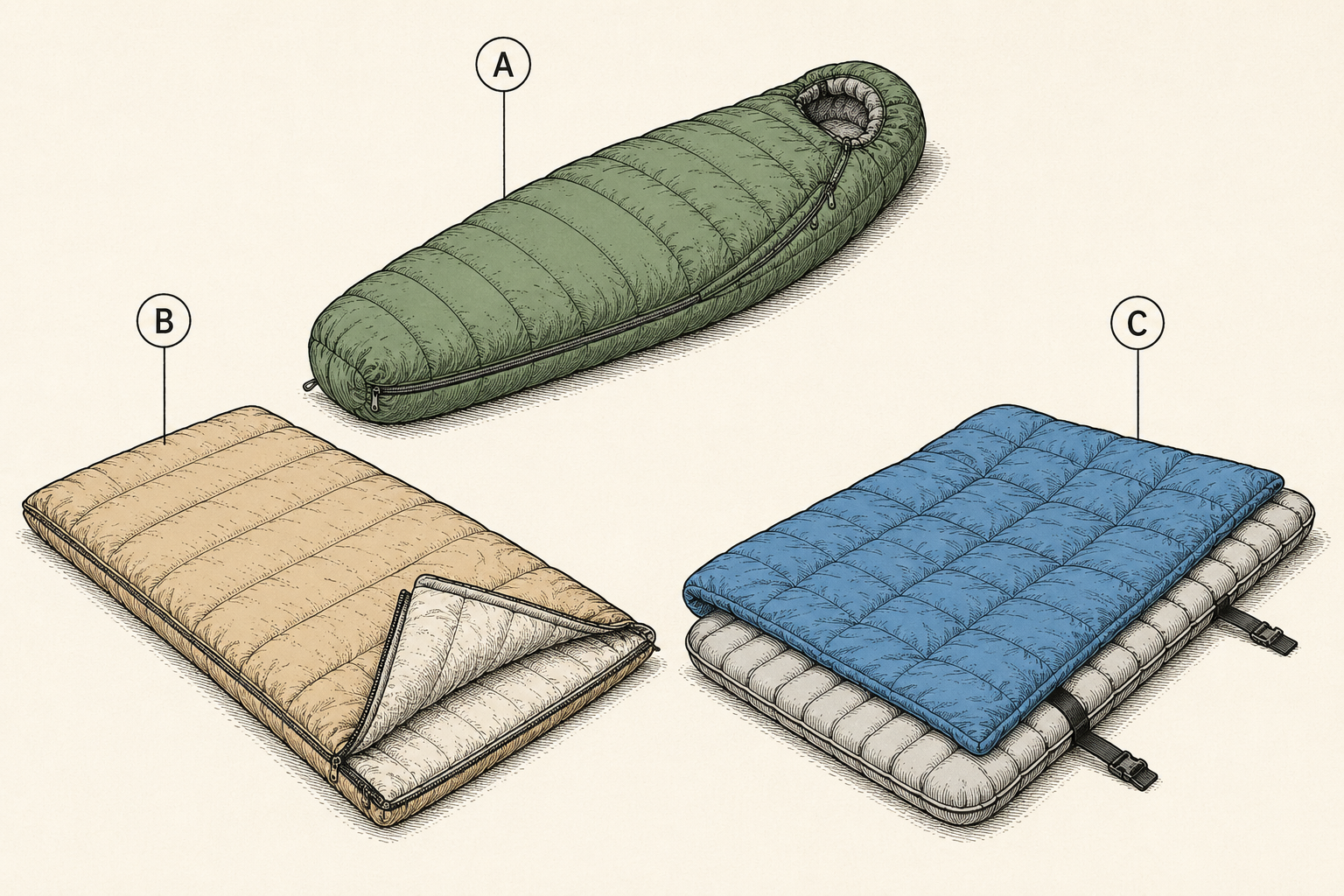
Choose on four axes: temperature rating (buy the EN/ISO comfort number for the coldest night you'll actually camp, minus a small margin), insulation type (down or synthetic), shape (mummy, rectangular, or quilt), and fit (snug traps heat; roomy leaks it). Price follows from the first two.
Before the axes, the physics, because every good bag decision comes from one fact: a sleeping bag makes no heat. You do. The bag is a heat trap, and what does the trapping is loft, the fluffy thickness of still air held by the insulation. More loft, more warmth; crushed or wet loft, no warmth, whatever the label promised. This single idea explains why the pad under you matters as much as the bag (Chapter 10), why a damp bag sleeps cold, why the same bag runs warmer with a hood cinched, and why storage habits (this chapter's last section) decide whether the bag you bought is the bag you own in five years.
Hold onto it. The rest of the chapter is that paragraph, applied.
Sleeping bag temperature ratings, decoded
Modern bags carry standardized EN/ISO test ratings, and the number to shop by is the comfort rating: the temperature at which a cold-prone sleeper rests comfortably. The lower "limit" rating (a warm-sleeping adult, curled, not comfortable but functional) is the number brands print biggest, and treating limit as comfort is the industry's favorite trick and the buyer's classic cold night.
So: find the spec sheet's EN/ISO block and read the comfort line. A "20-degree bag" whose comfort rating is 32°F is a 32°F bag for practical planning, and plenty of marquee "20-degree" bags are exactly that. Cheap bags without EN/ISO testing carry pure marketing numbers; subtract 10–15°F from whatever they claim and you'll be close.
Then apply your margin. Ratings assume a hooded bag on an insulated pad with a base-layer-clad sleeper; real nights include humidity, tired bodies, and the personal furnace variance Chapter 4 mentioned. The working rule: buy comfort-rated about 10°F below your expected coldest night. For three-season campground use across most of the country, that lands on a comfort rating near 20–30°F, which is why the "20-degree bag" is the perennial recommendation. Too warm is a zipper adjustment. Too cold is 4 a.m. push-ups.
Down vs synthetic: the real tradeoffs
Down insulates more per ounce, compresses smaller, and lasts decades; synthetic insulates when damp, dries fast, and costs less. Car campers should default synthetic; backpackers chasing warmth-per-pound should buy down and keep it dry. That's the whole war, settled.
| Down | Synthetic | |
|---|---|---|
| Warmth per ounce | Best | Good |
| Packed size | Small | Bulky |
| Wet performance | Collapses (untreated) | Keeps insulating |
| Dry time | Slow | Fast |
| Lifespan with care | 15+ years | 5–10 years (loft fades) |
| Price | High | Friendly |
| Best for | Backpacking, dry cold | Car camping, humid climates, kids |
Details that update the old folklore. Fill power (550, 650, 800+) measures down quality, meaning loft per ounce, so a higher number buys a lighter or smaller bag at the same warmth, never a warmer bag per se. Hydrophobic-treated down narrows the wet-weakness gap without erasing it. And kids' bags should be synthetic without debate: kids' bags meet spills, creek water, and washing machines on a schedule no down bag deserves.
The budget arithmetic favors synthetic more than gear culture admits. A quality synthetic 20°F bag costs a fraction of its down twin and gives up mostly packed volume, which a car doesn't care about. Spend the difference on the pad, where Chapter 10 will make it work harder.
Quilt or bag?
A camping quilt is a sleeping bag minus the parts your body was crushing anyway: no back, no hood, sometimes no zipper, strapped over a pad that supplies the bottom insulation. Quilts run lighter, cheaper per degree, and roomier; bags run simpler, draft-proof, and forgiving of restless sleepers. Backpackers and warm sleepers love quilts; cold sleepers and beginners keep bags.
The logic comes straight from loft physics: insulation under you is compressed to uselessness, so the quilt deletes it and assigns the job to the pad, full time. What you gain is real (a 20°F quilt commonly weighs less than a comparable bag and frees your legs to sprawl). What you lose is the sealed system: quilts admit drafts at the edges until you learn the strap-and-tuck routine, and below freezing that routine stops being optional. Hence the recommendation stack: first bag a bag; consider the quilt when you know you sleep warm, sleep still, or count grams.
Rectangular bags round out the shapes: heavy, roomy, cheap, zip-together-able into a double, and completely at home in car camping, where their inefficiency costs the trunk nothing. A rectangular synthetic bag plus a thick pad is honest, excellent family gear.
Fit: the ignored spec
A bag warms you by holding a thin envelope of air your body can heat; a too-big bag holds a bedroom's worth and never warms it, while a too-tight bag compresses loft at shoulders and feet into cold spots. Fit is a warmth spec, and it's on the size chart nobody reads.
Check three points against the chart: length (bags come in regular and long; your height near the cutoff means try both), shoulder girth (broad shoulders in a narrow mummy compress the sides all night), and footbox room (toes pressing the end crush the loft exactly where circulation is worst). Side sleepers and rotators should look at wider cuts or quilts before resigning themselves to mummy discipline.
Women's-specific bags are a fit product, not a color: shorter, wider at hips, narrower at shoulders, with extra fill at footbox and torso where women statistically sleep colder. For many women they're the correct default; for tall or broad-shouldered women the men's/unisex chart may fit better. The chart outranks the label, always.
Using the bag you have: free warmth
Before buying warmer, extract the warmth your current bag is hiding: cinch the hood to a fist-sized breathing hole, close the draft collar and zipper baffle, wear the hat and dry sleep socks, eat before bed, and add a liner. Together those moves are worth real degrees, and every one is free or nearly.
The hood is the big one. An uncinched hood on a cold night is a chimney: warm air rises off your body and pours out around your shoulders all night. Cinching it (and learning to sleep with it cinched, which takes a night or two) is the single largest no-cost upgrade in the sleep system. Liners (silk, fleece, or synthetic) add roughly 5–15°F depending on material and keep body oils out of the bag, which the washing section is about to make you care about.
And the pad disclaimer, one more time, because it rescues more cold sleepers than any bag upgrade: if you're cold from below, no bag fixes it. Chapter 10 is next for a reason.
How to wash a sleeping bag
Wash a bag rarely (once a season for heavy use, less otherwise), in a front-loading machine, with technical cleaner made for the fill, and dry it low and long. Never dry-clean a bag, never use fabric softener, and never store it compressed. Those three nevers kill more bags than campgrounds do.
- Spot-clean first. Most "dirty bag" problems are a shell smudge; diluted cleaner on a sponge saves the full wash.
- Front-loader only, no agitator. A center agitator tears baffles. Use the home machine if it's a front-loader, the laundromat's big one if not.
- Technical cleaner, tiny dose. Down wash for down, mild technical wash for synthetic. Household detergent strips down's natural oils and cakes synthetic fill.
- Rinse twice. Residue mats loft. If suds appear on squeeze, rinse again.
- Dry low, long, with tennis balls. For down: hours on low heat, with clean tennis balls breaking up the clumps every cycle. It's done when no lump remains anywhere; a damp clump hides mildew. Synthetic dries far faster, same low heat.
Between washes, the habits that stretch the schedule: sleep in base layers (body oil is the enemy loft never recovers from), air the bag inside-out every morning of a trip and again at home, and use a liner if you run oily or camp weekly.
Storage: where bags go to die (or don't)
Store every bag uncompressed: hanging in a closet, or loose in the giant cotton or mesh "storage sack" it came with. The stuff sack is transport only. Months of compression creases synthetic fill permanently and teaches down clumps it never fully unlearns, and this one habit gap quietly downgrades more bags than any campsite accident.
The full storage routine takes two minutes post-trip: shake the bag out, confirm it's bone dry (hang it a day if in doubt; a bag stored damp mildews, and mildew is forever), then into the big sack on a shelf. That's it. A down bag treated this way outlives cars. The same rule applies to the quilt and, with equal force, to the inflatable pad next chapter, stored unrolled with the valve open.
Trailhead Takeaways
- The bag traps heat you make; loft does the trapping. Everything follows: pad matters, damp kills, compression kills.
- Shop the EN/ISO comfort rating, never the marketing number or the limit rating. Aim comfort ~10°F below your coldest expected night.
- Down for backpacking and dry cold; synthetic for car camping, humidity, budgets, and every kid.
- Quilts trade draft-sealing for weight and freedom; great second purchase, debatable first one.
- Fit is warmth: right length, shoulder room, uncrushed footbox. Read the size chart.
- Free degrees before new gear: cinch the hood, wear the hat, eat dinner, add a liner.
- Wash rarely, front-loader, technical soap, dry low with tennis balls. Store loose, always, forever.
Where Trips Go Sideways
- Buying the number on the hang tag. The "20-degree" bag with a 34°F comfort rating met a 28°F night, and the sleeper met every hour of it. The comfort line is on the spec sheet, in small print, telling the truth.
- The bedroom-sized bag. A big roomy rectangle felt luxurious at the store and slept like a drafty apartment at 40°F, because a body can't heat that much air. Fit snug-ish or quilt-and-tuck, but never cavernous in cold.
- Down on a wet weekend. One soaked bag, zero backup, and the trip's remaining insulation was the car heater. Down is spectacular and unforgiving; if your climate is damp and your dry-bag discipline is young, synthetic is the adult choice.
- A winter in the stuff sack. The bag went in fluffy in October and came out a pancake in May, permanently. The storage sack was in the same closet the whole time, empty.
- Dry-cleaned "to be nice to it." Solvents stripped the down's oils; the bag never lofted again. The care tag said so. The care tag always says so.
Frequently asked
Should I get a 0-degree or 20-degree sleeping bag?
For three-season camping almost everywhere, the 20°F (comfort-rated) bag. A 0°F bag on a 45°F night is a sweat lodge with a zipper, and you'll own it for the two nights a decade that justify it. Cold snaps are better handled with the free-warmth stack and a liner than with a specialist bag.
What temperature rating do I need for summer camping?
Comfort ratings around 30–40°F cover most summer campgrounds, where lows in the 40s are routine at elevation. Warm lowland climates can run lighter, around 40–50°F or a simple quilt. The unzipped 20°F bag also summers fine, which is the argument for owning that one first.
Is a 20-degree bag too hot for summer?
Rarely, because bags vent better than they upgrade. Unzip it fully, drape it quilt-style over you, or start the night sleeping on top with a sheet until midnight's chill arrives, which at most campgrounds it reliably does. The reverse problem has no vent: a summer-weight bag on a 35°F shoulder-season night is simply cold, all night, with nothing to adjust.
Should I get a 15-degree or 30-degree bag?
Pick by your real coldest nights, then buy comfort-rated 10°F below them: shoulder-season mountain campers want the 15°F; summer-weekend lowlanders do fine at 30°F. When genuinely torn, take the warmer bag; venting excess warmth is trivial and manufacturing missing warmth at 4 a.m. is not.