Part III · The Camp Kitchen
How Long Does a Propane Cylinder Last?
The Flame You Control
What camping stove should you buy?
Car campers should buy a two-burner propane stove; backpackers should buy a canister stove; winter and expedition cooks graduate to liquid fuel. Those three answers cover nearly everyone, and the stove aisle's remaining variety exists mostly to make them harder to see.
The stove outranks the campfire as your kitchen, and it's worth saying plainly why: a stove cooks on demand, in rain, during fire bans, with a simmer setting, and without an hour of coal management. Chapter 5 already noted the legal asymmetry (stoves stay legal one restriction stage past wood fires across the fire-prone West). Fire cooking is a joy and a skill (Chapter 19 embraces it), and it's the second stove, never the first. Dinner should not depend on the weather's cooperation or the county's fire dashboard.
What you're buying in any stove is controlled heat, and the specs that matter are few: burner output (BTU numbers flatter; wind performance decides), simmer control (the difference between cooking and reheating), fuel type (the real decision), and stability under your actual pots. Everything else is trim.
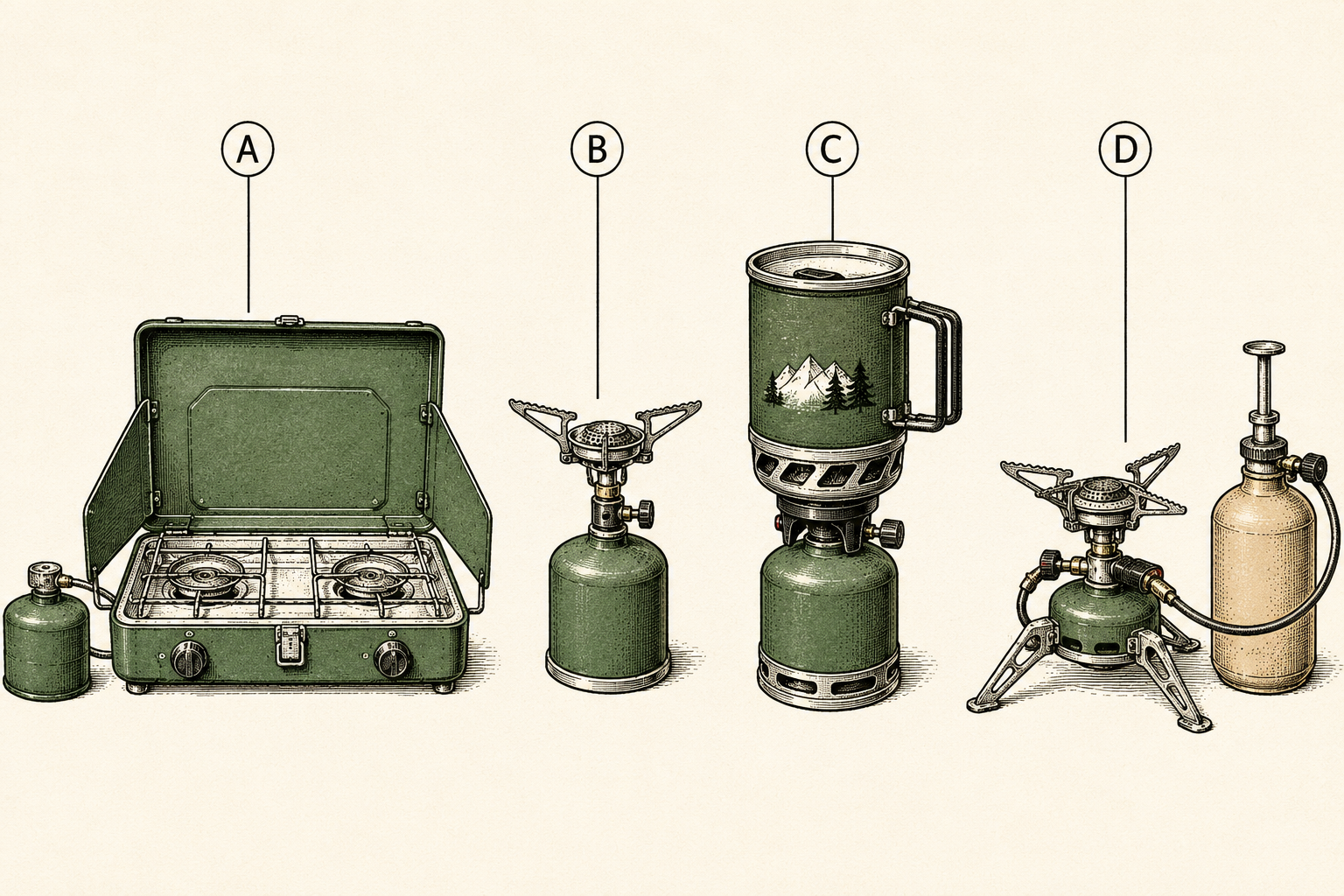
The two-burner propane stove: camp kitchen royalty
The classic folding two-burner propane stove is the best value in camp cooking: two real burners, honest simmer control, windscreens built in, and fuel from the green 1-pound cylinders sold at every gas station in America. It runs the Chapter 6 kitchen crate, and there is no meaningful reason for a car camper to start anywhere else.
Two burners is the feature that matters, and cooks know why without being told: coffee and eggs, sauce and pasta, the pan that needs searing heat beside the pot that needs a whisper. Output-wise, typical models run 10,000–20,000 BTU per burner, and within that range wind manners and simmer quality beat raw numbers every time; a 10k burner with a good windscreen out-boils a 20k burner in a breeze.
Fuel logistics: a 1-pound propane cylinder runs one burner on high for roughly an hour, so a weekend of family cooking wants two or three cylinders in the crate (date them with the marker, per Chapter 6). The upgrade path that actually matters isn't a fancier stove; it's the adapter hose to a refillable 5-, 11-, or 20-pound propane tank, which drops fuel cost dramatically, ends cylinder waste, and runs a whole week of basecamp.
Canister stoves: the backpacking default
The canister stove (a burner that screws onto a pressurized isobutane-propane canister) owns backpacking for good reasons: 3-ounce burners, one-hand ignition, instant simmer-to-roar control, and zero priming ritual. For three-season trail cooking, it's the recommendation without an asterisk.
The two flavors both earn their place. Screw-top burners (the tiny classic) weigh nothing, cost little, and cook in any pot; their weakness is wind and tippy pots on tall canisters. Integrated systems (burner, windscreen, and insulated pot as one unit) boil absurdly fast in weather and sip fuel, at the cost of weight, price, and being mediocre at anything besides boiling; if your trail menu is freeze-dried and coffee (most are, sensibly), that cost is invisible.
Canister math for planning: a standard 8-ounce (230 g) canister delivers roughly 15–20 boils of a liter in calm conditions, less in wind and cold. The float test estimates a mystery canister's remainder (float it in a pot of water and compare the waterline to the fresh-canister mark most brands print). Cold is the real limitation: canister pressure sags near freezing, and below about 20°F output gets sad without tricks (keep the canister in the bag overnight, warm it in a jacket, or run an inverted-canister remote stove). That sag is the door liquid fuel walks through.
Liquid fuel and the specialty shelf
White-gas (liquid fuel) stoves pressurize by pump, run hot in any temperature, and burn cheap fuel from a refillable bottle; they're the winter, high-altitude, and expedition answer, at the price of priming ritual, maintenance, and weight. Alcohol, tablet, and wood-burning micro-stoves fill the ultralight-and-hobbyist shelf: light, slow, ban-sensitive, and best adopted knowingly rather than as a first stove.
The liquid-fuel case in one paragraph: pressure comes from your pump strokes, not the fuel's vapor, so 0°F mornings don't care; fuel per calorie runs cheapest of any option; and a field-serviceable stove with a $12 o-ring kit (Chapter 13's advice made literal) survives decades. The bill: you'll prime it (a small controlled flare that alarms exactly everyone the first time), you'll clean the jet on a schedule, and you'll carry a stove that weighs what four canister burners do. Buy it when winter camping (Chapter 55) stops being hypothetical.
The specialty shelf gets one honest note each: alcohol stoves are featherweight, silent, and slow, with a near-invisible flame that fire bans and common sense both frown on (many restriction stages prohibit stoves without shutoff valves, which is most alcohol designs). Tablet stoves are the emergency-kit pick. Wood micro-stoves romance hard and answer to every fire rule wood does, which in the modern West means they're a sometimes-stove at best.
Wind, simmer, and the skills stoves reward
Wind is the tax every stove pays: a 10 mph breeze can double boil times and drink fuel accordingly, and managing it is the first real stove skill. Block it (the two-burner's lid and wings, a foil windscreen for remote-canister and liquid stoves, terrain and the cooler for anything), but never wrap a windscreen fully around a canister sitting under its own burner; trapped heat overheats the canister, which is a genuine hazard rather than a technique.
Simmer is the second skill, and it's mostly restraint: most camp burners run happiest at half throttle, where the flame stays under the pot instead of climbing its sides, fuel lasts longer, and oatmeal stops being a cleaning project. The stove's high setting exists for boiling water, and that's nearly its only job.
The third skill is boring maintenance, on the Chapter 13 schedule: o-rings checked seasonally on anything pressurized, jets cleaned on liquid stoves, connections tested with soapy water when anything smells like gas (bubbles mean stop, outside, valve off). And the eternal rule of fuel changes: swap canisters and refill bottles away from every flame, including the other burner, including the campfire twenty feet upwind. Fuel vapor travels invisibly and remembers everything.
Fuel math for real trips
Plan fuel with the boil count: tally the trip's boils (coffee, breakfast, dinner, dishes), add a third for wind and error, and convert. Car camping: one 1-pound propane cylinder per burner per weekend, plus one spare in the crate, covers a family's cooking with margin. Backpacking: one 8-ounce canister per person per long weekend of boil-centric meals, roughly halved for couples sharing a pot.
The count beats vibes because fuel failure is binary: the stove with 10% fuel cooks everything until the moment it cooks nothing, mid-pasta. Cold weather multiplies consumption (add half again below freezing), altitude stretches boil times, and big pots of pasta water cost triple a freeze-dried boil. When the trip is remote enough that fuel math matters, run the count on paper; when it's a campground, the answer is "bring the spare cylinder," which is why the crate has one.
The empties come home. Canisters recycle once fully vented and punctured per local rules (purpose-made tools exist), propane cylinders have retail take-back and hazardous-waste routes, and no fuel container of any type ever goes in a fire ring, which should not need saying and, judging by fire rings everywhere, does.
Trailhead Takeaways
- Two-burner propane for camp, canister for the trail, liquid fuel for real cold. The aisle is noise.
- The stove is the primary kitchen: rain-proof, ban-resistant, simmer-capable. The campfire is the second stove.
- Wind decides more dinners than BTUs. Block it, but never wrap a windscreen around a canister under its own burner.
- Canister pressure dies near freezing; plan tricks below 20°F or go liquid fuel.
- Fuel math: count boils, add a third; a 1-lb cylinder ≈ one burner-hour; an 8-oz canister ≈ 15–20 calm liter-boils.
- Change fuel away from all flame. Test suspicious connections with soap bubbles, never with a lighter.
- Outdoors only, forever. CO doesn't negotiate.
Where Trips Go Sideways
- Dinner scheduled around a campfire that got banned Tuesday. The county moved to Stage 2 while the menu stayed on coals, and the trip ate crackers. The stove is the plan; the fire is the treat.
- The BTU trophy in a breeze. Twenty-two thousand proud BTUs sprayed sideways across the picnic table while the neighbor's modest lidded stove boiled first. Wind protection is the spec that cooks.
- One canister, eyeballed. It felt "mostly full" at the trailhead and died Sunday at breakfast, because feel measures nothing. Float-test it or bring the spare, and in cold, bring the spare regardless.
- The tent vestibule kitchen. Rain arrived, the stove moved "just under the fly," and the evening's story became either carbon monoxide or melted nylon, whichever arrived first. The tarp is the rain kitchen. Pitch it or eat cold.
- Marshmallow-throttle everything. Every meal at full roar: scorched pots, halved fuel, and pasta welded to titanium. High is for water. Half throttle is for food.
Frequently asked
Is a canister stove or liquid fuel stove better?
Canister for three-season backpacking: lighter, simpler, instant control, no priming. Liquid fuel for winter, high altitude, and long expeditions: pump pressure ignores cold, fuel runs cheap, and everything's field-serviceable. Car campers skip the debate entirely; the two-burner propane stove out-cooks both at a picnic table.
How long does a 1-pound propane cylinder last?
Roughly one hour of one burner at full blast, and noticeably longer at the half-throttle most cooking wants. A weekend of family meals typically consumes one to two cylinders across two burners. The refillable-tank adapter hose is the frugal upgrade once camping becomes a habit.
Can you use a camp stove in a tent or vestibule?
No. Carbon monoxide accumulates invisibly in enclosed spaces, and tent fabric ignites in seconds; both failure modes have killed experienced campers who were "just boiling water" out of the rain. Cook under an open tarp with standing headroom, or wait out the squall. There is no third option.
How do you know how much fuel is left in a canister?
Float it: set the canister in a pot of water and compare its waterline against the full and empty marks printed on most brands (or against a new canister once, with a marker). Weighing works too if you note the full weight when new. Empties still hiss faintly when truly spent; silence plus featherweight means done. For remote trips, carry the partial plus a fresh one.