Part IX · Further: Seasons and Styles
Bikepacking vs Bike Touring
Camp by Bike
How do you start bike camping?
Ride the bike you already own, carry a lightened camp kit in whatever holds it (panniers, a seat pack, or honestly a backpack for trip one), and do an S24O: the sub-24-hour overnight: leave in the afternoon, ride 10–20 miles to a campground, sleep, ride home for breakfast. Bike camping is the most doorstep-accessible style in this book (Chapter 1 promised it), and the S24O is its whole entrance exam.
The style's honest appeal: no trailhead drive (the trip starts at your door, which deletes the Chapter 28–29 logistics entirely), a range between walking's and driving's (15–40 mile days open a map ring day hikers never see), and gear discipline that borrows backpacking's logic (Chapter 11's weight religion) at friendlier limits (the bike carries it; your legs just move it). The costs are equally honest: traffic is the real hazard (route planning is the safety chapter here), weather meets you at speed, and hills are load-multiplied truth-tellers.
The vocabulary sort, since the terms shop differently: bike touring is the classic pavement style (racks, four panniers, any distance, the loaded wanderer), bikepacking is its dirt-born cousin (soft bags strapped to the frame, gravel and singletrack, lighter kits), and bike camping is this chapter's umbrella: getting your camp somewhere lovely by pedal, in whichever dialect. Beginners shouldn't buy a dialect; they should ride an S24O and let the routes they love pick the gear.
The bike you have (probably works)
The first-trip bike test is short: does it fit you, do the brakes work, can it take the tires the route wants? A hybrid, an older mountain bike, a gravel bike, or a sturdy commuter all carry camp; the carbon race bike (no mounting points, twitchy loaded) and the department-store special (component roulette under load) are the honest exceptions. Tires are the upgrade that matters: something 35 mm or wider with modest tread turns pavement bikes into gravel-capable tourers, and lower pressures than road habit (the sidewall's range exists; loaded comfort lives in its lower half) are free suspension.
The pre-trip mechanical check, camping edition of Chapter 28's boring seven: brakes (pads and pull), shifting through the range under load, chain lubed, tires inspected and pressured, every rack bolt and bag strap torqued (loaded miles hunt loose hardware), and the test ride around the block fully loaded, which is where the mystery rattles introduce themselves politely instead of at mile twelve.
E-bikes join the party with two notes: they flatten the hills that gatekeep loaded riding (the family equalizer, honestly), and their access rules are their own map layer (class-by-class trail rules vary by land agency and change often; the same Chapter 5 check-before-you-go doctrine applies, plus charging math from Chapter 38 for multi-day ambitions).
Carrying it: panniers, soft bags, or the backpack
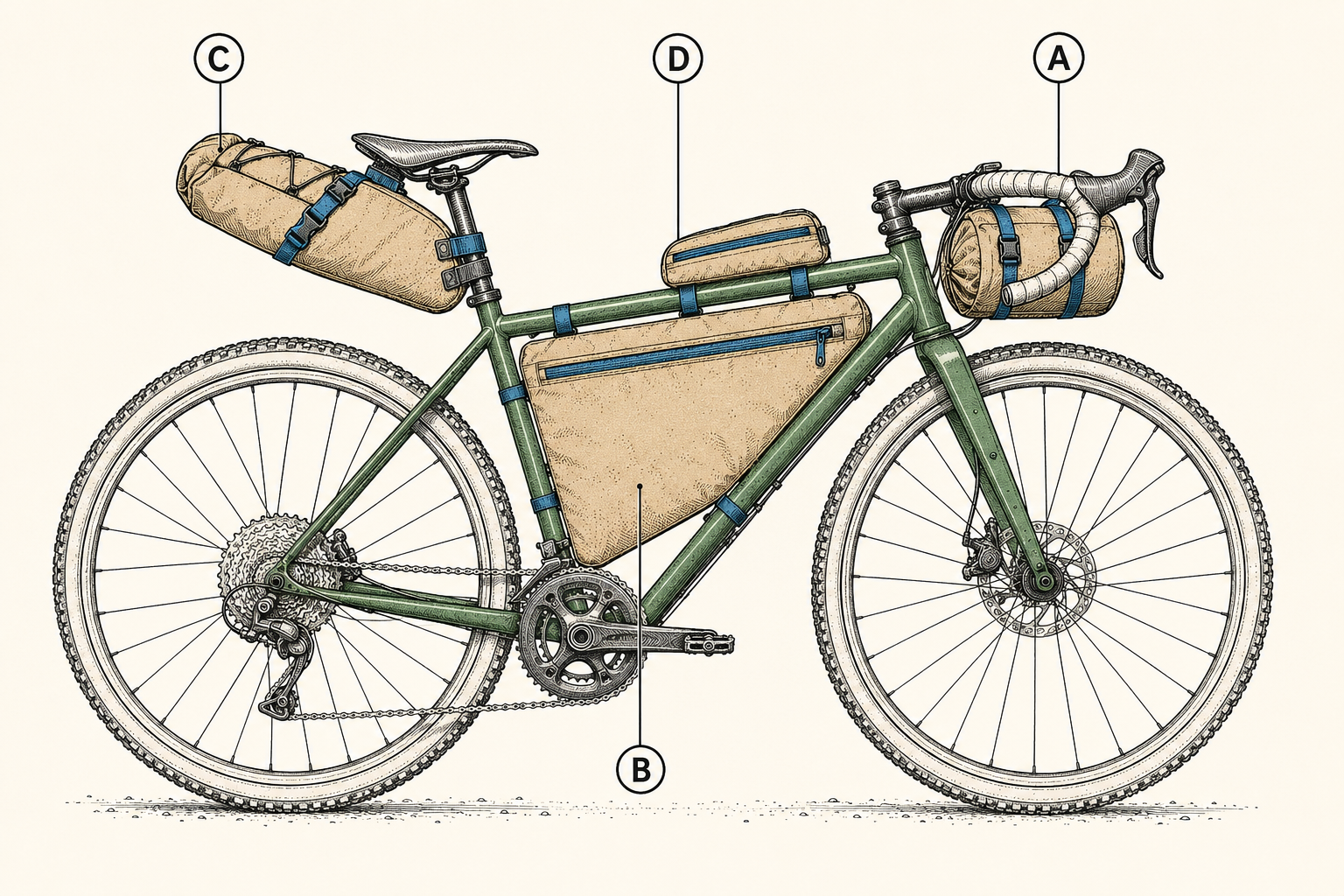
The three systems, honestly ranked for beginners: rack and panniers (the touring classic: a rear rack plus two clip-on bags swallows a lightened car-camping kit, costs modestly, and keeps weight off your back: the recommended first purchase if the S24O sticks), bikepacking soft bags (seat pack, frame bag, handlebar roll: no rack needed, rattle-free on rough trails, aerodynamic, and both pricier per liter and stingier in volume: the dirt-route answer), and the backpack (fine for trip one, sweaty and top-heavy as a habit: the system that proves you'll want one of the others).
Loading rules translate from Chapters 11 and 57: heavy low and centered (tent and food low in panniers or the frame bag: the bike's handling lives near the bottom bracket), balanced side to side (a lopsided pannier pair steers like an argument), light and bulky at the ends (sleeping bag in the handlebar roll, clothes in the seat pack), and daily-needs accessible (the Chapter 12 layer: snacks, tools, shell, and phone in the top-tube bag or pockets, because gear buried in a strapped roll is gear unused at speed).
The S24O: the doctrine of the first trip
The sub-24-hour overnight is bike camping's Chapter 2, and its design rules are the template's, translated: destination 10–20 miles out (90 minutes to 2 hours of loaded riding: enough to feel like travel, short enough to survive every beginner error), a campground you know or can trust (the Chapter 3 toolkit; hiker-biker sites, below, are the genre's gift), leave after lunch, arrive by Chapter 2's sunset math (loaded pace runs slower than your Saturday ride: plan 8–10 mph average with stops), and ride home for breakfast (the return leg is downhill in spirit regardless of terrain).
The kit translation from your existing gear: backpacking-flavored everything where you own it (the smaller tent, the pad that rolls tight, the Chapter 14 canister stove), car-camping gear shamelessly where you don't (a strapped-on cheap sleeping bag and a grocery-store dinner ride 15 miles fine), no cooler (the menu is Chapter 18's no-cooler mode: the genre's one hard subtraction), and water per Chapter 17's math plus the route's refill map (town spigots, campground taps: the bike's range makes resupply a feature).
Hiker-biker sites, the institutional secret: many state parks (the Pacific coast's system most famously) hold cheap, no-reservation sites for anyone arriving by muscle: the answer to "the campground's full" that only walk-ins and ride-ins get.
Routes: the safety chapter in disguise
Route quality is bike camping's safety variable, and the hierarchy is blunt: rail trails and paved greenways (car-free, grade-tamed: the perfect S24O venue and the family answer), gravel and forest roads (low traffic at low speeds: the bikepacking heartland, with Chapter 28's washboard reading translated to two wheels), low-traffic paved routes (county roads with shoulders, chosen by traffic count rather than scenery), and the busy road (avoided by planning, endured briefly when unavoidable, never toured on hope). The planning tools: bike-layer routing in the mapping apps (Chapter 42's toolkit carries cycling profiles), state and regional trail systems, and the route libraries the bikepacking community publishes with surface-by-surface honesty.
Visibility and traffic doctrine, compressed: lights on always (a rear flasher runs for days on Chapter 38's charging math and changes driver behavior measurably; the front light doubles as camp backup), ride predictable lines (the wobble-free loaded bike below helps), and the time-of-day layer (rural traffic peaks at commute and bar-close hours; the touring day that runs 8-to-3 misses both).
The turnaround doctrine translates too: Chapter 39's time-based turnaround becomes distance honesty (loaded hills halve your flat-ground estimates), the bail plan is the bike's built-in gift (nearly every route home is also a route to a bus, a train, or a phone-a-friend pickup), and weather at riding speed (Chapter 43's wind reading matters double: a 15 mph headwind is a gear you can't shift out of) plans the day.
Riding loaded: the ten-minute adjustment
The loaded bike is a different animal for exactly ten minutes: steering slows (the handlebar roll adds flop at low speed: grip relaxed, speed modest, and it disappears), stopping lengthens (brake earlier, especially loaded-downhill: the mass is real), standing climbs wobble (stay seated, spin low gears, and walk hills without shame: the tourer's oldest tradition: walking is riding at a different cadence), and the first mile is the test lab (bag sway diagnosed and strapped down now, not at speed).
The body adjustments: lower tire-pressure comfort (above), padded contact points doing more work (gloves and decent shorts stop being optional past 20-mile days), the eat-and-drink cadence tightened (Chapter 39's hourly rule runs faster at riding effort: a bonk on a bike arrives with less warning than on foot), and the pace humility that makes the whole genre work: the loaded tour is a rolling walk, not a race, and the riders who average 9 mph and stop at the farm stand are doing it correctly.
The repair kit, bike camping's Chapter 13: a spare tube (or two) plus patch kit, tire levers, a mini-pump, the multi-tool with a chain breaker, a quick link for the chain, and zip ties plus the duct-tape wrap already in your kit: the set that fixes 95% of roadside failures, learnable in one YouTube-and-driveway afternoon (the flat-tire drill especially: practice it at home once, because the roadside is a bad classroom, per this book's standing doctrine).
Camp with a bike
The bicycle at camp is luggage, vehicle, and valuables at once: security scales to setting (leaned against the tent in the backcountry; locked to something solid at developed campgrounds and every town stop: a lightweight cable lock rides along for exactly this), weather care (chain relubed after rain days; the bike under the tarp's edge or the picnic table in real weather: it's the trip home), and the kickstand-free lean (drive-side up against trees and tables, or flat on the ground, per the mechanics who see the derailleur damage).
Camp routines translate intact: the Chapter 45 storage law includes the frame bag's snack layer (bears don't respect luggage categories), the Chapter 37 teardown adds the mechanical check (tires, bolts, chain) before the ride home, and the trip plan (Chapter 39) rides along like always: route, campground, ETA, filed with the home contact: the bike's speed doesn't outrun the paperwork's value.
The multi-day extension, once the S24O converts you: chained overnights with town resupply (the credit-card tour: camp gear plus café meals: a legitimate and luxurious dialect), the gravel loops the route libraries map, and the gear refinement that follows actual desire lines (the seat pack after the pannier rattle, the dynamo hub after the third power-bank shuffle). The doctrine holds at every scale: the trip starts at your door, which was always the point.
Trailhead Takeaways
- The bike you own probably works: fit, brakes, and 35 mm+ tires are the test. The S24O (ride out after lunch, camp, ride home for breakfast) is the entrance exam.
- Rack-and-panniers is the beginner system; soft bags are the dirt answer; the backpack is trip-one-only.
- Load heavy low and centered, balanced side to side, sleeping bag at the bars, day-needs reachable. The first loaded mile is the test lab.
- Routes are the safety gear: rail trails first, gravel second, low-traffic pavement third. Lights always; plan around traffic hours.
- Loaded pace is 8–10 mph with humility: brake early, spin seated, walk hills without shame, eat before the bonk.
- The repair kit (tube, levers, pump, multi-tool, quick link) fixes 95% of roadside trouble: drill the flat at home.
- No cooler: Chapter 18's shelf-stable mode plus the route's refill map. Hiker-biker sites are the genre's cheat code.
- Lock at developed camps and towns, lean drive-side up, re-check bolts before the ride home.
Where Trips Go Sideways
- The maiden voyage at mile zero. First-ever loaded ride, launched straight onto the route: bag sway, mystery rattles, and a seat pack kissing the rear tire, all discovered in traffic. The around-the-block shakedown was the whole fix, and it was free.
- Saturday-ride math. Twenty miles planned at unloaded pace met loaded hills and a headwind, and the sunset-minus-three rule died at mile fourteen. Loaded estimates run 8–10 mph with stops: the S24O's short leash exists for exactly this arithmetic.
- The scenic highway. The prettiest line on the map carried the county's traffic at 55 mph with no shoulder, and the tour became an endurance of mirrors. Route quality is the safety chapter: the rail trail two miles east was flat, empty, and pointed the same direction.
- The unpracticed flat. Mile eleven, first-ever tube change, fading light, and the quick lesson that tire levers have technique. The driveway drill costs twenty minutes and a YouTube video; the roadside version costs the evening.
- The cooler dream. Strapped atop the rear rack like a rumor of car camping, it steered the bike from back there for six wobbling miles before the bungees surrendered. The genre's one subtraction is real: shelf-stable menus ride; ice stays home.
Frequently asked
What do I need to start bikepacking?
The bike you own (fit, working brakes, wider tires if it takes them), a lightened camp kit in panniers, soft bags, or a trip-one backpack, the roadside repair kit, lights, and a route built from rail trails or low-traffic roads. The S24O overnighter proves the habit before any real spending starts.
What is the difference between bikepacking and bike touring?
Dialect, mostly: touring is the pavement classic (racks, four panniers, big capacity, any distance); bikepacking is its dirt-born cousin (soft bags strapped to the frame, gravel and singletrack, backpacking-sized kits). Beginners don't need to pick: ride an overnighter with what mounts on your bike, and let your favorite routes choose the vocabulary.
How far should a beginner bikepack in a day?
Ten to twenty loaded miles for the first overnight, planned at 8–10 mph average including stops, with hills and headwinds treated as pace taxes rather than tests. Experienced loaded tourers ride 30–50 comfortably; nobody's first weekend needs to. End with energy left: Chapter 39's surplus doctrine rolls too, and the ride home the next morning is where the surplus gets spent.
Do you need a special bike for bike camping?
No: hybrids, older mountain bikes, gravel bikes, and sturdy commuters all carry camp. What matters is fit, sound brakes, tire clearance around 35 mm or better, and mounting points (or strap-on bags where they're absent). The exceptions are twitchy race bikes and department-store roulette; the upgrade that matters is tires, not the frame.