Part III · The Camp Kitchen
What Is a Good Trail Mix Ratio?
The Snack Layer
What snacks are best for camping?
The best camping snacks share three traits: they survive heat and crushing, they mix salt, fat, and carbohydrate (outdoor bodies want all three), and they're accessible without opening the food cooler. Build a dedicated dry snack bin plus a cooler-free fresh bowl (apples, oranges, carrots), and station both where hands pass.
Snacks at camp aren't treats between meals; they're the third fuel system, running alongside meals and water. Hiking, swimming, and even standing around in cold air burn through blood sugar faster than house life does, and the crash arrives as crankiness before anyone identifies it as hunger (in children this transition takes roughly ninety seconds). The snack layer is how trips stay cheerful between the kitchen's official productions, which is why Chapter 18 budgeted it double and why this chapter treats it with recipe-grade seriousness.
Logistics first: the snack bin is its own labeled container in the crate system, browsing is legal all day, and it never migrates into the tent (Chapter 45's food-storage law covers snacks with special emphasis, because a granola bar in a kid's sleeping bag is the classic violation).
The trail mix formula
Trail mix is a ratio, not a recipe: 2 parts base (nuts), 1 part dried fruit, 1 part something sweet, plus a salty wildcard and, ideally, one surprise. Mix it yourself in a gallon bag: cheaper than packaged by half, tuned to your crew, and free of the banana-chip filler nobody has ever finished.
The formula in practice: 2 cups mixed nuts (roasted, salted; peanuts for economy, almonds and cashews for morale), 1 cup dried fruit (raisins, cranberries, apricot pieces, mango for the ambitious), 1 cup sweet (chocolate chips in shoulder season, M&M-style candies in summer because their shells laugh at heat), plus a fistful of pretzels or sesame sticks, plus the surprise (coconut flakes, wasabi peas, espresso beans for the drivers). Shake in the bag, portion into small bags per hiker for trail days so the chocolate-mining economy stays fair.
Heat is the design constraint the formula already handles: everything in it tolerates a hot car except bare chocolate, which is what the candy-shell swap is for. Dark chocolate holds shape better than milk when you insist on the real thing; insist in October.
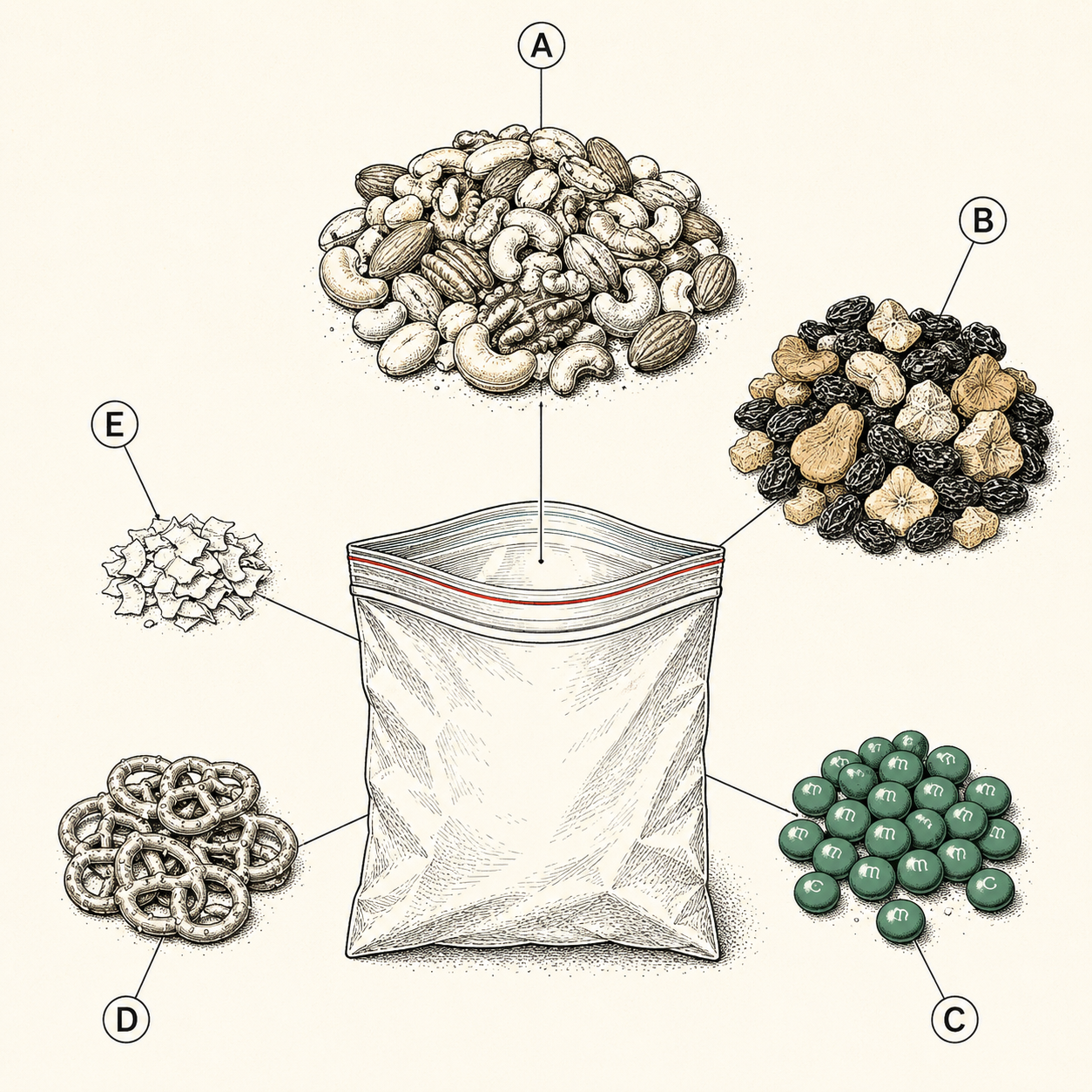
The snack roster: what actually gets eaten
The proven bin, by category. Salty: pretzels, tortilla chips (doubles as chili mac topping), crackers, popcorn (pre-popped, or the foil pan kind that's half snack, half fireworks), jerky, sesame sticks. Sweet: the trail mix, granola bars, dried mango, cookies that ship well (ginger snaps, oatmeal; delicate cookies arrive as crumble topping). Substantial (the meal-adjacent tier that bridges a late dinner): cheese and salami with crackers, peanut butter on anything, hummus cups with pretzels day-one-or-two, hard-boiled eggs cooked at home. Fresh: apples, oranges (nature's packaging), carrots, snap peas, cherry tomatoes.
What earns removal from the roster: anything that melts into a unified mass (bare chocolate in July), anything that shatters into dust (the fancy crackers), anything requiring the cooler's cold chain to stay safe for hours in a daypack (Chapter 16's rules follow the snacks out of camp). The bin self-edits within a season: whatever comes home twice gets replaced by more of whatever ran out first, which is the only snack survey that never lies.
Trail-day portioning borrows Chapter 18's math: each hiker carries their own snack bag, sized to 150–250 calories per hour of moving time, and the group's shared "emergency morale" chocolate rides with the leader, deployed at the whiny mile. It has never once failed.
S'mores, done properly
The canonical s'more is one roasted marshmallow and one square of chocolate pressed between two graham cracker halves, and its engineering problem is famous: molten marshmallow meets rock-solid chocolate that declines to melt. The fix is pre-staging: assemble the cracker-and-chocolate chassis at the fire's edge (the rim's gentle heat softens the chocolate) while the marshmallow roasts, then press and count to ten before biting; the interior is lava.
Marshmallow craft, the actual skill: roast over coals at the fire's rim, not in flame, rotating like the rotisserie the stick wants to be, until the surface is evenly bronzed and the interior sags. The torch-it-and-blow-it-out school produces carbon shells with cold centers and one predictable safety incident: a flaming marshmallow is napalm on a stick, and the instinctive arm-whip to extinguish it launches it at whoever's nearest. House rule for kids and honest adults: a burning marshmallow gets lowered and blown out low, pointed at the fire, never waved.
Variations that have survived committee review: peanut butter cups instead of chocolate (they melt properly and end the engineering problem), chocolate-hazelnut spread on the crackers, a fudge-striped cookie as the whole chassis (kid meta), and the strawberry slice that makes the whole thing taste intentional. The purist objection to all of these is noted and overruled.
Banana boats and the foil dessert family
The banana boat is the campfire dessert for people who claim they're too full: a banana slit lengthwise in its peel, stuffed with chocolate chips and mini marshmallows, wrapped in foil, and set on the coal bed's edge for 5–8 minutes until everything inside goes molten. Eaten with a spoon out of its own peel, zero dishes, and the peel packs out with the trash.
The variations write themselves once the pattern registers (fruit + melty things + foil + gentle coals): apples cored and packed with butter, brown sugar, and cinnamon, wrapped and cooked 15–20 minutes; peaches halved with a butter-brown-sugar center, 10 minutes cut-side up; the chocolate-raspberry packet that's really just an excuse. All of them run on Chapter 19's foil rules: double wrap, medium-to-gentle coals, opened away from the face, contents categorically molten.
These are also the designated kid-cooking desserts: assembly is safe, the foil goes on and off the coals with tongs and gloves under supervision, and the results are theirs. Ownership converts dessert into a skill, which is Chapter 51's whole pedagogy in miniature.
The Dutch oven cobbler and the skillet brownie
Chapter 19 taught the dump cobbler as Dutch oven baking's gateway; this chapter adds the two upgrades that complete a camp dessert repertoire. Cobbler upgrade: fresh or frozen berries instead of one filling can (3 cups berries, half a cup of sugar, a squeeze of lemon), same cake-mix-and-butter top, same 9-under-15-on-top coal count for a 12-inch oven, 35–45 minutes. The berry version tastes like a decision instead of a shortcut, and it feeds twelve.
The skillet brownie is the smaller crew's answer: boxed brownie mix prepared per its bag (which you repackaged, per Chapter 18, with the instructions torn off and tucked in), poured into the buttered cast-iron skillet, covered with foil, and cooked on the gentlest coals (the 6–7 second zone) or the stove's lowest flame with a lid, 25–35 minutes until the center barely sets. Edges caramelize against the iron in a way the home oven never manages. Serve in the skillet with spoons; plates are for people who weren't there.
Both desserts obey fire-dessert law: gentle heat and patience, because sugar burns at temperatures coals treat as a warm-up, and a scorched dessert bottom is the genre's one recurring tragedy. When in doubt, fewer coals underneath and more on top.
Trailhead Takeaways
- Snacks are the third fuel system: salt, fat, carbs, stationed in an always-open bin plus a fresh bowl. Crankiness is hunger wearing a costume.
- Trail mix is a ratio: 2 nuts, 1 fruit, 1 heat-proof sweet, a salty wildcard, one surprise. Portion per hiker; 150–250 calories per moving hour.
- The bin self-edits: replace what comes home with more of what ran out.
- S'mores: roast at the rim to even bronze, pre-warm the chocolate chassis, count ten before biting. Flaming marshmallows lower and blow out, never wave.
- Foil desserts (banana boats, baked apples) are kid-owned cooking: gentle coals, tongs, gloves, zero dishes.
- Dutch oven cobbler feeds twelve; skillet brownie feeds the rest. Sugar burns easy: fewer coals under, more on top.
- No snack sleeps in a tent. Ever. Chapter 45 explains who else likes granola.
Where Trips Go Sideways
- The snackless death march. Lunch was "in an hour" for three hours, the six-year-old melted down at mile two, and the trip's memory is the meltdown. The leader's chocolate bar and a per-kid snack bag cost ounces and buy entire afternoons.
- July chocolate, bare. The good dark bar became a unified brown envelope of regret by 11 a.m. Candy shells in summer, real chocolate in October, peanut butter cups year-round because they're right anyway.
- The flaming marshmallow orbit. Torched, panicked, whipped: molten sugar traveled eight feet and found a forearm. Lowered and blown out, pointed at the fire. Teach it before the first stick is issued.
- Cobbler on a bonfire's floor. Twenty-five coals underneath because more is more: carbonized bottom, raw top, twelve disappointed people. Baking heat comes mostly from the lid. Nine under, fifteen on top, rotate, believe.
- The tent granola bar. It rode in a jacket pocket, slept in the corner, and by 2 a.m. something with better hearing than the whole family knew it. Snacks live in the bin, the bin lives in the car or locker, and sleep stays boring.
Frequently asked
What is a good trail mix ratio?
Two parts nuts, one part dried fruit, one part heat-stable sweet, plus a salty wildcard and one surprise ingredient. Mixed at home in a gallon bag, it runs about half the packaged price and skips the filler nobody finishes. Raid the bulk bins for variety; the formula forgives every substitution except stale nuts. Portion into personal bags for trail days so the chocolate economy stays honest.
How do you make the perfect s'more?
Roast the marshmallow over coals at the fire's rim, rotating to an even bronze while the cracker-and-chocolate chassis warms at the fire's edge. Press, let the marshmallow's heat finish melting the chocolate, count ten, bite. Peanut butter cups solve the cold-chocolate problem permanently.
What desserts can you make while camping?
On the fire: s'mores, banana boats, foil-baked apples and peaches, Dutch oven cobbler for crowds, and the cast-iron skillet brownie. On no fire at all: cookies, dried mango, and the chocolate stash. The pattern for the fire set is constant: gentle coals, foil or iron, and patience with sugar.
What snacks won't melt in a hot car?
Nuts, pretzels, jerky, crackers, granola bars (the baked kind, not chocolate-dipped), dried fruit, candy-shell chocolates, and whole fruit like apples and oranges. The melters, bare chocolate leading the list, ride the cooler's top layer or stay home from June through September.