Part V · Getting There and Making Camp
What Knot Tightens as You Pull It?
Ten Knots, One Camper
What knots do you need for camping?
Ten knots run an entire camping life, grouped by job: two fixed loops (bowline, figure-eight loop), three hitches to objects (clove hitch, two half-hitches, timber hitch), two tensioners (taut-line hitch, trucker's hitch), two joins (sheet bend, and the square knot with its warning label), and one slider (prusik). Learn the bowline, taut-line, and trucker's hitch first; those three alone rig 80% of camp.
Knots are the rare camping skill that's pure practice and zero purchase: a four-foot length of cord in a pocket or on a desk, five minutes a day for two weeks, and you own them for life. The learning method that works: one knot at a time until your hands tie it without your eyes, then the next, and always in the knot's real context at camp that weekend (the taut-line learned on a desk gets certified on a guyline).
Vocabulary, quickly, because instructions need it: the working end is the end you're moving; the standing part is the rope that isn't; a bight is a folded section that doesn't cross itself; a loop does cross. And the finishing rule that separates knots that hold from knots that half-hold: dress the knot (arrange it neatly, no crossed strands) and set it (pull all parts snug) before trusting it. A sloppy bowline is a suggestion; a dressed one is a fact.
The bowline: the loop that won't strangle
Job: a fixed loop that never slips and never jams: around a tree for the Chapter 8 ridgeline, through a grommet, around anything you'll want to untie after loading. The king of knots, and the first one to own.
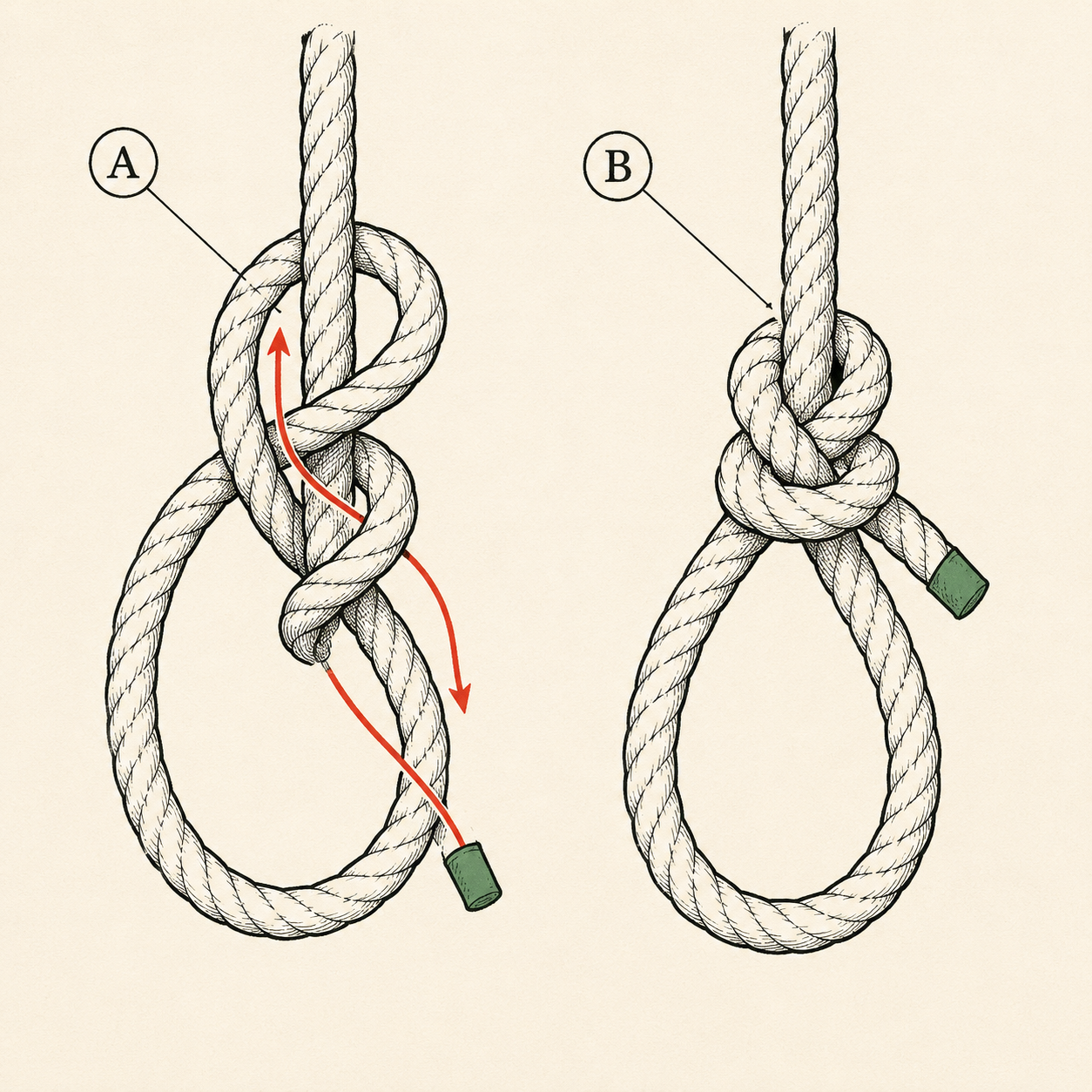
- Make a small loop in the standing part, working end on top (the "rabbit hole").
- Bring the working end up through the loop from below (rabbit out of the hole),
- around behind the standing part (around the tree),
- and back down through the loop (back in the hole). Dress and set.
The memory cue is the classic for a reason: up through, around behind, back down. Its defining virtues: the loop holds its size under any load, and it unties with a push of its "collar" even after hauling a canoe, which is exactly what the square knot and friends can't promise. Practice until the rabbit runs without narration; this is the knot your hands should know in the dark.
The figure-eight family: the climber's stopper and loop
Job: the figure-eight alone is the stopper knot (a fat, unjammable lump that keeps a rope end from escaping a grommet, pulley, or tensioner); tied on a bight, it's a fixed loop that's bulkier than a bowline but even harder to tie wrong, which is why climbing adopted it.
The stopper: make a loop, pass the working end around behind the standing part, then down through the original loop. It draws into a neat "8." The loop version: fold a bight, then tie the same 8 with the doubled rope; the result is a strong fixed loop anywhere along a line, no end required.
Camp uses run quieter than the bowline's but constant: a stopper on the tarp line's end so the tensioner can't escape, a mid-line loop for hanging the lantern, the kid-teachable knot that builds rope confidence (the 8 checks itself visually: if it looks like an 8, it is one; if it looks like scribble, retie).
The clove hitch: fast, adjustable, temporary
Job: fastening a line to a post, stake, or rail in three seconds, with easy adjustment after: the tarp's corner to a stake, a line between two trees at exact height, the canoe's painter to a rail while lunch happens.
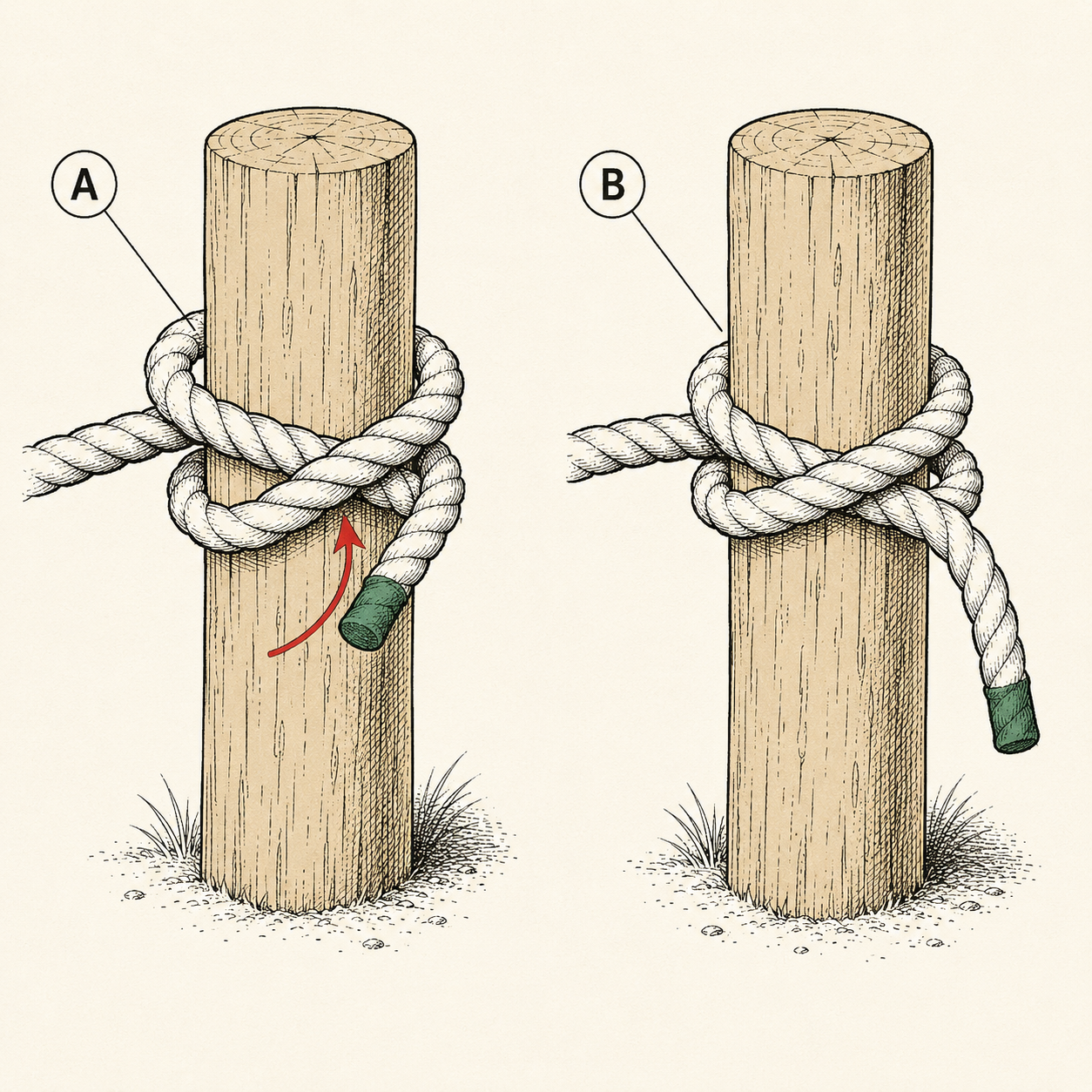
Around the post once, cross over the first wrap, around again, and tuck the working end under that second wrap so both wraps trap it. Dressed, the two crossings ride parallel. The over-a-post shortcut is even faster: form two identical loops in hand, slide the second behind the first, drop both over the post, snug.
Its honest limits define its jobs: the clove hitch holds under steady pull and can walk loose under cyclic loading and spinning (a boat surging on waves), so it's the temporary and adjustable choice, backed up with a half-hitch when it must hold unattended. For permanent or critical, the bowline or two half-hitches take over.
Two half-hitches and the timber hitch: the workhorse and the log-dragger
Two half-hitches. Job: tying a line off to a ring, tree, or grommet so it stays tied: the tarp ridgeline's second tree (after the bowline started the first), the food-hang line, the clothesline. Pass the working end around the anchor, then tie two identical half-hitches around the standing part (around and through, twice, same direction). It grips harder as load grows and stays untie-able. This is the knot for "attach this and forget it."
Timber hitch. Job: dragging or hoisting anything log-shaped: firewood rounds to camp, a beam for the kid-fort. Pass the end around the log, wrap the working end around its own standing part, then tuck it back around itself 3–4 times against the log. Load it and the wraps bind; slack it and the whole thing falls off, which is the feature: zero untying after the drag.
Together with the clove hitch, these three cover "attach rope to thing" completely: clove for fast-and-adjustable, two half-hitches for firm-and-forgettable, timber for drag-and-drop.
The taut-line hitch: the knot that tightens as you slide it
Job: an adjustable loop that grips under load and slides when you want it to: guylines, clotheslines, anything needing re-tensioning as fabric stretches and temperatures change. This is the knot Chapter 8's hardware tensioners imitate, and the free version weighs nothing and fits any line.
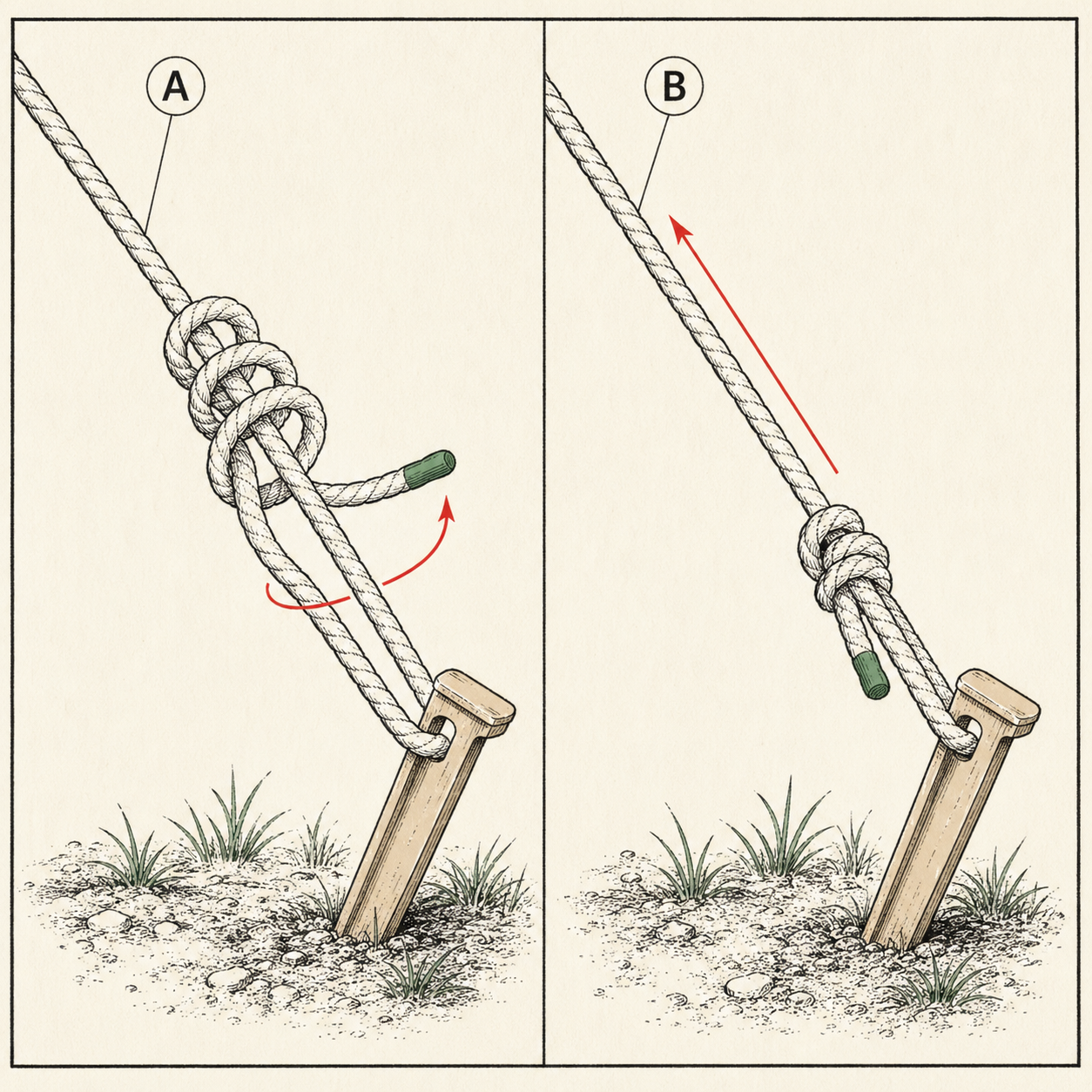
Around the stake or through the grommet, then with the working end: two wraps around the standing part inside the loop (toward the stake), then one more wrap outside the first two (away from the stake), snug it dressed. The knot slides along the standing line by hand, then locks under tension exactly where you left it.
The test that certifies yours: tie it on a staked line, slide it to tighten the line drum-taut, and yank the line hard. Holds where you put it: pass. Slips: your wraps are sloppy or your cord is too slick for the standard version (add a second outside wrap for slippery line). The taut-line is the single most-used knot in an average camp evening; it's worth ten minutes of drilling all by itself.
The trucker's hitch: mechanical advantage from nothing
Job: getting a line genuinely, violently tight: the tarp ridgeline that shrugs off wind, the canoe on the roof rack, the load that cannot shift (Chapter 28's tug test, achieved). The trucker's hitch is a pulley you tie mid-rope, tripling your pulling power, and it's the most impressive thing your hands will learn this month.
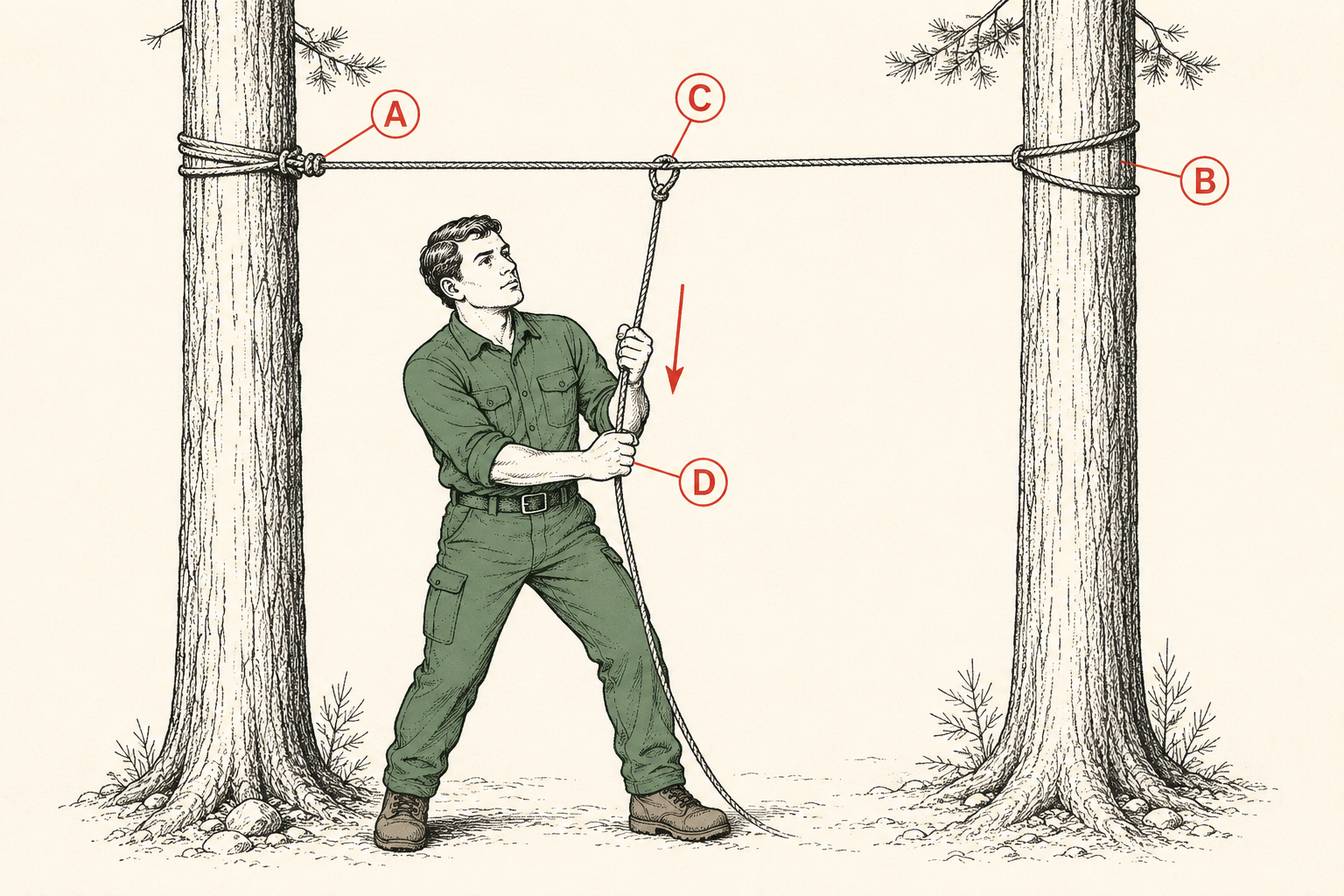
- Tie off the far end (bowline around the first tree).
- Mid-line, make a slippery loop (a loop with a bight pulled through it, so it releases later with one tug).
- Run the working end around the anchor (second tree, rack bar) and back up through the loop: that loop is now a pulley.
- Haul down on the working end (feel the 3-to-1 help), and while holding tension,
- lock it off with two half-hitches just below the loop.
The ridgeline demonstration converts every doubter: bowline, slippery loop, through, haul, and a line you can bounce a tarp on, then one tug and two flicks to strike it all. Roof-rack notes: pad sharp rack edges (the mechanical advantage that tensions lines also saws them), and the same knot in ratchet-strap country is the backup that never jams, breaks, or goes missing.
Joins and the slider: sheet bend, square knot, prusik
Sheet bend. Job: joining two ropes, especially unequal ones (the tarp line to the thicker tow strap, two short cords into one long): fold a bight in the thicker rope, run the thinner working end up through, around behind both strands, and tuck it under itself. It's the square knot's honest cousin: it holds unequal lines, and it unties after load.
Square (reef) knot, with its warning label. Job: tying two ends of the same cord around something (a bundle of kindling, a bandage, a package): right over left, left over right, dressed flat. The label: it is a binding knot, not a join for load; square-knotted ropes under real tension can capsize and slip, which is exactly what the sheet bend exists to prevent. Teach it, use it for bundles, and never trust it with anything that matters mid-air.
Prusik. Job: a loop that slides along a taut line by hand and locks under load: hanging things along the ridgeline (lanterns, wet socks, the food bag's pulley point), adjustable tie-outs on a line already tensioned. Tie a small cord loop (double fisherman's or just a solid knot), wrap it around the main line through itself three times, dress the wraps neat. Slide it anywhere; load it and it bites. The camp version of a one-way clamp, free.
Cordage: what to buy and how to keep it
The camp rope locker is simple: 50 feet of 550 paracord (the Chapter 6 standby, right for nearly everything above), a hank of 2–3 mm accessory cord (guylines, prusiks, small work; reflective per Chapter 8), and one 20–30 foot length of thicker utility rope (3/8 inch) for hauling, bear hangs (Chapter 45), and towing luck. Nylon stretches (good for absorbing shock, bad for drum-tight ridgelines), polyester holds (better tarp lines), and the melt-the-ends rule applies to all of it: cut ends fuse with a lighter flame, at arm's length, outside.
Rope care in three habits: coil and hank consistently (the butterfly or simple hank; YouTube once, hands forever) so line deploys instead of birdnesting, keep cordage off the ground and out of UV between trips, and retire anything with a visibly damaged core section from load duty to bundle duty. Cheap cord is cheap insurance; frayed cord under tension is a slingshot.
And the pocket-practice cord one more time, because it's the actual secret: four feet of paracord in a jacket pocket converts idle minutes into permanent skills. Two weeks. Ten knots. Done for life.
Trailhead Takeaways
- Three knots run 80% of camp: bowline (fixed loop), taut-line (adjustable tension), trucker's hitch (violent tension). Learn these first.
- Dress and set every knot: neat strands, all parts snug. Sloppy knots are suggestions.
- Attach-to-things trio: clove (fast, adjustable), two half-hitches (firm, forgettable), timber (drag and drop).
- Figure-eight stops rope ends and makes foolproof loops; the prusik slides and locks along any taut line.
- Sheet bend joins ropes, especially unequal ones. The square knot binds bundles and betrays loads.
- Buy paracord, thin reflective accessory cord, and one thicker hauling length. Fuse ends, coil consistently, retire damaged core.
- Four feet of cord in a pocket, five minutes a day, two weeks: the whole chapter, owned.
Where Trips Go Sideways
- The granny-knotted guyline. An improvised tangle held the tarp beautifully until the wind mattered, then surrendered all at once. Nobody could untie the survivors either. Ten real knots exist precisely so improvisation doesn't have to.
- Square knot, real load. It joined two ropes for the roof rack because it was the one knot remembered from scouts. It capsized at highway speed, as square knots under tension do. The sheet bend was two minutes away from being known.
- The ratchet strap religion. Every job solved with hardware until the day the ratchet jammed at a trailhead. The trucker's hitch weighs nothing, breaks never, and was invented for exactly that afternoon.
- Undressed and untested. The bowline was tied hastily, looked roughly right, and slipped under the canoe's first surge because its strands crossed. Dress it, set it, yank-test it. The three seconds are part of the knot.
- The birdsnest bag. Fifty feet of paracord stored as a wad, deployed as a puzzle, solved by knife at dusk. Coil it the same way every time and rope becomes equipment instead of an argument.
Frequently asked
What is the best knot for camping?
If forced to one: the bowline, the fixed loop that never slips and always unties. The honest answer is three: bowline for loops, taut-line hitch for adjustable guylines, trucker's hitch for real tension. That trio rigs tarps, lines, racks, and hangs, and takes a week of pocket practice to own, four feet of cord and five minutes a day being the entire tuition.
What knot tightens as you pull it?
The taut-line hitch is the camp answer: it slides by hand to tension a line, then grips harder as load increases, holding wherever you leave it. The timber hitch and prusik share the bite-under-load property for their own jobs (dragging logs; sliding along a taut line).
What are the 10 basic knots?
This chapter's set, grouped by job: bowline and figure-eight loop (fixed loops), clove hitch, two half-hitches, and timber hitch (attaching to things), taut-line and trucker's hitch (tension), sheet bend and square knot (joining and binding), and the prusik (slide-and-lock). Learn them in that order of usefulness.
What are the 12 most useful knots?
Start with this chapter's ten; the two additions most lists append are the double fisherman's (permanently joining two cords, and the proper way to make prusik loops) and the alpine butterfly (a strong mid-line loop that isolates damaged rope). Both are graduate versions of jobs the core ten already handle.