Part II · Shelter and Sleep
Do You Need the Ten Essentials?
The Bag That Never Unpacks
What are the Ten Essentials?
The Ten Essentials are ten systems (not ten objects) that let you handle an unplanned night or a minor emergency: navigation, sun protection, insulation, illumination, first aid, fire, repair kit and tools, nutrition, hydration, and emergency shelter. The list dates to 1930s mountaineering and survives because the question it answers hasn't changed: can you take care of yourself if the day stops going to plan?
Read them as questions, and the list stops being a shopping errand. Can you find your way if the trail or phone fails? Handle sun for hours? Stay warm if you stop moving? See after dark? Patch a body? Patch gear? Start a fire? Eat and drink past your planned turnaround? Survive a night out? Ten yeses means you're carrying the essentials, whatever brands are involved, and most of the yeses cost ounces, not dollars.
The deeper point this chapter builds toward: the essentials only work if they're actually with you, and the way they end up with you is a daypack that never unpacks. Gear you have to assemble each morning stays home on exactly the morning that matters.
The bag that never unpacks
Build one daypack containing the ten systems, restock it after trips, and never disassemble it. It lives by the door or in the trunk, it goes on every hike by default, and its contents are boring precisely because they're always the same. This is the Chapter 6 kit philosophy at its highest stakes.
The standing build, concretely: offline maps downloaded plus a paper backup and button compass (navigation), sunscreen and SPF lip balm (sun), a packable insulating layer and beanie (insulation), headlamp with charged batteries (illumination), the small first-aid kit from Chapter 47 (first aid), a lighter plus stormproof matches (fire), a mini multi-tool, duct tape wrap, and repair patches (repair), two energy bars past your plan (nutrition), capacity for extra water plus treatment tablets (hydration), and an emergency blanket or bivy (shelter). Total weight runs 3–4 pounds before water, which is the whole argument: the difference between a bad afternoon and a news story weighs less than a laptop.
The restock ritual is the system's heartbeat: after any hike that used anything, the pack gets its bars, bandages, and batteries back within the week. An essentials pack with a dead headlamp is a prop.
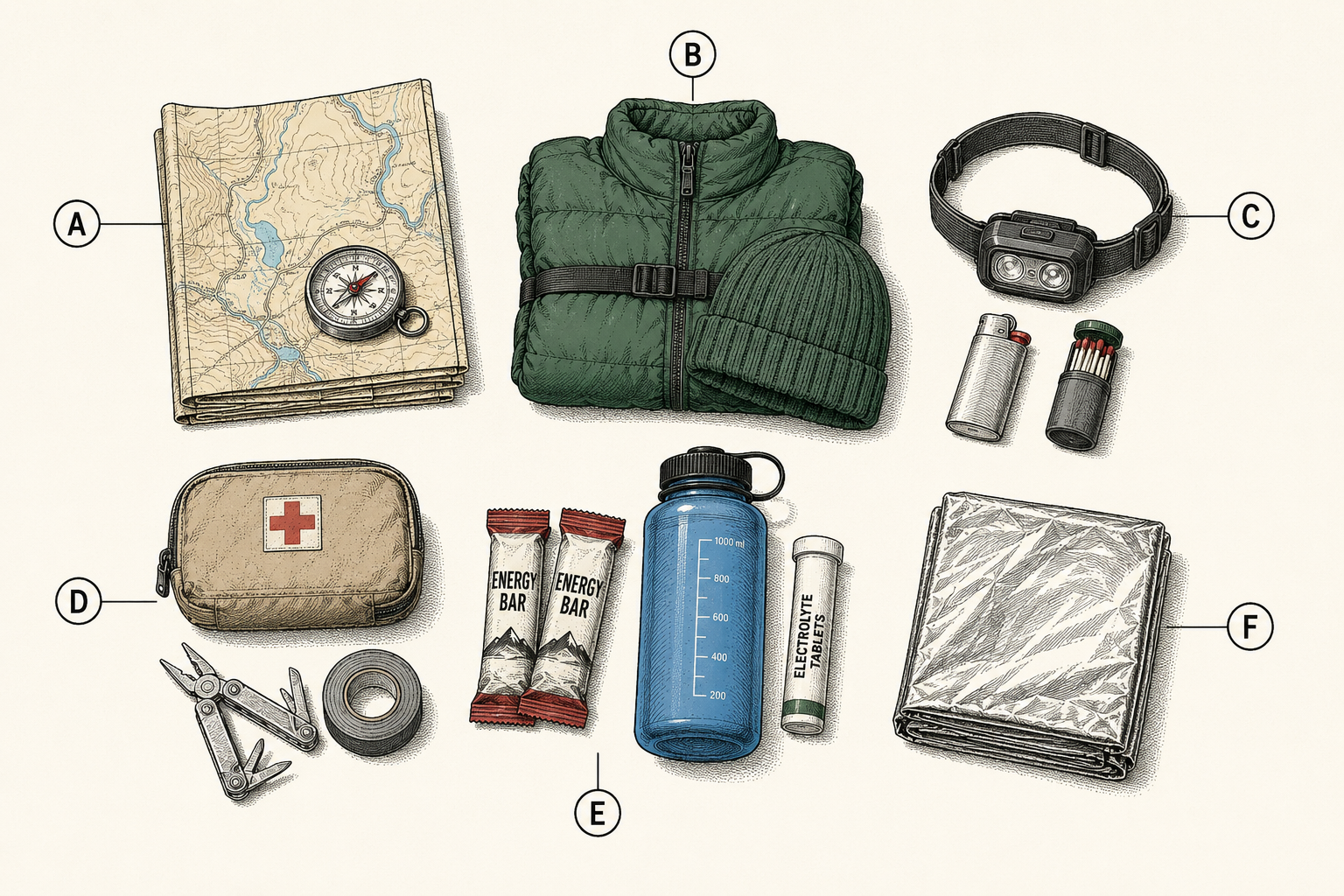
Navigation and illumination: find your way, then see it
The navigation system in 2026 is layered: a phone running offline maps (downloaded before the trailhead, where cell bars go to die), a paper map of the area, and a compass you can actually use. The illumination system is a headlamp per person, charged, plus a backup path (spare battery, tiny second light, or the phone as last resort).
The layering logic is failure independence. Phones are the best navigation tools ever put in a pocket and they fail in phone ways: batteries, cold, screens, creeks. Paper fails in paper ways (wind, water, being left in the car), which are different ways, and that's the point. Chapters 40–42 teach the actual skills; the essentials rule is simpler: carry the layers on every hike past the campground loop, because "I know this trail" is the opening line of a remarkable number of search-and-rescue reports.
Illumination earns its slot on arithmetic: the most common unplanned night out isn't an injury, it's a slow hike that met an early sunset. A headlamp converts that from an emergency into a late dinner. Check the charge the way you check your keys: every time, thoughtlessly.
Insulation, sun, and the stopped-body problem
The insulation essential answers one scenario: your body stops moving (injury, a wrong turn, a twisted ankle in the group) and the heat production Chapter 9 described drops to embers. The packable puffy or fleece plus a beanie you didn't think you'd need is what "extra layer" means: sized for sitting still at the day's coldest plausible hour, not for hiking.
Sun protection is the essential that gets skipped for being unglamorous, then billed later: sunscreen (reapplied; the morning coat expires by lunch), lip protection, sunglasses at elevation or on water, and cover (hat, or the sun hoodie Chapter 27 endorses). Sunburn on a day hike is misery; sunburn plus the dehydration it accelerates is how "minor" compounds. Deserts and snowfields multiply everything, glare included.
Both systems cost almost nothing to carry and everything to lack, which is the essentials pattern in miniature.
Fire, shelter, and the unplanned night
Fire and emergency shelter exist for one shared scenario, the unplanned night out, and they solve its two killers: heat loss and time. Fire: a lighter plus stormproof matches, carried always, plus a purpose-made firestarter (cotton pads in wax, or a commercial cube) that turns cold fingers and damp wood from a crisis into a chore. Shelter: at minimum a mylar emergency blanket; better, a 4-ounce emergency bivy that becomes a windproof, waterproof sleep sack.
The emergency blanket deserves its own paragraph because it's the most misunderstood item in the pack. It works by reflecting radiant heat and blocking wind and wet, which means it works wrapped tightly around a person, ideally with insulation inside, and works poorly draped loose like a cape at a finish line. Its off-label uses justify the second one in the pack: groundsheet under a patient, shade panel in deserts, signal mirror of last resort (the shiny side flashes for miles), water catch, and windbreak for the fire you're starting with those stormproof matches.
Food, water, and the margin habit
The nutrition and hydration essentials are margins, not meals: food and water beyond what the planned day needs. The standing numbers: two bars that live in the pack permanently, one extra liter of capacity, and water treatment (tablets weigh nothing and turn any creek into supply; Chapter 17 covers the chemistry).
Margins are boring until the day they're the story. The hike that "should take four hours" takes seven for a hundred ordinary reasons (a wrong fork, a slow knee, a kid's pace, a view that deserved an hour), and the difference between a party that's late and a party that's late, hungry, dehydrated, and making bad decisions is exactly the margin. Dehydration in particular degrades judgment before it announces itself as thirst, and judgment is the tool every other essential depends on.
The kid corollary: children run out of fuel faster and crash harder. Their margin is bigger, per pound, and it's chocolate-adjacent on purpose. Morale is a survival resource; Chapter 51 says so at length.
First aid, repair, and the fix-it-there kit
The first-aid essential is the small kit Chapter 47 builds (blister care doing most of its real-world work), sized to the group and the distance from the car. The repair essential is its gear twin: a mini multi-tool or knife, a flat wrap of duct tape, a few safety pins, and the specialty patches your gear demands (pad patch, brain-dead-simple and covered in Chapter 13).
The pairing is deliberate: bodies and gear fail on the same trips, and both kits obey the same law of usefulness, which is that they're only as good as your familiarity with them. Open your own kits at home. Know where the blister supplies are before a hotspot is shouting. Tape a practice patch onto a sacrificial pad. Five minutes of kitchen-table rehearsal is the difference between a kit and a talisman.
Scaling the essentials honestly
The ten systems flex with the trip: a campground loop with the family needs sunscreen, water, snacks, and a headlamp in a pocket; a solo shoulder-season summit wants every system, doubled where it's cheap. The skill is scaling consciously instead of by mood, and the tool is one question: what happens here if we're out four hours longer than planned?
Ask it at the trailhead, honestly, and pack the answer. A paved nature trail's answer is "we're bored." A remote canyon's answer involves darkness, temperature, and the distance help would travel, and the pack should reflect it. What never scales to zero: water, and the phone-plus-headlamp pair. What scales up first as trips get bigger: insulation, navigation redundancy, and the shelter layer, because those are the unplanned-night systems and the unplanned night is the scenario that writes the rules.
Trailhead Takeaways
- Ten systems, ten questions: way-finding, sun, warmth, light, first aid, fire, repair, food, water, shelter. Yes to all ten and you're equipped.
- Build the daypack once; never unpack it; restock within a week of use. 3–4 pounds buys the whole insurance policy.
- Phone plus paper plus compass: layered navigation fails independently, which is the point.
- The extra layer is sized for sitting still, not hiking. The unplanned night is the design scenario.
- Emergency blankets work wrapped tight, insulation inside, and moonlight as shade, signal, and groundsheet. Carry two.
- Food and water are margins; dehydration spends judgment first. Kids get bigger margins and better snacks.
- Scale by the four-hours-longer question, never by mood. Water and light never scale to zero.
Where Trips Go Sideways
- "It's just a day hike." The five most expensive words in the outdoors. Day hikers, statistically the search-and-rescue regulars, carry the least margin because the plan was short, and plans are exactly what unplanned nights ignore.
- The essentials in a drawer. Assembled after a scare, scattered within a month: the headlamp migrated to the garage, the bars got eaten at a soccer game. If it unpacks, it doesn't exist. The bag lives packed or it doesn't live.
- A phone as the whole plan. Navigation, light, and emergency contact in one glass rectangle at 8% battery, in the cold, at dusk. Redundancy isn't paranoia; it's respect for how phones actually behave.
- The cape blanket. Draped over shoulders in the wind, the mylar flapped, leaked heat everywhere, and reassured no one. Wrap it, tuck it, insulate inside it. It's a burrito, never a cape.
- Rationing water on the way down. Half a liter hoarded "for emergencies" while the emergency (a dehydrated, stumbling descent) was already underway. Drink the water; the emergency it prevents is the one you're in.
Frequently asked
What are the Mountaineers' 10 essentials?
The systems version, maintained by the Seattle Mountaineers, whose climbing courses originated the list: navigation, sun protection, insulation, illumination, first-aid supplies, fire, repair kit and tools, nutrition, hydration, and emergency shelter. It's framed as capabilities rather than objects, updated over the decades (headlamps for lanterns, phones added to navigation), and unchanged in purpose since the 1930s: handle the unplanned night.
What are 10 basic hiking rules?
Most codes distill to: tell someone your plan, check weather, start early, carry the essentials, stay on trail, turn around on time, drink before thirst, keep wildlife distance, pack out everything, and match the hike to the weakest hiker. The turnaround rule prevents the most rescues.
Do I need the Ten Essentials at a campground?
As a rigid list, no; as questions, they answer themselves fast: the car covers shelter and repair, camp covers food and fire. What still rides on every campground hike, even short ones: water, sun protection, snacks, and the headlamp, because "we walked farther than we meant to" is a campground story too.
What's actually worth carrying in an emergency blanket?
The 2-ounce mylar sheet is the minimum; the 4-ounce emergency bivy (a mylar sleeping sack) is the meaningful upgrade, because it seals wind out instead of negotiating with it. Either one earns its slot only wrapped around a person. Carry the bivy where nights are cold, the sheet everywhere else, or both.