Part VIII · Camping Together
The Best Time to See Wildlife
Neighbors with Fur and Feathers
How do you see more wildlife while camping?
Be out at dawn and dusk, watch the edges (where forest meets meadow, where anything meets water), hold still and quiet longer than feels natural, and keep the distance that lets animals behave like animals instead of reacting to you. That formula, plus a decent pair of binoculars, converts the average campground from "we saw a chipmunk" to a season of sightings, because the animals were always there: the formula is about becoming watchable-around.
The reframe that makes this chapter work: wildlife watching isn't luck, it's showing up where and when the schedule says (most mammals run crepuscular shifts: active at the day's dim edges, bedded through its middle), and the campground is genuinely good habitat for it: edges everywhere, water nearby (Chapter 30 camped you near the commuter routes on purpose, at a respectful setback), and animals mildly habituated to human presence, which shortens the patience requirement that wild-wild watching demands.
The chapter's spine is three skills (timing, stillness, optics) plus the two laws (distance and never-feeding) that keep the whole enterprise ethical, and a camp-photography section that's honest about phones.
The schedule and the edges
Timing: the golden hours are wildlife's rush hours: the first hour of light (the dawn shift: deer moving from feeding to bedding, birds at full song, the night shift's last stragglers) and the last two before dark (the reverse commute, plus the crepuscular specialists). Midday belongs to birds, squirrel drama, and reptiles on warm rocks; full night belongs to the audio show (owls, coyote choruses, the mystery crunch Chapter 2 already identified as almost-certainly-a-deer). The practical camp move: one deliberate early morning per trip (coffee in hand, per the sit spot below) outproduces every midday walk combined.
Terrain: edges are where the action lives: the meadow's rim, the water's margin, the brushy line where two habitats trade species. Water multiplies everything (every animal drinks, most at the dim hours: the reason Chapter 30's respectful-distance camp placement doubles as a viewing blind), and trails, sandbars, and mud are the guest book: tracks and scat tell you who's around before you ever see them (the Chapter 52 track game is this section's training program).
Weather: the overlooked variable: animals move before storms and feed hard after them (Chapter 43's front-reading doubles as a wildlife forecast), light rain concentrates activity into breaks, and wind is the watcher's enemy (it masks your noise but spooks everything and wrecks the audio layer, which is half of wildlife detection: most animals are heard first).
The distance law
The standard, adopted from the national parks and applied everywhere: at least 25 yards (23 m) from most wildlife, 100 yards (91 m) from bears and wolves, and farther the moment behavior changes. The field test that requires no rangefinder: the thumb rule: arm extended, thumb up: if the animal isn't fully covered by your thumb, you're too close for the big-predator standard, and the animal-behavior test outranks everything: if it stopped feeding, stood up, staring, or moved off because of you, you were too close, whatever the yardage.
Why the law is a viewing tip as much as an ethic: distance is what lets animals keep being animals: the fawn stays bedded, the heron keeps fishing, the beaver keeps its rounds, and you see behavior instead of a departure. Binoculars exist precisely to make distance and detail compatible, which is the next section, and the approach discipline rides along: never directly at an animal (angle obliquely, stop often, let it watch you be boring), never between a mother and young, never surrounding anything (the multi-family kid-cloud drifts into a circle without noticing; the adult's job is noticing).
Binoculars, decoded
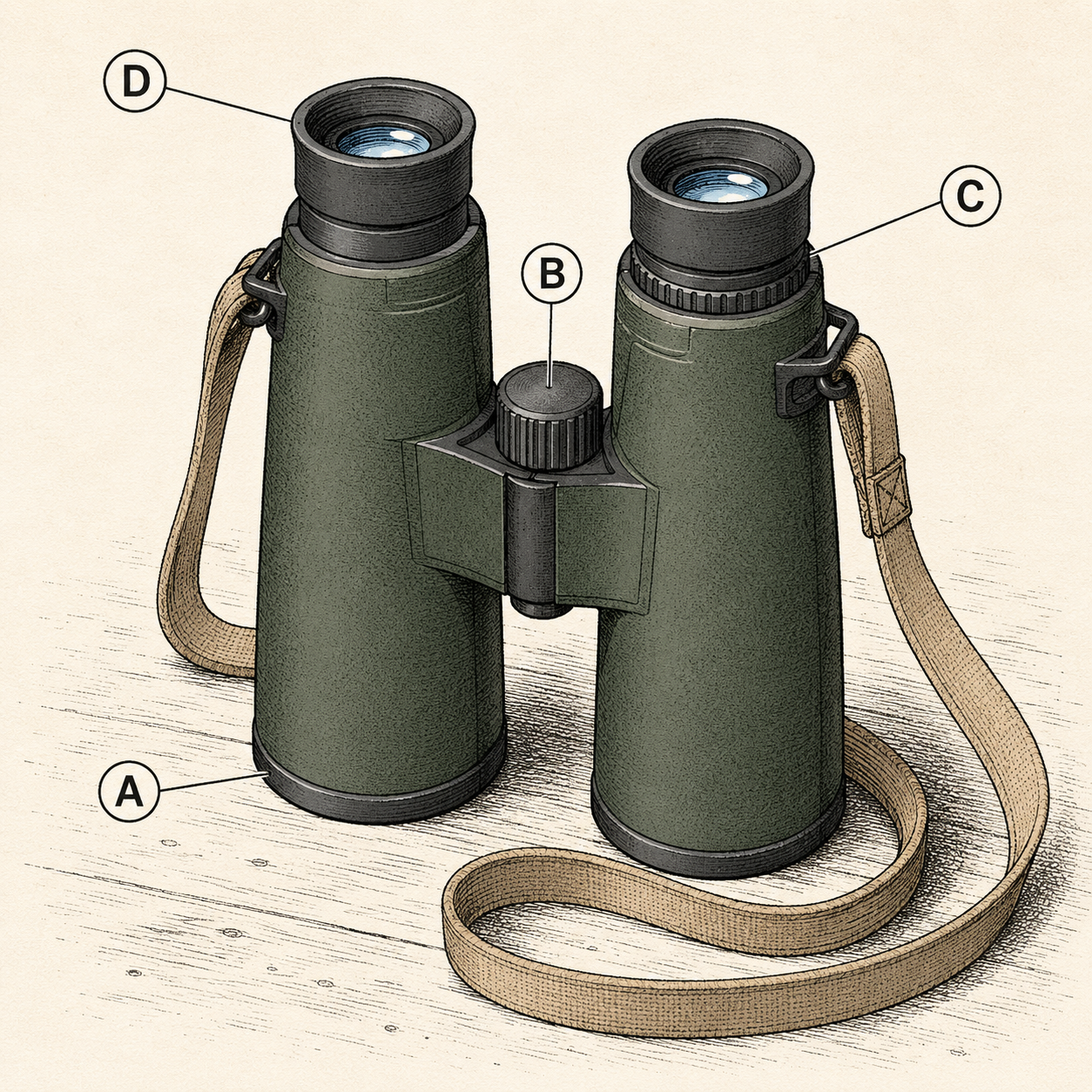
The numbers on every pair (8×42, 10×25) are magnification × objective lens diameter in millimeters, and the beginner's answer is 8×42: 8 power is the most magnification most hands hold steady (10x shows more and shakes more), and the 42 mm objectives gather enough light for the dawn-dusk hours where wildlife actually happens. Compact 8x25s trade that light for pocketability (fine for daylight, dim at the golden hours); kid pairs run 8×32 or rugged compacts, real optics rather than toys (a kid who can't actually see through them retires from birding at seven).
Price honesty: the middle tier ($100–300) delivers most of what the stratosphere costs, modern budget glass ($50–100) beats everything your parents owned, and the feature that matters beyond glass is eye relief for eyeglass wearers (fold the eyecups, check the spec).
The technique nobody teaches: find the animal with your naked eyes first, lock your gaze on it, then raise the binoculars to your sightline without looking away. Beginners scan with the binoculars (a soda-straw view of empty branches) and lose the bird every time; the eyes-first move lands it in the glass in one motion. Set the diopter once (the little adjustment ring for your eyes' difference: focus left eye with the center wheel on a sign, then right eye with the diopter), and the pair is calibrated for life. Strap on, always (Chapter 27's glasses logic at higher stakes), and the campground's best binocular subject on a slow day is the moon, which never flushes.
The sit spot: stillness as a superpower
The single best wildlife technique is also the simplest: pick a spot with edge and water in view, sit still for thirty minutes, and let the landscape forget you. The forest runs a fifteen-minute alarm clock: your arrival silences everything, and stillness resets it: birds resume first, then squirrels, then the real traffic, and the watcher who outlasts the alarm sees the woods at its unwatched normal. Camp chairs at the site's quiet corner count; dawn coffee at the water's edge counts double.
The supporting skills: wide-angle vision (soften focus to the whole scene and let motion flag targets: movement-detection is what eyes are actually good at), ear-first detection (most sightings begin as sound: the scold of a jay announcing a predator, the wrong-rhythm rustle; the quiet camp hears more, one more argument for Chapter 5's noise etiquette), and the freeze discipline when something appears (animals key on motion; the watcher who becomes furniture gets the show).
The kid version, engineered for actual children: shorter sits (ten minutes is heroic at seven), the counting game (how many species by sound before we move), the sit-spot log (a notebook of sightings that becomes a competitive family document), and the reframe that stillness is stalking, which converts fidgeting into tradecraft.
The camp cast: knowing the regulars
The recurring characters worth knowing anywhere in North America: deer (the dawn-dusk headliners; count points quietly and watch for the parked fawn in June meadows: it's not abandoned, and the law is look-from-afar), the squirrel-chipmunk economy (the midday show: caching drama, territorial opera, and the camp-robbery unit Chapter 45's storage law already defeated), the corvids (jays and ravens: the forest's smartest residents and its alarm system: their scolds map predators for you), woodpeckers and the dawn chorus (the bird show runs all day at the feeder-free campground; a laminated regional bird card in the game kit converts curiosity into identification), raptors on the thermals (midday's consolation prize: learn the turkey vulture's wobbly V from the hawk's flat glide and you're birding), and the night audio (owl calls learnable from the app at home: the great horned's bass line is the gateway).
The tracking layer completes the cast list: the guest book (mud, sand, dust) read on every water walk, the four-print patterns (bounders, walkers, hoppers) that the Chapter 52 track game teaches, and scat-and-sign literacy at the it-was-here level, which is all the campground requires and exactly what makes kids feel like detectives.
Regional headliners (moose in the north country, elk in the mountain West, alligators in the Southeast's waterways, javelinas in Chapter 59's desert) come with local rules the campground board and Chapter 45's respect-radius logic already frame: bigger animal, bigger circle, same ethic.
Camp photography: phones, honestly
The phone is a genuinely great camp camera and a genuinely bad wildlife camera, and knowing which is which saves the trip's photos: great at light and place (golden-hour camp scenes, fire glow, the tarp in rain, portraits of people doing camp things: the trip's actual memories), bad at distance (digital zoom is cropping with confidence; the deer at 25 legal yards is eleven blurry pixels). The fixes: shoot wildlife as scenes (animal-in-landscape at honest distance holds up; fake telephoto doesn't), and for real reach, digiscoping: the phone's lens held to the binocular's eyepiece (steady both, tap to focus: fiddly, learnable, and startlingly good for the price of patience).
The craft rules that upgrade everything: light beats subject (the golden hours again: the same picnic table is a painting at 7 a.m. and a snapshot at noon), no flash at animals ever (blinding nocturnal eyes for a black frame), burst mode for anything alive, and the narrator's rule for family archives: photograph the doing (hands on the fire steel, the fish coming to net, the fort under construction) rather than only the done.
The legal layer, briefly: drones are prohibited in national parks and most wilderness (and unwelcome at quiet campgrounds everywhere: Chapter 5's noise ethic at altitude), baiting or calling wildlife for photos violates both park rules and this chapter's whole premise, and the geotagging conversation (whether to publish the exact location of the fragile and beautiful) waits for Chapter 60, where it belongs.
Trailhead Takeaways
- Dawn and dusk at the edges, near water, quiet and still: the animals were already there.
- Distance law: 25 yards standard, 100 for bears and wolves, thumb test as the gauge, behavior change as the verdict. Distance is what makes behavior watchable.
- 8×42 is the binocular answer: steady, bright at the golden hours. Eyes find the animal first; the glass rises to the sightline.
- The sit spot outperforms every walk: thirty minutes of stillness resets the forest's alarm. Ears first; motion flags targets.
- Learn the regulars: deer schedules, corvid alarms, the track-and-scat guest book. The jay's scold is a predator map.
- Phones photograph camp brilliantly and wildlife poorly: shoot animal-in-landscape or digiscope through the binoculars. No flash, no drones, no baiting.
- Never feed anything, ever: the begging chipmunk and the bold bear are the same lesson at different weights.
Where Trips Go Sideways
- The 10 a.m. wildlife walk. Loud, midday, down the trail's middle, verdict: "no animals here." The woods had run two rush hours before breakfast and would run another at dinner; the schedule was posted in every field guide.
- Scanning with the binoculars. The hawk was right there until the glass came up and the soda-straw hunt began. Eyes lock first, then the raise: one motion, bird in view: the single technique that fixes beginner birding.
- Closing the distance for the photo. Fifteen steps toward the elk for a better frame, the head came up, the feeding stopped, and the photo shows an animal deciding to leave. The behavior was the show, and the approach ended it.
- The fed chipmunk. One trail-mix handout produced a tent-zipper specialist by August and a story the camp host has told forty times, sadly. The distance law and the feeding law are the same law: wild things stay wild at arm's length plus policy.
- Flash at the owl. The night's best sighting, blinded for a black rectangle. Night animals get ears and red light and memory; the camera sits that one out.
Frequently asked
What is the best time to see wildlife while camping?
The first hour of light and the last two before dark: most mammals commute at the day's dim edges between feeding and bedding. Midday belongs to birds and squirrels, night to the audio show. One deliberate dawn sit with coffee outproduces every midday walk of the trip, and the sit spot near water and edges is where the schedule pays out.
What binoculars should a beginner buy?
8×42: eight-power magnification holds steady in ordinary hands, and 42 mm objectives gather enough light for dawn and dusk, when animals actually move. Mid-tier glass delivers most of premium's view; set the diopter once, learn the eyes-first raise (lock your gaze, then bring the glass to the sightline), and wear the strap.
How close can you get to wild animals?
The park standard travels well: 25 yards from most wildlife, 100 from bears and wolves, and farther the instant behavior changes: an animal that stops feeding or stares at you has answered the distance question. Binoculars exist so that respect and detail don't have to compete.
How do you take good wildlife photos with a phone?
Accept the phone's limits: shoot animals as part of the landscape at honest distances, or digiscope (phone lens to binocular eyepiece) for real reach. Use burst mode, never flash, and spend your ambition on light instead: golden-hour camp scenes are where phones genuinely excel.