Part I · Deciding to Go
How to Find and Book a Campsite
Claiming Your Spot
How do you find campsites?
Campsites live in four inventories: the federal system (booked through Recreation.gov), state park systems (each state runs its own), private campgrounds and networks, and free dispersed sites on national forest and BLM land. Finder apps search across all four; booking happens inside each system.
That split between finding and booking trips people up, so fix it in your head now. An app like The Dyrt or Campendium is a search engine with reviews: brilliant for discovering that a lakeside state park exists 40 minutes from your house, useless for reserving site 14 in it. The reservation itself happens on the system that owns the campground. Search wide, book at the source.
Which inventory to start with depends on the trip. For a first trip or a family weekend, state parks usually win: good facilities, reasonable fees, less booking competition than the famous federal spots. For big-name destinations, you're in Recreation.gov's world and its timing games, covered below. For free and solitary, dispersed is its own craft at the end of this chapter.
Recreation.gov and the state systems
Recreation.gov handles reservations for most federal campgrounds (national parks, forests, and BLM developed sites) with booking windows that typically open six months ahead on a rolling daily basis. Each state park system runs separately, with windows commonly between three months and a year.
The six-month rolling window is the fact to internalize. At popular federal campgrounds, sites for a given July Saturday become bookable one specific winter morning, usually at a fixed release hour (often 10 a.m. Eastern for Recreation.gov), and the desirable ones go in minutes. That's not a reason to despair; it's a reason to know your dates. Casual demand books casually, and there's far more inventory than the horror stories suggest once you look past the ten most famous names.
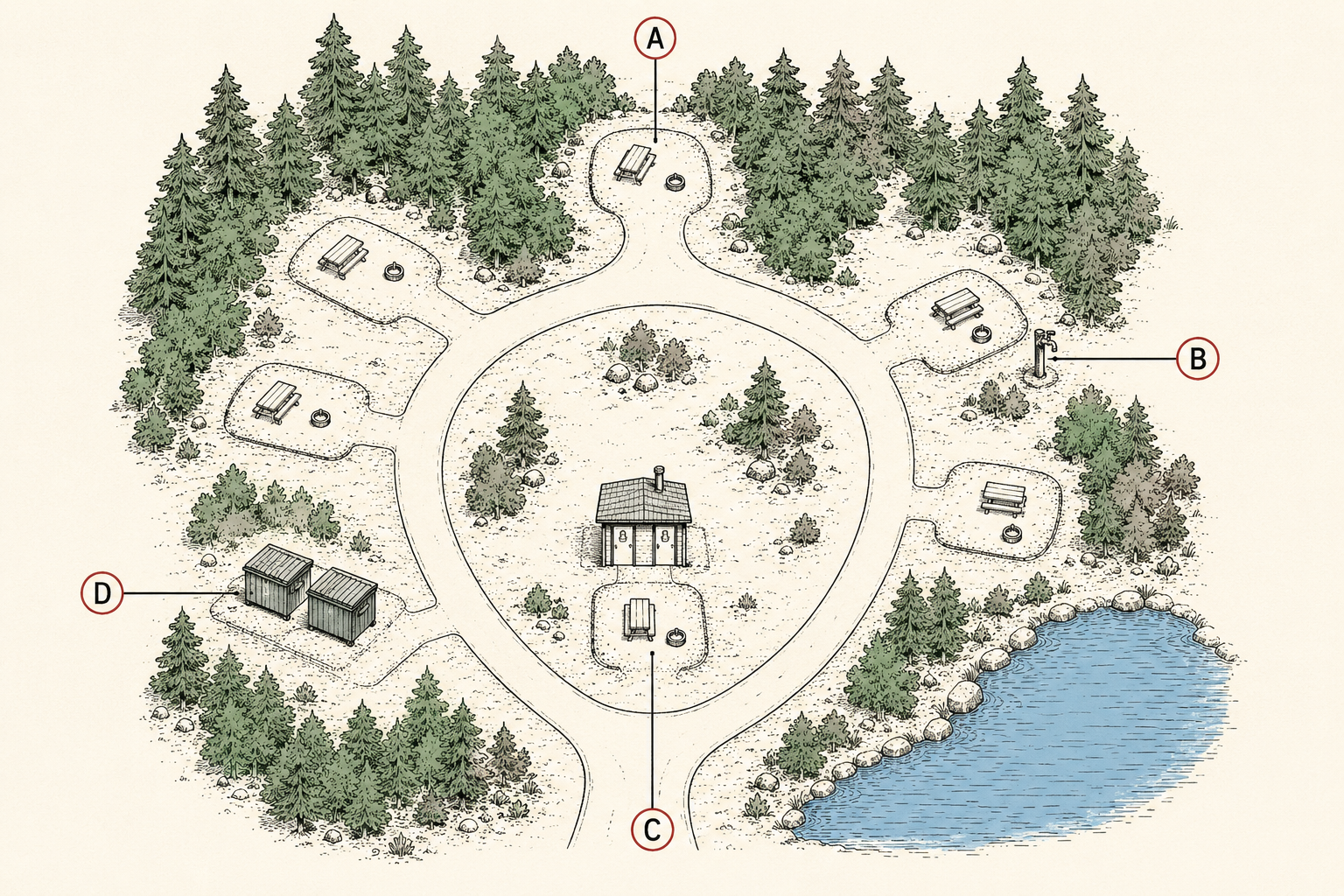
Create your accounts before you need them, with payment saved: one for Recreation.gov, one for your home state's parks. Half of losing a fast-moving site is fumbling a password at the release minute. And read the site details page before committing anywhere: pad length, shade, hookups, distance to toilets, and the reviewers' photos. Loop position matters more than campground name. A great campground's worst site backs onto the dumpsters.
The best apps for finding campsites
Use one review-rich finder plus the satellite view in your regular maps app. The Dyrt and Campendium lead for campground reviews and coverage; iOverlander and FreeRoam specialize in free and dispersed spots; Hipcamp lists private-land camping you won't find anywhere else.
Every one of these is a discovery layer, and the free tiers do everything a normal camper needs. What the reviews give you that official pages never will: whether the train runs behind the campground at 3 a.m., which loop floods, which sites have real shade, and whether "lakefront" means on the lake or within a highway's width of it. Three recent reviews tell you more than the amenities checklist ever will.
The satellite-view habit separates people who get good sites from people who get sites. Before booking site 14, look at it from above: tree cover, spacing from neighbors, distance to the toilet building (close is convenient, adjacent is fragrant). Two minutes of scrolling beats two nights of regret. This same habit graduates into scouting dispersed sites later, so build it now.
Booking a high-demand campground
Winning competitive reservations takes three tactics in order: know the exact release date and hour for your target dates, be logged in with the site already in a favorites list, and book the instant the window opens. If you miss, switch to cancellation hunting, which works far more often than people expect.
The release-minute game is straightforward preparation. Look up the campground's booking window and release time, set an alarm for five minutes early, log in, have two backup site numbers chosen from the map, and don't comparison-shop at 10:00:15. The first decent site you can hold, hold. You can swap later if something better frees up.
Cancellation hunting is the underrated half of the system. Plans collapse constantly, and every collapse puts a site back into inventory; the two biggest waves come right after cancellation-penalty deadlines (commonly 2–14 days out) and the evening before arrival. Finder apps and dedicated scanner services will watch a booked-full campground and alert you the moment anything opens. A canceled site Tuesday night for a Friday arrival is a normal event, not a miracle. Set the alert and pack anyway.
Permit lotteries and timed entry
A handful of marquee destinations meter demand with lotteries (applied months ahead) or timed-entry vehicle reservations (day-of or season releases). If your dream trip touches one of these, the application calendar becomes part of trip planning, sometimes half a year out.
The mechanics vary by park and change year to year, which is the point to respect: the rules that governed a friend's trip two summers ago may simply be gone. Before planning around any famous name, open the park's official site and read its current "plan your visit" page for the words "lottery," "timed entry," or "permit required".
Two pieces of standing advice survive the annual rule churn. First, lotteries are cheap to enter and the odds beat their reputation, especially for weekday dates and shoulder season; apply, then plan a backup as if you lost. Second, timed entry usually governs the gate, not the campground: a campground reservation inside a park often covers or replaces the entry reservation. Read your confirmation email's fine print; that sentence is in there.
Walk-up and first-come sites: the timing game
First-come, first-served campgrounds reward timing over refreshing: arrive mid-morning on a weekday, or 9–11 a.m. on Sunday, when the checkout wave frees sites. Friday afternoon is the worst possible arrival, and holiday weekends barely have a best one.
The Sunday-morning trick alone is worth this section. Weekenders clear out before checkout, which means a campground that was full at 8 a.m. often has a dozen open sites by 10:30. If your schedule allows Sunday-to-Tuesday camping, you'll live like reservation royalty without ever booking anything. Mid-week works the same way at three-quarters strength.
Have a plan B and C in the same drainage before you commit to any first-come target, because "full" is an answer you can't argue with. Rangers at the entrance station usually know which nearby campgrounds still have space, and asking them beats guessing. One more etiquette line, because it causes genuine fights: an empty site with a token on the post or a chair on the pad is claimed. Occupying gear is how first-come campers hold sites through a supply run, and pulling someone's marker is the campground version of keying a car.
Campground or dispersed: which do you want?
A campground trades money for infrastructure: toilets, water, a graded pad, neighbors, and a reservation you can count on. Dispersed camping on national forest or BLM land trades all of that away for free, solitary, unstructured nights. Neither is the upgrade; they're different products.
| Established campground | Dispersed site | |
|---|---|---|
| Cost | Nightly fee | Free |
| Toilets, water, table | Usually | None; bring everything |
| Certainty | Reservable | First-come, unmarked |
| Neighbors | Guaranteed | Rare |
| Best for | First trips, families, big groups | Solitude, flexibility, budget |
| Skills assumed | Chapter 2 | Parts V–VII, honestly |
The honest recommendation: campgrounds for your first several trips, dispersed once camp operations (water, waste, food storage, fire judgment) run on autopilot. Dispersed camping with campground-level skills isn't dangerous so much as it's uncomfortable in ways that teach the wrong lesson. When there's no spigot, no toilet, and no ring, the infrastructure you didn't bring becomes your evening.
Finding dispersed sites
Legal dispersed sites are found with three tools: the national forest's Motor Vehicle Use Map (MVUM, free, shows every road where camping is allowed), a crowd-sourced app like iOverlander or FreeRoam for known spots, and satellite view to scout the specific pull-off. Look for existing bare-ground sites with a used fire ring; using them concentrates impact.
The MVUM is the legal backbone and the least-known of the three. Every national forest publishes one (paper, PDF, and in the free Avenza Maps app with GPS positioning), and it answers the only question that matters: is camping allowed along this road? Rules of thumb that hold across most forests: camp within a vehicle-length of designated routes, at least 100–200 feet from water (the specific district sets the number), never in meadows, and respect posted no-camping corridors near trailheads and lakes. Chapter 5 covers the full rulebook.
Scout with daylight arithmetic. Dispersed sites take longer to find than any app suggests: the pin that looked flat is sloped, occupied, or gated, and the next candidate is 20 minutes on. Start hunting with at least two hours of light, and take the first acceptable site after the halfway point of your light budget. The perfect bench above the creek isn't worth pitching blind at 9:40.
Private options: Hipcamp, club networks, and the farm stay
Private-land camping fills the gaps public inventory leaves: Hipcamp and its competitors list farm fields, vineyard corners, and ranch creeksides by the night, while membership networks (Harvest Hosts, Boondockers Welcome, and similar) trade an annual fee for stays at businesses and driveways, mostly serving RVs.
Hipcamp works like lodging rental: real photos, host reviews, instant booking, and wildly variable products, from a mowed field with a portable toilet to canvas tents with beds. For sold-out weekends near popular parks, it's often the release valve, and for nervous first-timers a host on the property is a feature, not a compromise. Read what's included carefully; "campsite" can mean anything from full facilities to literally a field.
Don't sleep on the humble commercial campground either, the KOA-style operation with hookups, showers, and a camp store. Camping purists roll their eyes, and the sites are close-packed, but hot showers and a pool have salvaged more family trips than scenery ever has. It's also the standard answer for the night before a big park entrance: cheap staging, easy late arrival.
Trailhead Takeaways
- Search wide with an app (The Dyrt, Campendium, Hipcamp); book at the source (Recreation.gov, your state's system).
- Most federal campgrounds open six months out, rolling daily, at a fixed morning release time. Know your release date; be logged in.
- Missed it? Hunt cancellations. The waves hit after penalty deadlines and the evening before arrival. Alerts do the watching.
- Read reviews and satellite view before choosing a site number. Loop position beats campground name.
- First-come sites are a timing game: weekday mid-morning or Sunday 9–11 a.m., never Friday afternoon.
- Dispersed camping is free and glorious and assumes skills. MVUM for legality, apps for candidates, satellite for scouting, daylight for margin.
Where Trips Go Sideways
- Treating the finder app as the booking system. The Dyrt review was five stars, the family arrives, and the reservation exists only as a screenshot of a search result. If money didn't change hands with the actual land manager or host, nothing is booked.
- Booking blind at a "great campground." Site 41 turned out to be a sloped gravel wedge between the toilets and the RV generator row. Two minutes of satellite view and one review photo would have said so. The campground's name tells you nothing about your hundred square feet of it.
- Showing up Friday at 5 p.m. to a first-come campground in July. Full at noon, full at five, full at eight, and now it's dark and the backup plan is a trailhead parking lot. First-come is a morning game with a plan B.
- Skipping the fine print on fees and gates. Extra-vehicle fees, day-use parking, a gate locked at 10 p.m., a 14-day stay limit: all in the details page nobody read. The details page is two minutes long. Read it in line for coffee.
- Scouting dispersed sites at dusk. Every pin is somehow occupied, sloped, or behind a locked gate, and the "twenty-minute" hunt is now its second hour in failing light. Two hours of daylight minimum, and take the first good-enough site past halfway.
Frequently asked
What is the best way to find campgrounds?
Run two layers: a review app for discovery (The Dyrt and Campendium have the deepest coverage) and the official reservation system for booking (Recreation.gov federally, plus your state's park system). Add satellite view before you pick a specific site. Discovery tells you what exists; the source system is the only place a reservation is real. Keep a shortlist of proven close-to-home campgrounds too; repeats beat research.
What is the best app for finding campsites?
For reviewed campgrounds, The Dyrt or Campendium. For free dispersed spots, iOverlander or FreeRoam. For private land, Hipcamp. Most campers need exactly one from the first group plus satellite view; add the dispersed apps when your skills outgrow campgrounds. Free tiers cover normal use.
What is the 200 rule for camping?
Camp, wash, and dig catholes at least 200 feet (about 70 adult paces) from lakes, streams, and springs. The distance keeps soap, waste, and trampling out of the water that everyone downstream, human and otherwise, depends on. Some districts post different setbacks for vehicles; the posted number wins.
How far in advance should I book a campsite?
For famous destinations in summer: the morning the window opens, often six months out. For ordinary state parks: 2–6 weeks ahead for weekends, less for weeknights. For shoulder season: days. When you miss a window, cancellation alerts routinely recover sold-out weekends.