Part IV · Dressing for Outside
Why Does My Rain Jacket Wet Out?
When the Sky Opens
What rain jacket do you need for camping and hiking?
For most campers: a mid-tier waterproof-breathable shell (2.5- or 3-layer construction, around 10,000 mm waterproof rating or better) with an adjustable hood, pit zips, and room for a fleece underneath. Spend enough to get taped seams and real adjustability; past the mid-tier you're buying grams and fashion.
The rain jacket carries more mythology than any other garment, so this chapter's job is mostly translation: what the membrane actually does, why a "waterproof" jacket seems to leak when it's dirty, and which features change wet days versus which decorate spec sheets. The one-sentence summary of all of it: a rain shell is a system of membrane, coating, and care, and most "failed" jackets are just overdue for the wash this chapter ends with.
Budget candor up front: the $40 "rain resistant" windbreaker is not this garment, and the $500 alpine shell is this garment with a mortgage. The honest middle, where nearly everyone should shop, runs roughly $100–250.
How waterproof-breathable actually works
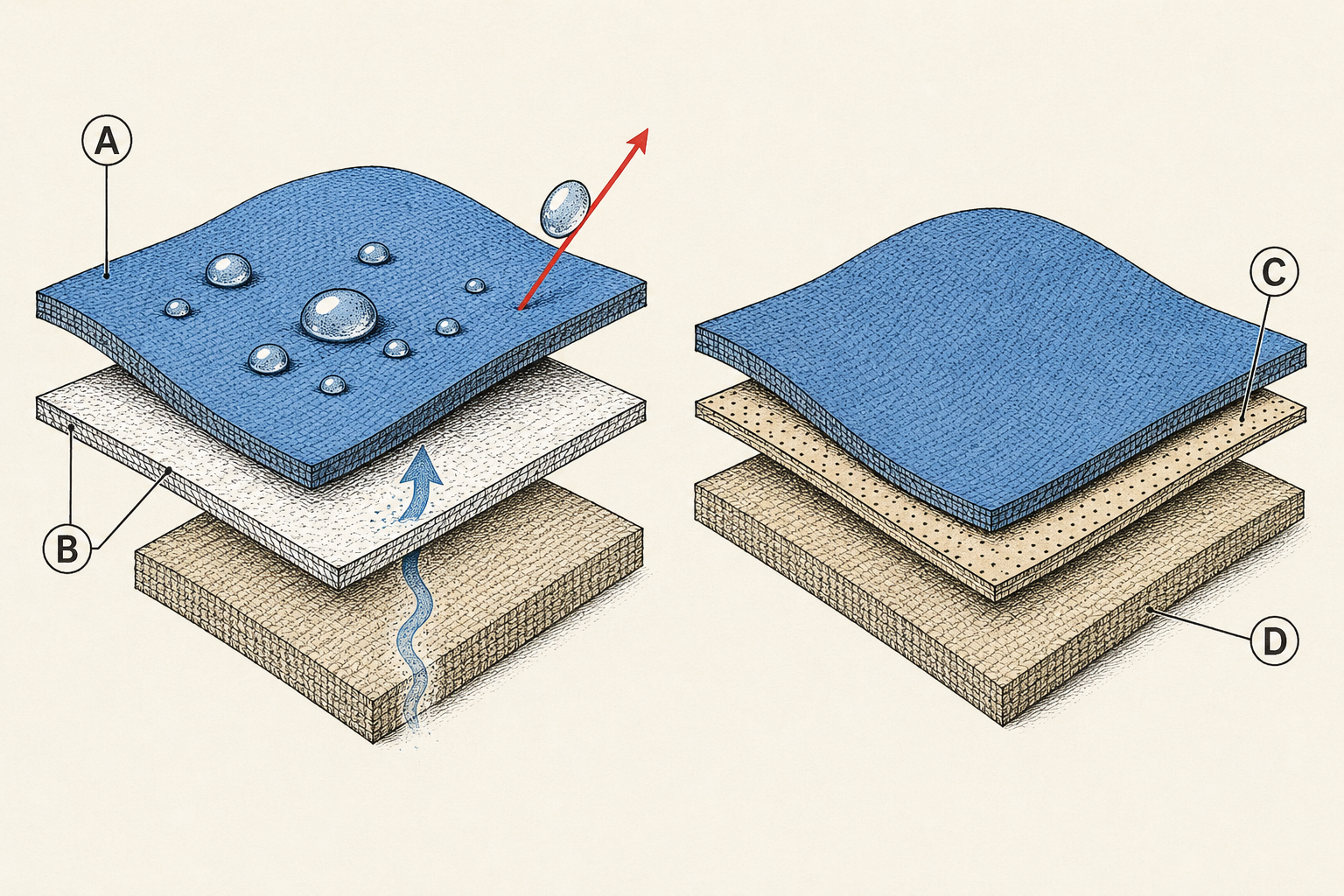
A waterproof-breathable fabric is a membrane (or coating) full of pores large enough for water vapor molecules to escape but far too small for liquid water drops to enter, laminated inside a face fabric. Rain stays out while some of your sweat steams through. The numbers on the tag: waterproofness in millimeters of water column (10,000 mm handles sustained rain; 20,000+ handles wind-driven storms) and breathability ratings that matter less than the pit zips.
The word "some" above is the honest one, and it sets real expectations: no membrane vents as fast as a working body sweats. Climb hard in a sealed shell in mild temps and you'll wet out from the inside, membrane or no membrane, which is why venting features and pacing (later section) do as much as chemistry. Breathable means "less of a plastic bag," never "not a bag."
The membrane also only breathes when its outer face sheds water, which brings us to the most misunderstood part of the whole system: DWR, and the wet-out phenomenon that sends thousands of working jackets to landfills annually.
Wet-out: the leak that isn't
When a rain jacket's face fabric darkens and soaks flat in rain, the jacket has "wet out": the factory DWR (durable water repellent) coating has worn off, water sheets against the membrane instead of beading off, breathability drops to zero, and the clammy interior convinces the owner the jacket "leaks." It almost never leaks. It needs to be washed and re-treated, per the routine at this chapter's end.
The physics of the misdiagnosis: the membrane still blocks liquid water fine, but a water-sheeted face fabric can't pass vapor, so your sweat condenses inside, and wet-from-within feels identical to wet-from-without at mile four. Meanwhile the saturated face fabric conducts heat away and the jacket hangs heavy and cold. Every symptom says leak; the cause is a $12 bottle of DWR treatment and a dryer cycle. That's the whole cure.
Dirt and body oils accelerate DWR death (they're wicking bridges through the coating), which produces the counterintuitive care rule: washing your rain jacket regularly makes it more waterproof-feeling, not less. The jacket that's never been washed in three seasons isn't well-preserved; it's clogged.
Construction: 2, 2.5, or 3 layers
The layer number describes how the membrane is protected: 2-layer (membrane glued to the face, loose liner hung inside; heavier, cheaper, fine for camp), 2.5-layer (a printed protective film inside; the lightweight value class most hikers should buy), and 3-layer (a bonded interior fabric; durable, quiet, expensive, for heavy use). The differences are durability and feel, never waterproofness.
Practical translation: the 2.5-layer shell is the daypack resident (light, packable, half the 3-layer price, with a slightly clammy interior feel its price forgives), while the 3-layer earns its cost for people who wear a shell many days a month, bushwhack, or carry packs that abrade shoulders. The 2-layer with its hanging liner is the campground-and-town coat: comfortable, bulky, and wrong for a pack. Packs want 2.5.
Features that earn their price
Five features change wet days: an adjustable, brimmed hood that turns with your head; pit zips (the venting that actually works); a hem drawcord and cuff tabs (seal or vent at will); pockets set above a hipbelt line; and a two-way front zipper on longer cuts. Features that mostly decorate: "storm flaps" over modern water-resistant zips, wired brims on non-alpine jackets, and any lining marketed as a technology.
The hood is where cheap jackets die and good ones earn devotion: it needs a real brim (rain off the glasses), cinches that track head-turns (a hood you look into the side of is a blindfold), and helmet compatibility only if you'll ever wear one. Test in the store: hood up, cinched, look hard left and right; if the hood stays put and vision stays clear, the jacket's serious.
Pit zips address the breathability ceiling honestly: two zippers dump more heat and vapor in a minute than the membrane manages in an hour, converting the shell from sauna to wearable across the whole effort range. For anyone who hikes hard, they're the single feature worth paying up for. Sizing completes the feature list: buy roomy enough for the fleece and puffy beneath (bring them to the fitting), because a shell that compresses your mid-layers is stealing warmth to look trim.
Ponchos, umbrellas, and the cheap seats
The alternatives deserve honest grades. Ponchos: superb ventilation, cover the pack too, flap violently in wind, snag brush; grade B+ for still-air climates and budget kits, D in wind. Hiking umbrellas: genuinely excellent in warm steady rain and fierce sun (the desert crowd knows), useless in wind and bushwhack; a niche A. The $25 PVC rain suit: zero breathability, total waterproofness, perfectly rational for a canoe or a soccer sideline; C+ for hikers, who will marinate. The emergency poncho in the Chapter 12 pack: not rain gear, a contingency; it has one job and one use in it.
The system answer for a family outfitting on a budget: real 2.5-layer shells for the adults who'll hike in weather, ponchos or budget shells for growing kids (Chapter 51 sizes the tradeoff), and the umbrella in the car for campground errands, where it's frankly the best tool anyone brought.
Rain pants ride the same logic one notch cheaper: a basic pair with ankle zips (on-and-off over boots is the whole game) covers shoulder-season camping; full side zips and 3-layer builds are for people who live in shells. Below 60°F and wet, rain pants stop being optional gear and start being the difference between a damp day and a cold one; Chapter 23's shell-for-legs paragraph was the preview.
Working in the rain: technique beats fabric
A shell keeps rain out; staying comfortable in one is technique. Vent early and often (pit zips open before the climb, hood down between squalls, cuffs loose until wind says otherwise), pace below the sweat line (the shell halves your body's cooling; slow down accordingly), and layer light underneath (base plus fleece, almost never the puffy, which the shell will steam).
The transitions are where wet days are won: shell on at the first real rain rather than after the fleece is damp, shell off (and shaken, and stuffed in the outside pocket) the minute the sky settles, ten times a day if that's the weather. Wet-day pack strategy rides along: the shell lives in the pack's most reachable spot (Chapter 11 assigned it), and everything that must stay dry (the puffy, the sleep set) lives in an actual dry bag or a nested trash liner, because pack fabric wets through in sustained rain no matter its rating.
Camp-in-rain notes complete the picture: the tarp (Chapter 8) is the rain kitchen and rain living room; the shell handles transit between shelters; and wet shells dry overnight hung under the tarp, never sealed in the tent, where their moisture joins the condensation budget (Chapter 31's problem).
The wash-and-restore routine
Twice a season for regular use (or whenever water stops beading): machine-wash the shell with technical cleaner, then heat-reactivate the DWR in a dryer on low for 20 minutes, and when beading still fails, apply a spray-on or wash-in DWR and heat again. That routine resurrects nearly every "leaky" jacket for the price of the products.
- Zip everything closed, empty pockets, loosen cinches.
- Wash on gentle, warm, with technical cleaner (never household detergent or softener; both leave wicking residues), double rinse.
- Dry low, 20 minutes. Heat re-blooms the existing DWR. Test with sprinkled water: beading means done.
- Re-treat if needed: spray-on DWR to the clean damp face (even coat, wiped after) or wash-in per bottle, then the dryer again.
- Store dry, hung or loose, never stuffed long-term; sustained compression creases membranes.
Seam-tape peel and interior flaking (the 2.5-layer print wearing off) are age, not dirt; that jacket has served, and its next role is bike commutes. Everything short of that washes back to life, which most owners never learn, which keeps the jacket industry cheerful.
Trailhead Takeaways
- Buy the honest middle: 2.5-layer, ~10,000 mm or better, taped seams, real hood, pit zips, sized over your fleece.
- Membranes pass vapor, not miracles. Pit zips and pacing do what chemistry can't.
- A darkened, soaked face fabric is wet-out, not a leak: the DWR died. Wash, heat, re-treat, resurrect.
- Washing a rain jacket regularly improves it. The three-seasons-unwashed shell is clogged, not cherished.
- Layer count = durability and feel, not waterproofness. 2.5 for most, 3 for heavy users, 2 for the campground.
- Ponchos vent, umbrellas shine in niches, PVC suits belong in canoes. The emergency poncho is a contingency, once.
- Rain pants with ankle zips join the kit below 60°F-and-wet. Legs have limits too.
Where Trips Go Sideways
- The "leaking" jacket, replaced. Two hundred dollars re-spent on a shell whose predecessor needed a $12 wash-and-treat. Wet-out fools nearly everyone once. Now it can't fool you.
- Sealed shell, hard climb. Zipped to the chin at full effort in 55°F drizzle: soaked from inside by the saddle and cold at the top, with the fabric blamed. Pit zips open, pace down, hood back between squalls.
- The puffy under the shell on the move. The insulation meant for camp steamed like dumplings on the trail. Base and fleece hike; the puffy waits in its dry bag for the stop.
- Fitted slim, worn cold. The trim shell that looked sharp over a T-shirt in the store crushed every layer beneath it in October and delivered style at the price of loft. Bring the fleece and puffy to the fitting.
- Detergent and softener, twice a year. The care that killed the coating: household products leave wicking residues that drink water into the face fabric. Technical cleaner, low dryer, DWR when needed. The care tag was right all along.
Frequently asked
What's the difference between water-resistant and waterproof?
Water-resistant fabrics (windbreakers, soft shells) shed light drizzle briefly and soak through in real rain; waterproof-breathable shells carry a membrane rated in millimeters of water column (10,000+ for sustained rain) with taped seams. If the tag lists no rating and no taped seams, it's a windbreaker wearing rain-jacket marketing. The rating lives on a hangtag or the product page; stores rarely volunteer it.
Why does my rain jacket wet out?
The factory DWR coating wore off, so water sheets against the face fabric instead of beading away; the membrane still blocks rain, but breathability collapses and interior condensation feels like leaking. Dirt and body oils accelerate it. The fix is the wash-heat-retreat routine, not a new jacket.
Is a poncho better than a rain jacket?
In calm, warm rain: arguably, since it ventilates hugely and covers the pack. In wind, brush, or serious weather it flaps, snags, and channels rain sideways. Most campers want the shell as the primary and grant the poncho its niche; growing kids and tight budgets flip that honestly.
How often should you wash a rain jacket?
Every 10–15 hard wears, or twice a season, or immediately whenever water stops beading on the face: gentle cycle, technical cleaner, 20 minutes in a low dryer, DWR re-treatment when heat alone doesn't restore beading. Regular washing extends membrane life; avoidance is what actually wears jackets out.