Part V · Getting There and Making Camp
How to Start a Fire With Wet Wood
Fire, Built Right
How do you build a campfire?
Prepare all three fuel stages before striking anything (tinder that catches from a flame, pencil-thin kindling, then wrist-thick fuel), arrange them so flame climbs upward through air gaps (the teepee is the beginner's lay for good reason), light the tinder low and windward, and feed progressively as each stage commits. Fires fail from impatience and suffocation, almost never from bad luck.
The legality preamble, standing and short: current fire restrictions checked before every trip (Chapter 5), fires only in existing rings or legal setups (this chapter's dispersed section), and Chapter 33 owns the safety, ban, and extinguishing rules that frame everything here. This chapter is the craft, taught inside the law.
One framing before the technique: a campfire is an air machine. Every classic failure (the smoking pile, the log that won't catch, the fire that dies when fed) is an air-flow failure wearing a disguise. Hold "flame needs air from below and fuel above" in mind and the rest of the chapter is applications.
Fuel prep: the three stages, gathered first
Gather and stage everything before the first match: a double handful of tinder (dry pine needles, birch bark curls off the ground, shredded inner bark, dryer lint from home, or a purpose-made starter), a shoe-box volume of kindling in two sizes (pencil-thin and thumb-thick), and fuel wood split to wrist and forearm thickness. The count that prevents most failures: twice as much kindling as feels reasonable. Kindling shortage is the number-one fire killer, and it always announces itself at the worst moment, mid-catch.
Wood quality rules: dead, dry, and snappy (green wood hisses and smokes; punky rot smolders), standing or hanging deadwood over ground-soaked pieces where gathering is legal (many campgrounds prohibit gathering entirely; the camp-store bundle is the law-abiding default, bought local per the firewood rule), and split faces catch faster than bark (split the bundle's rounds if a hatchet or a batoning-sized knife is in the crate, or buy pre-split).
Species knowledge, the useful minimum: softwoods (pine, fir, spruce) light easily and burn fast with snap and spark, making them the starting wood; hardwoods (oak, hickory, maple, ash) light reluctantly and burn long to the dense coals Chapter 19 cooks on. The classic sequence uses both: softwood to establish, hardwood to sustain. Mixed camp-store bundles usually deliver exactly this by accident.
The lays: three shapes cover everything
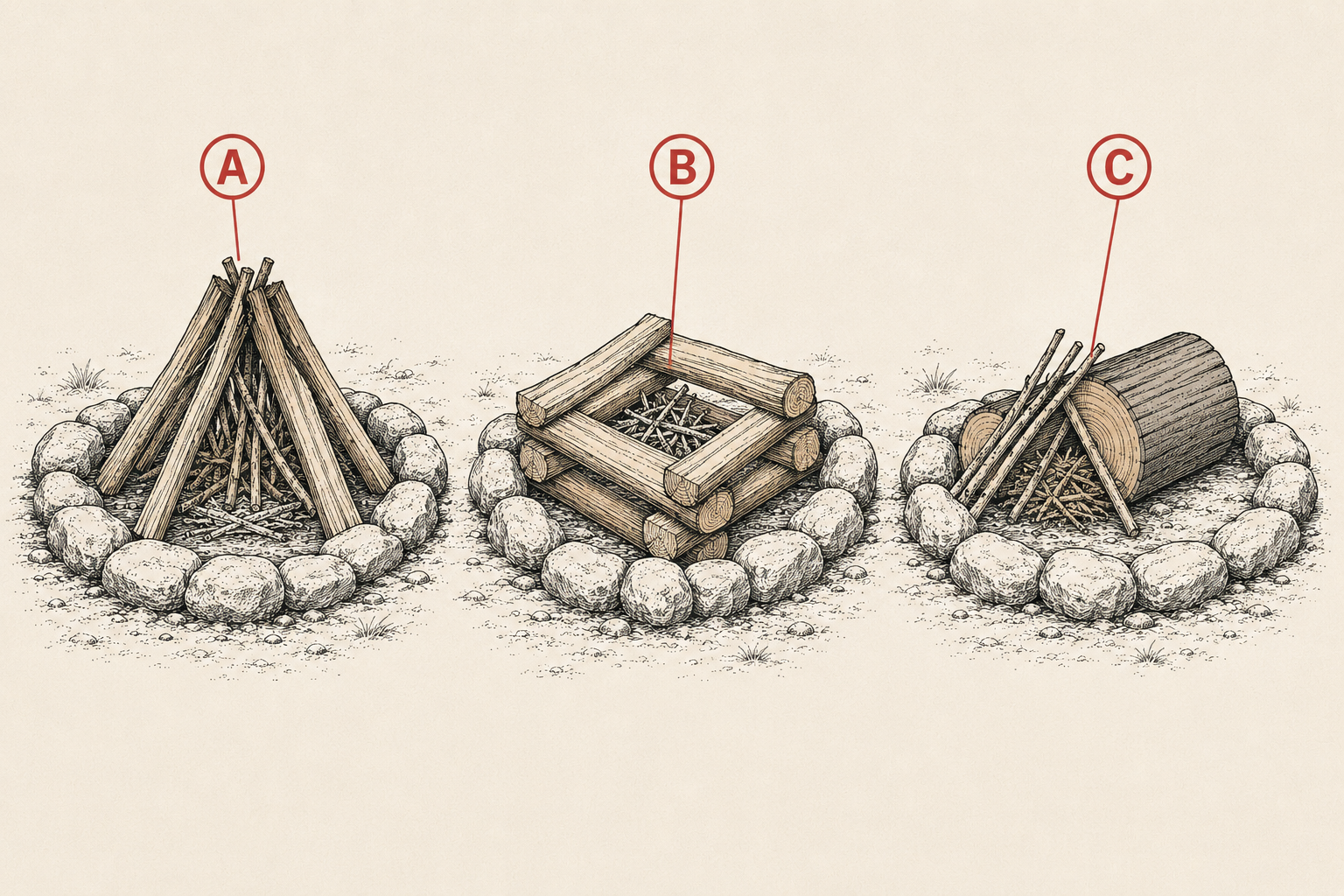
The teepee (tinder at center, kindling leaned into a cone around it, fuel teepeed outside that) is the starting lay: it self-feeds as flame climbs, breathes from below by design, and collapses into the beginnings of a coal bed. Its flaw is appetite; it burns fast and wants tending.
The log cabin (two parallel fuel logs, two crosswise on top, repeated into a low crib around a tinder-and-kindling core) is the cooking lay: stable, slower, air-fed through its gaps, and it burns down into the even coal bed the Dutch oven and grate were waiting for. Most camp cooks light a teepee inside a log cabin and let the first collapse into the second.
The lean-to (a thick log as windbreak, kindling leaned against its lee side over the tinder) is the weather lay: the log shields the infant flame from wind and rain while feeding it reflected heat. In gusts that would strip a teepee, the lean-to lights.
The upside-down (top-down) fire earns its honorable mention for camp evenings: big fuel flat on the bottom, layers shrinking upward to tinder on top, lit at the top so it burns down through itself. Slow, low-tend, long-burning, and clean; a favorite for the sit-around fire that nobody wants to manage.
Lighting: the one-match discipline
Light from below, windward side, flame to the tinder's base, and stay down there: the match or lighter holds until the tinder is unmistakably committed, and the first minute belongs entirely to protecting and feeding the infant flame with your smallest kindling, one piece at a time. The one-match standard isn't machismo; it's a diagnostic. A lay that needs five matches wasn't ready, and the fix is always prep, not more matches.
The feeding rhythm that separates keepers from smotherers: add the next size only when the current size is fully involved, lay pieces on (never drop; dropping crushes the air structure), and resist the bonfire instinct completely. Flames should build like an argument you're winning: steadily, with evidence. The classic beginner move (a fat log onto a two-minute-old flame) is the air machine unplugged; the flame chills against the cold mass and dies of suffocation under the thing meant to feed it.
Wind management at the light: body and gear as windbreaks, the lean-to lay when it's real, and the lighter's flame cupped low. A breeze that helps a committed fire kills an infant one; your job is to be the difference for ninety seconds.
Fire starters: cheap insurance, honest rankings
Purpose-made starters turn bad conditions into minor ones, and the homemade versions cost pennies: cotton balls worked with petroleum jelly (five minutes of burn from each, waterproof-ish in a zip bag, the classic), dryer lint packed in cardboard egg-cup cells with wax poured over (each cell burns 8–10 minutes), or the commercial cubes and tabs that do the same with receipts. One or two starters plus the lighter beats a whole survival-store aisle.
The ferro rod gets its honest paragraph: a ferrocerium rod showers hot sparks in any weather, never runs out at the worst moment, and lights properly prepared tinder well, and it's a skill toy for most campers rather than a primary tool. Carry it as the fun backup it is (kids love earning ferro-rod privileges under supervision), and keep the boring redundancy that actually matters: a lighter in the crate, a lighter in the pocket, stormproof matches in the Chapter 12 pack.
Wet-weather fire craft compresses to three moves: find dry wood inside wood (split rounds are dry at the heart; standing dead branches under conifer canopies stay lightable in rain), make more surface area (feather sticks: curl shavings up a dry stick's length with a knife, stopping short so they stay attached; a batch of these is kindling insurance), and double the starter dose. Rain fires are prep fires; the flame itself lights the same way.
Managing the fire you built
A managed fire is small, fed on schedule, and never left: flames knee-high for cooking and conversation (Chapter 2's doctrine, still true), fresh wood added before the fire needs rescue rather than after, coals raked to the Chapter 19 cooking zone as they form, and one adult always effectively on duty while anything glows. Wind rising means the fire shrinks or ends; embers travel, and Chapter 33 inherits everything that happens next.
The social physics worth knowing: fires draw chairs inward all evening, so the ring's perimeter gets re-established for kids (a stick-drawn line or "one giant step back" radius) before marshmallows deploy, and the walking path stays on the non-fire side of the circle. Smoke chasing you around the ring is real and mostly solvable: smoke follows the pressure shadow of bodies and windbreaks, so the seat directly opposite the wind stays clearest, and "white man's fire" jokes aside, a smaller fire smokes less because it burns hotter and cleaner.
Feeding etiquette for groups: one fire manager per evening (rotating the honor beats committee management), everyone else requests rather than tosses, and bottle caps, foil, and trash stay out of the ring absolutely (they don't burn, they linger for the next decade of campers, and Chapter 60 will find them).
Dispersed fires: mound, pan, and the leave-no-trace versions
Where fires are legal outside established rings, the responsible formats are the fire pan (any metal pan or purpose-made model with sides, elevated on rocks, ashes packed out; river and desert country's standard) and the mound fire (a 6–8 inch platform of mineral soil laid on a ground cloth, fire built on the mound, everything dispersed and naturalized after). Both exist to deny the fire contact with soil, roots, and the organic layer, which scars for decades and can smolder underground for days.
The existing-ring rule from Chapter 5 does most dispersed fire ethics for you: where a ring exists, use it rather than building new; where none exists, ask whether tonight actually needs a fire (the stove cooks, the puffy warms, the stars entertain) before engineering one. When you do build: mineral soil or rock base, well clear of duff and roots, modest size, and the site returned to anonymous by morning, ashes cold-crushed and scattered, rocks returned, mound dispersed.
This is also where the fire-pan-as-gift observation belongs: a cheap steel oil-drain pan in the car kit makes legal, ethical fire possible at countless dispersed sites while containing every trace. Ten dollars, lifetime service.
Trailhead Takeaways
- Fires are air machines. Every failure is an air failure: crushed gaps, cold mass, smothered flame.
- Prep before striking: tinder, double the kindling you think, fuel split to wrist size, all staged.
- Teepee to start, log cabin for cooking coals, lean-to in weather, top-down for the long lazy evening.
- One-match discipline: light low and windward, protect the infant flame, feed one size at a time, on, never dropped.
- Starters are pennies: jelly cotton balls, wax-lint cells. Ferro rods are the fun backup, lighters the real one.
- Wet wood is dry inside: split it, feather it, double the starter.
- No accelerants. Not once, not a splash, not ever.
- Dispersed: existing rings first, else pan or mound on mineral soil, gone without trace by morning.
Where Trips Go Sideways
- The single-log bonfire dream. One fat round balanced over a fistful of tinder, five matches, and a verdict of "wet wood." The wood was fine. The three stages weren't there, and the air had nowhere to work.
- Kindling bankruptcy at minute two. The tinder caught beautifully and died waiting for pencil-wood someone was off snapping in the dark. Stage everything first. The fire has no pause button.
- The victory log. Flame established for ninety seconds, rewarded with a forearm-thick log dropped from height: structure crushed, air gone, fire out, physics blamed. Feed the size that's burning, lay it on, wait.
- Squeeze-bottle courage. A struggling fire, a splash of camp fuel, and a flash that took eyebrows and could have taken more. The prep was missing; the accelerant was never the answer. Rebuild instead, every time.
- The trash-fed fire. Foil, caps, and a plastic wrapper "just this once": half-melted archaeology for the next decade of campers, and smoke nobody should breathe. The ring burns wood. The trash bag is eight feet away.
Frequently asked
What is the best formation for a campfire?
Match the lay to the job: teepee to get flame established fast (it self-feeds as fire climbs), log cabin for cooking (it burns down to an even coal bed), lean-to when wind or rain threatens the start, and top-down for a long, low-maintenance evening fire. Most nights use two: a teepee start inside a log cabin, so the fast starter collapses into the steady cooker without anyone rebuilding anything mid-evening.
What type of wood is best for a campfire?
Both kinds, in order: dry softwood (pine, fir) to light and establish, dense hardwood (oak, hickory, maple) for lasting heat and cooking coals. Everything dead, dry, and snappy; nothing green or rotten. Buy bundles near the campground per the move-no-firewood rule, and split faces light faster than bark.
Are snakes attracted to campfires?
No; if anything, the heat, vibration, and activity push snakes away. The snake stories around fire rings come from rock piles and woodpiles nearby, which are legitimate snake real estate. Stack firewood a bit away from seating, wear shoes on night trips to the woodpile, and the fire itself is a snake repellent, not a lure.
How do you start a fire with wet wood?
Find the dry wood hiding inside: split rounds expose dry hearts, standing dead branches under conifer canopies stay lightable, and feather sticks multiply surface area on any dry core. Double your tinder and starter dose, build the lean-to lay behind a windbreak, and give the infant flame twice the small-kindling patience.