Part IX · Further: Seasons and Styles
What Size Snowshoes Do I Need?
Walking on Water (Frozen)
How do you start snowshoeing?
Rent snowshoes sized to your total weight (body plus pack), add poles with snow baskets, dress by Chapter 55's vapor discipline, and walk: snowshoeing's entire learning curve is twenty minutes of wide-stance adjustment, which is why it's winter's on-ramp sport and the camping family's route to the quiet season. If you can walk, you can snowshoe: the slogan is honest, and the details below are refinements, not prerequisites.
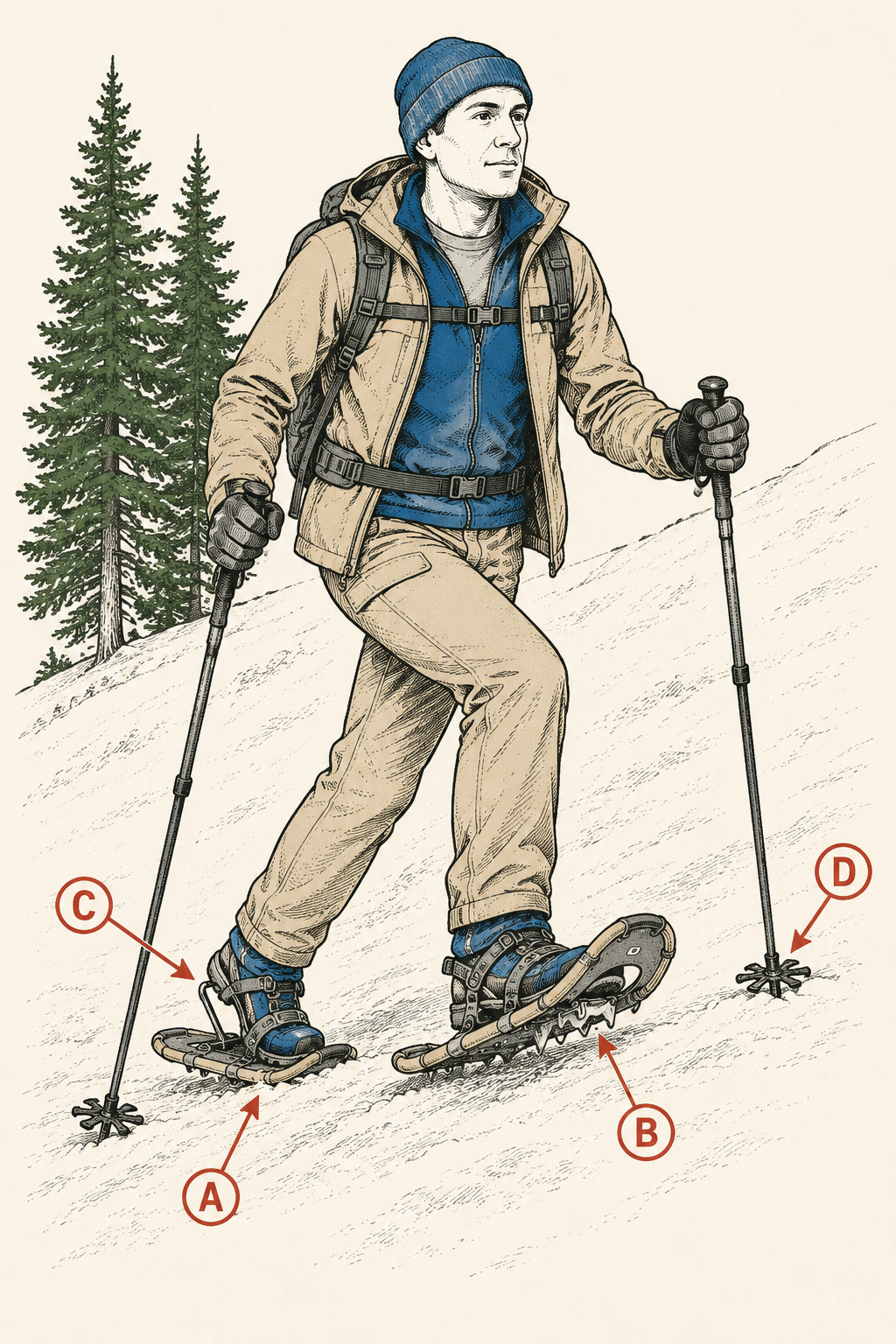
What snowshoes actually do, so the sizing makes sense: they spread your weight across enough surface area that you float on (or near) the snow's surface instead of postholing thigh-deep with every step, which converts unpacked winter terrain from an exhausting wade into a walk. Flotation scales with area, area is sized to load, and everything else on a modern snowshoe (traction crampons underfoot, bindings, heel lifts) is supporting hardware.
The trip context: snowshoes are how Chapter 55's camps get reached when snow is deeper than boots, how winter day hikes happen from plowed trailheads, and how the campground's summer trail network reopens in January, empty and remade. Rent first (every ski shop and many ranger stations), buy after the third trip proves the habit.
Gear: sizing, bindings, poles
Sizing runs on total load: body weight plus everything carried, matched to the maker's chart, with the snow-type footnote that matters: powder country wants bigger (more flotation), packed-trail and wet-snow country gets away with smaller (more maneuverability). The classic beginner error is sizing to body weight alone and then adding a 30-pound winter pack; the chart's number is the loaded number. Kids' models size the same way and run happily cheap; the growth-spurt economics favor renting until feet stop moving.
Bindings are the fit point that decides comfort: they wrap your regular insulated winter boots (snowshoes need no special footwear: half their charm), and the shop test is torsion (crank the strapped shoe side to side: the boot shouldn't slop) plus glove operation (buckles and ratchets you can work in mitts, because you'll be adjusting at 15°F, not in the store). Traction comes standard on modern shoes (crampon points under the ball and heel) and matters most on the packed-and-icy trails where flotation matters least: it's the feature that makes snowshoes useful even in shallow-snow country.
Poles with snow baskets (the wide disks that keep pole tips from spearing through) complete the kit: Chapter 39's trekking poles accept swap-on winter baskets, sized per the same 90-degree elbow, lengthened slightly for deep snow. They're balance, rhythm, and the get-up lever after falls, and they're not optional for beginners in any honest accounting.
Heel lifts (televators): the flip-up bars under the heel that reduce calf strain on sustained climbs: flip them up when the slope tilts, down on the flats, and thank whoever invented them at the top.
Technique: the twenty-minute curriculum
The stance: slightly wider than your normal walk (the frames need clearance; the first ten minutes of stepping on your own shoes is the entire hazing ritual), with a normal rolling gait otherwise: no exaggerated lifting, no duck walk. Turning: wide arcs where space allows; the kick turn where it doesn't (poles planted for stability, lift and pivot one shoe 90-plus degrees, commit, bring the second around: practice it on the flat once and own it forever).
Uphill: shorten the stride, kick the toe crampon into the slope on firm snow, flip the televators, and traverse (switchback) anything steep rather than assaulting the fall line: Chapter 39's rest-step rhythm transfers whole. Downhill: slight sit-back posture, heels engaged, poles ahead, and small steps: the crampons grip more than instinct expects, and the undignified-but-effective glissade-on-the-shoes (a controlled shuffle-slide) handles short steep bits. Deep powder: the lead position is real work (breaking trail costs double; rotate leaders on a schedule per Chapter 39's group logic), and the rhythm is patience: powder pace is its own gear.
Falling and rising, taught because everyone falls in powder and the getting-up defeats the untaught: roll to face uphill, shoes downhill and beneath you, cross poles into an X planted in the snow, and push up on the X (or crawl to any tree or firm patch). In deep powder without the pole trick, swimming motions to pack a platform first. It's five practice seconds in the yard and it saves the comedy from becoming exhaustion.
Skis or snowshoes: the honest decision
| Snowshoes | XC / backcountry skis | |
|---|---|---|
| Learning curve | Twenty minutes | Seasons |
| Cost of entry | Low (rentals everywhere) | Moderate to high |
| Terrain flexibility | Everything walkable | Wants suitable snow and grades |
| Speed on the flat | Walking pace | Two to three times faster |
| Downhill | Controlled plod | The entire point (and the risk) |
| With a heavy pack | Stable, boring, reliable | Advanced skill |
| Best fit | Access, family trips, dense forest | Distance, open terrain, grace |
The honest translation: snowshoes are transportation; skis are a sport that also transports. For the camping use case (getting a family and its gear to a winter camp, walking the summer trails in January, following the dog around the meadow) snowshoes win on every axis that isn't speed and joy-of-motion. Cross-country skis win the groomed-track day outing and the rolling-terrain tour for anyone willing to invest the seasons; backcountry ski setups are a deep and expensive craft this book waves at respectfully from the flats.
The hybrid reality most winter families reach: snowshoes as the household default (everyone can, immediately, including the seven-year-old and the grandparent), skis as the enthusiast's parallel track, and the trip planned to the slower mode per Chapter 39's weakest-hiker doctrine.
Winter pace math and route planning
Chapter 39's formula gets its winter coefficients: packed trail on snowshoes ≈ summer pace minus a third; breaking trail in powder ≈ half pace or slower, with the lead rotating; and the daylight budget runs Chapter 55's short-day arithmetic (a 4:45 sunset makes a 10 a.m. start a half-day trip, and the turnaround time does not negotiate in winter: darkness plus cold stack consequences that summer doesn't). Energy math scales the same direction: snowshoeing burns meaningfully more than walking (the snack cadence tightens to Chapter 55's schedule), and water discipline holds despite the cold's thirst-muting.
Route selection, winter edition: summer trails under snow lose their tread but keep their corridors (blazes and cut lines read fine; junction signs may be buried: Chapter 42's track recorder and offline maps carry more weight in winter than any other season), meadows and frozen lakes tempt with easy travel and answer to the ice-thickness question (this book's line: no lake crossings without local knowledge and recent-cold confidence; the shoreline route costs twenty minutes and zero dread), and the avalanche line from Chapter 55 stands: gentle terrain, forecast read, training before ambition.
The trip plan (Chapter 39) upgrades to winter weight: routes and turnaround shared, the messenger charged and warm (Chapter 38's cold-battery rule), and the bail criteria written with winter's multipliers, because a sprained ankle at 20°F is a different document than the same ankle in July.
Track etiquette and the shared winter
Winter trails carry a courtesy code worth knowing before the first outing: never walk or snowshoe in ski tracks (the parallel grooves, machine-set or skier-made, are infrastructure: postholes and snowshoe crush ruin them for everyone behind; snowshoers travel beside the track or on the designated side), downhill traffic has the right of way on shared slopes (they can't stop as easily), fill your postholes' worst craters where you've sunk (the boot-only hiker's deep holes freeze into ankle traps: one more argument for flotation), and dogs on winter trails follow Chapter 54's rules plus the track rule (a dog trotting down the set track earns the same glare its owner would).
Groomed and fee areas (nordic centers, sno-parks with permits) post their own rules and are, honestly, the perfect first-outing venue: packed surfaces, marked loops, warming huts, rentals on site, and consequences a hot chocolate can fix. The progression from there runs: packed public trails, then broken backcountry routes, then Chapter 55's camps, each step adding margin-management rather than new technique.
Kids, dogs, and the family winter
Kids snowshoe younger than expected (four-year-olds manage short outings on kid shoes; the gear is cheap to rent and the falling is the fun), with the Chapter 51 coefficients doubled: half distance again, snack attractions at winter cadence, the cold-kid watch (Chapter 51's quiet-kid rule at winter stakes), and the sled as auxiliary transport (the classic pulk-lite: a kid who rides the flat sections hikes the fun ones cheerfully). The turnaround rule parents actually use: turn around while everyone's still having fun, which in winter means earlier than anyone requests.
Dogs love snow with two caveats from Chapter 54's regional-hazard logic: ice balls in paw fur (the between-toes trim and paw balm before the trip, booties for the susceptible; the limping stop-and-check is mandatory, not optional) and the energy burn (snow travel exhausts dogs faster than dirt; water and the turnaround apply to the four-legged column too). The stake-out and tent rules winter over unchanged.
The family payoff, stated once: the campground you love in July, under two feet of January snow, empty, silent, and yours: the same loops, the same lake, a different planet, reachable by a rental rack of snowshoes and one thermos. That trip converts more families to winter than any gear list ever has.
Trailhead Takeaways
- If you can walk, you can snowshoe: twenty minutes of wide-stance adjustment is the whole curve. Rent first, buy at trip three.
- Size to total load (body plus pack) on the maker's chart; bindings tested in gloves; poles with baskets non-negotiable.
- Uphill: toe crampons, televators, traverse. Downhill: sit back slightly, small steps. Falls: face uphill, X the poles, push up.
- Skis are a sport that transports; snowshoes are transportation. Families default to snowshoes and plan to the slower mode.
- Winter pace: packed trail = summer minus a third; breaking powder = half, leads rotating. Daylight budgets rule; turnarounds don't negotiate.
- Never travel in ski tracks. Downhill has right of way. Groomed areas are the perfect first venue.
- Kids from four-ish at doubled coefficients with sled backup; dogs with paw care and honest energy math.
- No lake crossings without local knowledge. The shoreline costs twenty minutes; the alternative costs more.
Where Trips Go Sideways
- Sized to the body, loaded like a mule. The chart said 25-inch shoes for 160 pounds; the winter pack added 35 more, and the "floating" was archaeological. The loaded number was always the number.
- The fall-line assault. Straight up the steep pitch in powder, ten steps of slipping per twenty taken, and the party gassed before the meadow. The traverse was longer on the map and half the cost on the legs.
- Postholes down the ski track. A snowshoe party walked the set tracks for a mile, and every skier behind them for a week said the same words. The etiquette is one sentence and it was posted at the trailhead.
- Summer pace math in January. Six miles planned at hiking speed met unbroken powder and a 4:45 sunset, and the headlamps came out with two miles left at 18°F. Winter's coefficients aren't suggestions; they're the trip.
- The dog's ice-ball limp, ignored. "He's fine, he loves snow" lasted until mile three, when the between-toes ice had done its work. The stop-and-check at the first limp was the whole fix, and the paw balm was in the car.
Frequently asked
Is snowshoeing hard for beginners?
No: it's walking with a slightly wider stance, learnable in twenty minutes on a packed trail. The real adjustments are winter's, not the snowshoes': Chapter 55's sweat discipline, tighter snack-and-water cadence, and daylight math. Rent at a nordic center for the first outing and the whole entry costs an afternoon, warming hut and hot chocolate included, which is the correct way to meet winter.
What size snowshoes do I need?
Size to your total load (body weight plus pack and clothing) on the manufacturer's chart, then adjust for snow: bigger for deep powder country, smaller for packed trails where maneuverability beats flotation. The classic error is sizing to body weight alone and then shouldering a winter pack.
Are skis or snowshoes better for winter camping?
Snowshoes for most campers: no learning curve, stable under heavy packs, cheap to rent, and at home in dense forest. Skis travel two to three times faster and are a joy that costs seasons to learn, especially loaded. Mixed groups plan to the slower mode, which is usually the snowshoes.
Can you snowshoe on any trail?
Any walkable summer trail becomes a snowshoe route, with three amendments: stay out of set ski tracks, respect the avalanche line on anything steep (gentle terrain without training), and treat frozen lake crossings as local-knowledge questions rather than shortcuts. Buried junction signs make Chapter 42's offline maps winter's best companion.