Part IV · Dressing for Outside
Trail Runners or Hiking Boots?
The Two Feet That Carry Everything
Should you wear hiking boots or trail runners?
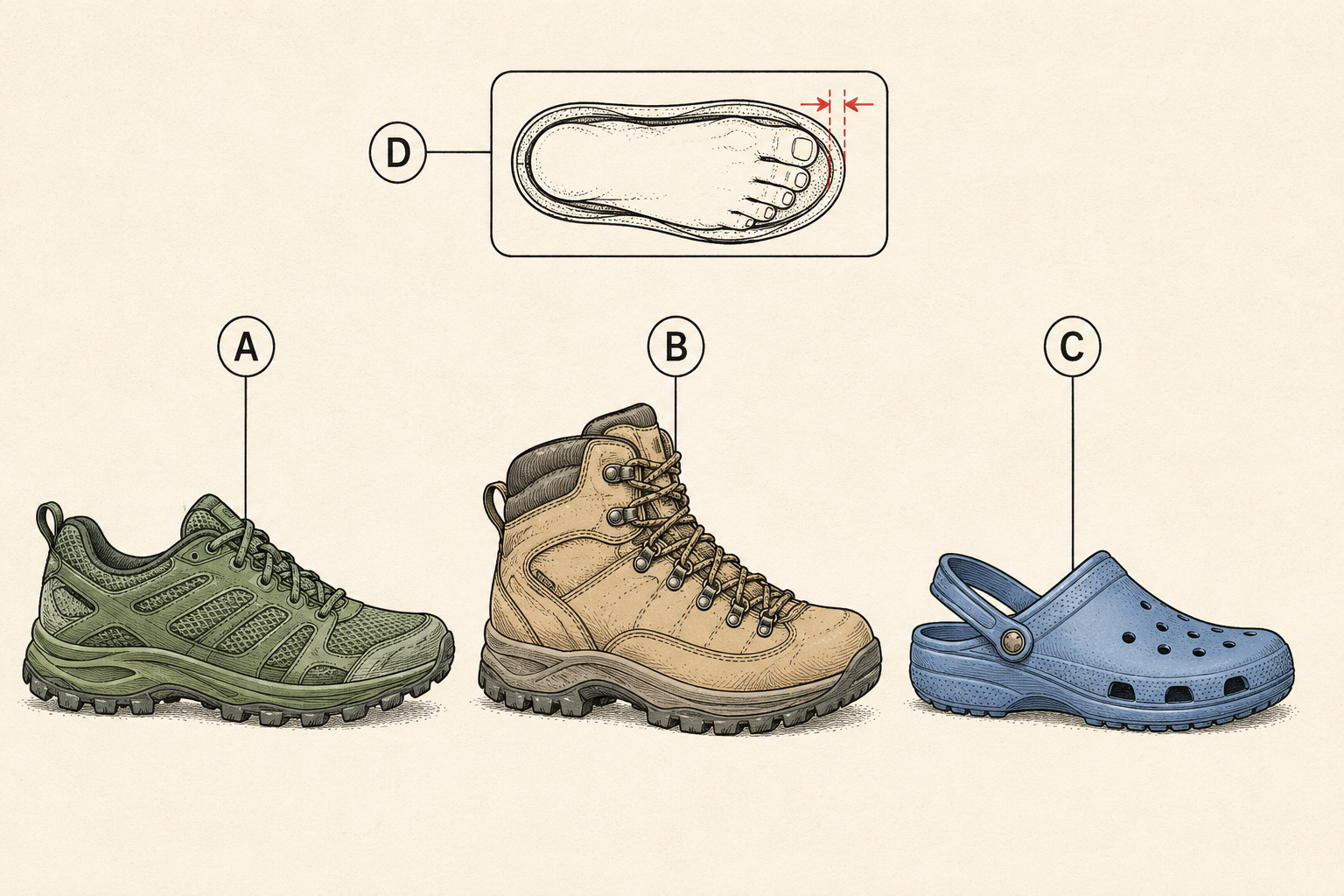
Trail runners for most people on most trails: lighter, comfortable out of the box, and faster-drying. Boots for heavy packs (past roughly 35 pounds), rough off-trail terrain, ankle-injury histories, and cold or snowy conditions. The old rule ("real hikers wear boots") died a decade ago; the new rule is match the shoe to the load and terrain, not to tradition.
The physics that killed the old rule: weight on your feet costs several times its equivalent on your back over a day of steps, so a boot that weighs a pound more per pair taxes every mile. Meanwhile modern trail runners borrowed the grippy outsoles and rock plates that used to justify boots. What boots still genuinely offer: stiffness under loads (the sole resists wrapping around every rock when you're carrying 40 pounds), ankle coverage (support is debated; protection from rock strikes and debris isn't), warmth, and durability measured in years instead of miles.
So the fleet most campers converge on: trail runners or low hikers as the daily drivers, boots if and when the load or the season demands them. Nobody needs both on day one; buy for the trips you're actually taking (Chapter 1's rule, again).
| Trail runners | Hiking boots | |
|---|---|---|
| Weight per pair | 1–1.5 lb | 2–4 lb |
| Break-in | None | Days to weeks |
| Dry time when soaked | Hours | Days |
| Load comfort | To ~35 lb | Past 35 lb happily |
| Durability | 300–500 miles | Years |
| Best for | Day hikes, summer backpacking | Heavy packs, rough terrain, cold |
When boots earn their weight
Four cases put boots back on the recommendation: pack weight past 35 pounds (family-hauler backpacking, Chapter 11's big end), genuinely rough terrain (talus, off-trail, scree, where the stiff sole and rand armor pay per step), a personal history of ankle sprains (coverage plus a locked heel reduces the rolls that runners invite on loose ground), and cold-wet seasons (an insulated or full-leather boot holds warmth no runner attempts).
Inside the boot world, the honest tiers: lightweight fabric-and-mesh hikers (runners with ambitions; fine for most), midweight leather-synthetic mids (the classic backpacking boot; the default "boots" recommendation), and heavyweight full-leather or mountaineering boots (specialist gear that beginners buy by mistake and regret by mile two). The midweight covers every "I need boots" case this book generates, including Chapter 55's shoulder of winter.
One boot myth to retire on the way past: stiff high tops do not immunize ankles. They reduce some rolls, shield from strikes, and mostly relocate forces; strong ankles and attentive feet prevent more sprains than any collar height. If ankles worry you, the runner-plus-trekking-poles combination protects as well as boots for many hikers, at half the weight.
The fitting method: afternoon feet, thumb of room
Fit in the afternoon (feet swell a half-size over a day and over a hike), in the socks you'll actually hike in, with a thumb's width of space past your longest toe, a heel that stays planted when you walk an incline, and zero pressure points anywhere on lap one. Then walk the store's ramp downhill: if toes touch the front, size up or re-lace; toes hitting the toe box is how downhill miles eat toenails.
The sequence, because order matters: measure both feet (they differ; fit the bigger), start a half-size up from your street shoe, lace snug through the midfoot with the heel seated back, and walk ten minutes minimum including stairs or ramp. Judge three stations: toes (wiggle room always, contact never), midfoot (held, not squeezed), heel (a millimeter of lift at most; heel slip is the blister factory Chapter 26 fights). Any hot spot in the store is a certainty on the trail; there is no "it'll break in" for a pressure point, only for stiffness.
Width is the ignored dimension: many makers cut multiple widths, and the hiker in pain from a D-width last no amount of length-sizing can fix should be in EE, not in a bigger shoe. Ask. Aftermarket insoles (flat feet, high arches) are legitimate and change fit; bring yours to the fitting.
The sock system
Socks are footwear, not accessories: merino or synthetic hiking socks (never cotton, the Chapter 23 law at its highest stakes), in a cushion weight matched to the shoe, two to three pairs per trip in rotation, changed the moment they're soaked. Half of blister prevention (Chapter 26 has the other half) is sock discipline.
What the wool sock does that the cotton tube sock can't: wick sweat off skin, hold structure when damp (wet cotton bunches into friction ridges), cushion where feet strike, and stay warm soaked. Weights run light (summer, trail runners), mid (the default), and heavy (boots, cold); match sock bulk to the shoe's fit, since a heavy sock in a snug shoe re-sizes it.
Liner socks (a thin slick layer under the hiking sock, moving friction between fabrics instead of on skin) are the traditional blister answer that toe-socks and modern singles have largely replaced; blister-prone feet should still try the pairing, since it's cheap and it still works. Rotation logistics: yesterday's washed pair dries on the pack lid (sun and airflow), today's pair works, the sleep pair stays sealed with the sleep set. Chapter 26 turns all this into a pre-blister protocol.
Waterproof or not: the membrane question again
Waterproof-lined footwear (the "GTX" tier) keeps feet dry in dew, puddles, and shallow snow, and turns into a slow-drying bucket once water tops the ankle or the day runs truly wet. Non-waterproof mesh soaks immediately and dries in hours. The split that works: waterproof for boots in cold and shoulder seasons (cold-wet is the enemy), mesh for trail runners in warm seasons (wet-warm is survivable; wet-forever isn't).
This is Chapter 24's membrane logic on feet, with one cruel addition: feet sweat constantly, shoes can't pit-zip, and a membrane that blocks rain in also blocks sweat out, so waterproof shoes run damper day-to-day than mesh even in dry weather. Warm-season hikers who accept "wet feet, fast dry" and carry the sock rotation report happier feet than the waterproof faithful in every climate that isn't cold.
Cold flips the verdict completely: wet feet at 35°F (2°C) are a safety problem, not a comfort one, and the waterproof boot plus gaiters (the fabric cuffs that seal the boot-pant gap against snow and scree) is the right winter answer, expanded in Chapter 55.
Camp shoes and the rest of the fleet
Camp shoes are policy, not luxury (Chapter 6 already packed them): anything slip-on with a real sole, worn the minute boots come off, for foot recovery, midnight bathroom runs, and creek crossings that don't deserve wet boots. Foam clogs and strapped sandals dominate on merit; flip-flops fail the midnight-and-gravel test.
The crossing role deserves its note: fording a creek barefoot is how camp injuries happen (invisible glass, shifting rock), and fording in your only boots is how the day ends squelchy. The camp shoe with a heel strap does crossings; the boots ride the pack; the feet dry on the far bank. Chapter 39's stream-crossing section builds on exactly this.
Around the fire, one material warning: foam camp shoes and flying sparks are a melting acquaintance, and bare feet near coals are a Chapter 48 case study waiting for a narrator. Soles stay on at the fire ring.
Buying well: miles, retirement, and the second pair
Footwear is a wear item on a schedule: trail runners retire around 300–500 miles (midsole foam dies before the upper looks tired; the signal is new aches after ordinary days), boots resole or retire by years and condition (cracked rands, worn lugs, dead cushioning). Log roughly when a pair started; feet complain in hindsight otherwise.
Buying tactics that work: shop the afternoon (fitting rule), shop last season's colorway (Chapter 7's discount logic applies to every category), and once a pair proves itself across a season, consider buying its twin before the model "updates" itself out of fitting you, a genre of grief every hiker eventually knows. Online buying works only with a proven size in a proven model; new models get fitted in person, always.
The two-pair fleet most campers land on: proven trail runners or low hikers plus camp shoes, with boots joining when the trips demand them. Total investment under two hundred dollars for gear that determines more trip comfort than the tent does.
Trailhead Takeaways
- Match footwear to load and terrain: runners under ~35 lb on trails; boots past that, off-trail, cold, or with ankle history.
- Weight on feet taxes like multiples on the back. Lighter shoes buy real miles.
- Fit afternoon feet, in hiking socks: thumb-width at the toes, held midfoot, planted heel, downhill ramp test. Store hot spots never heal.
- Wool or synthetic socks only, matched to the shoe, rotated dry. Socks are half of blister prevention.
- Waterproof for cold seasons and boots; mesh-and-dry-fast for warm seasons and runners. Feet can't pit-zip.
- Camp shoes are policy: recovery, midnight gravel, creek crossings. Straps beat flip-flops; soles stay on at the fire.
- Runners die at 300–500 miles, quietly. Log the start date and believe new aches.
Where Trips Go Sideways
- Buying boots because "hiking means boots." Four pounds of leather for flat summer day hikes: hot, heavy, and a two-week break-in for terrain a runner handles out of the box. The load and the terrain pick the shoe. Tradition doesn't get a vote.
- The morning fitting. Perfect at 10 a.m., a size small by the afternoon swell of mile six. Toenails paid the downhill bill. Afternoon feet, hiking socks, ramp test: the whole method exists because of this exact story.
- Cotton tube socks in good shoes. Two hundred dollars of footwear undone by a $2 sock that bunched wet into a friction ridge. The sock is footwear. Wool or synthetic, or stay home.
- Waterproof runners in July. Every creek topped the ankle, the membrane held the water in faithfully, and the shoes were buckets for two days. Warm season: mesh, fast dry, rotate socks. Save the membrane for the cold.
- "They'll break in." The pressure point at the store's minute eight became the blister at trail mile two, on schedule. Stiffness breaks in. Pressure points break skin. Know the difference at the register.
Frequently asked
Should I wear trail runners or hiking boots?
Trail runners for most day hiking and light backpacking: lighter, no break-in, fast-drying. Boots when the pack tops ~35 pounds, terrain goes rough or off-trail, seasons go cold and wet, or your ankles carry a sprain history. Load and terrain decide; tradition retired.
Can I use trail running shoes as hiking shoes?
Yes, and half the long-distance hiking world does exactly that: modern trail runners carry the grippy outsoles and rock protection that once required boots. Mind their limits (heavy loads, talus, snow) and their lifespan (300–500 miles of midsole), and they're legitimate hiking footwear, full stop.
Do I need hiking boots for Yosemite?
For the famous maintained trails, no: trail runners or low hikers handle Valley and rim trails fine in season. Boots earn their place there for heavy backpacking loads, early-season snow on high passes, or off-trail scrambling. The trail's surface and your pack weight answer this question anywhere, park by park.
How do I know if hiking boots fit right?
Fitted on afternoon feet in hiking socks: a thumb's width beyond your longest toe, a midfoot that feels held without squeeze, a heel that lifts a millimeter at most on an incline, and zero pressure points in a ten-minute store walk including a downhill ramp. Any store hot spot disqualifies; stiffness softens, pressure doesn't. Bring your own insoles and hiking socks to the fitting; both change the verdict.