Part IX · Further: Seasons and Styles
How Long Is a 10-Mile Canoe Trip?
Camp by Canoe
How do you start paddle camping?
Rent a canoe, fit PFDs properly and wear them without exception, load your existing camp kit into dry bags, and paddle a calm lake to a shoreline site an hour from the launch: paddle camping's entry trip is Chapter 2's template on water, and the canoe is the reason Chapter 1 called this the family's step past the campground: it carries coolers and comfort like a rolling trunk while delivering campsites roads can't reach.
The honest framing: a loaded canoe on flat water is among the most beginner-friendly craft there is (stable, roomy, forgiving), and water is simultaneously the least forgiving medium this book visits, which is why this chapter's safety layer (PFDs, cold water, wind, and the whitewater line) is absolute where the land chapters negotiate. The formula: gentle water plus rigid rules equals the best family trips available; ambitious water without the training this book doesn't provide equals the statistics.
The skills inventory is smaller than it looks: the boat decision, the PFD fitting, the load, three strokes, wind judgment, and the route rules. Everything else (the camp itself) you already know: it just arrives by hull.
Canoe or kayak: the camping answer
| Canoe | Touring kayak | |
|---|---|---|
| Cargo | Enormous (coolers, kids, the dog) | Modest (dry bags in hatches) |
| Crew | 2–3 plus gear | Solo per boat |
| Learning curve | Minutes to move, seasons to master | Hours (plus wet-exit skills for sit-ins) |
| Wind and waves | Catches wind loaded | Slices it better |
| Portages | One boat, two people, doable | Awkward |
| Camping fit | The family truck | The solo tourer |
The camping answer for most readers is the canoe: capacity is the whole game when camp comes along (Chapter 1's delivery-system logic: the canoe is the trunk), tandem paddling carries kids and dogs, and rentals are everywhere water is. Kayak camping is absolutely a thing (the sit-inside tourer with sealed hatches is a fast, seaworthy solo system with its own devoted culture), and it's the second boat: it demands more technique (including wet-exit and re-entry skills for real water), carries less, and suits the solo traveler the canoe suits the family. Sit-on-top kayaks split the difference for warm-water day use and minimalist overnights.
The tandem-canoe social note, offered with love: the stern paddler steers, the bow paddler powers and calls obstacles, and the traditional nickname ("the divorce boat") describes crews who haven't agreed on those jobs. Agree at the launch, rotate if you like, and the boat goes straight.
The PFD law
The rule, absolute and first: a properly fitted PFD, worn, zipped, and buckled, on every person, any time the boat is on the water or anyone is playing at its edge. Not stowed under the thwart, not "within reach," not "we're just crossing the cove": worn. Nearly all paddling fatalities share one autopsy line (no PFD or PFD not worn), calm water drowns people via cold shock and surprise (below), and the modern paddling PFD is comfortable enough that the old excuses expired a generation ago.
The fitting, once per person per boat season: choose a paddling-cut PFD (big arm openings, foam distributed for a seated torso), size by chest measurement, put it on and cinch from the waist up (waist band snug first, then side straps, shoulders last and barely), and run the lift test: a partner hauls upward on the shoulders: if the PFD rides up past your ears, tighten from the bottom or downsize: in water, that ride-up is the jacket floating without you.
Kids' PFDs add non-negotiables: sized by weight class (never "to grow into": Chapter 25's boot logic at drowning stakes), crotch strap used on the small sizes (it defeats the ride-up little bodies invite), the heads-up flotation collar for the youngest, and the law-and-lore alignment: most states require worn PFDs for children on the water, and this book requires them at the water's edge in camp too (Chapter 51's water rule, now with hardware). Dogs get their own (Chapter 54's kit grows a flotation handle: the retrieval grip is the point).
Loading the boat
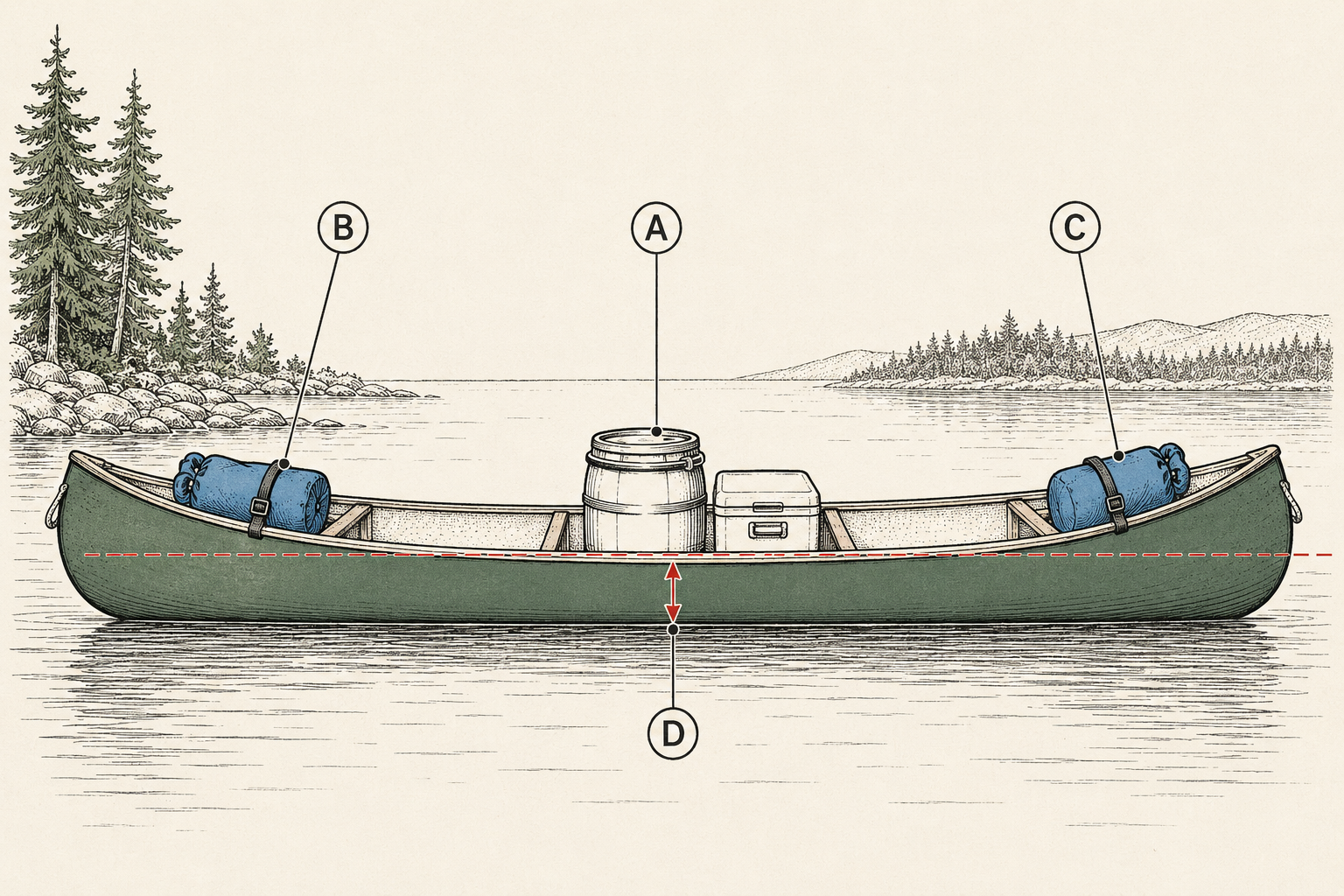
The load rules, which are Chapter 11's pack physics rotated horizontal: low and centered (heavy items on the hull's floor at the boat's center: the cooler is ballast when it's low and a capsize lever when it's on a seat), trimmed level (bow-to-stern balance checked at the beach: a bow-light boat weathercocks in wind; adjust by sliding gear, not by wishing), everything in dry bags (the roll-top dry bag is the price of admission: sleep system and clothes in their own bags, the Chapter 47 kit and day layer in a small one clipped within reach), and everything secured (gear clipped or tied to thwarts with quick-release: a swamped boat with tied-in gear stays a boat with gear; a swamped boat with loose gear is a debris field: the flat-water tie-in debate resolves toward "attached" for camping loads).
The packing translation from car camping: the bins become dry bags and barrels (the blue barrel with harness is canoe-country tradition for food and doubles as bear storage where hard-sided counts), the cooler rides (small trips) or stays (portage trips), and weight stops mattering the way it did on your back and starts mattering as trim and freeboard (the loaded boat should keep a hand's width of hull above waterline; overloading sinks margins before it sinks boats).
Three strokes and the tandem contract
The flat-water minimum is three strokes per seat: forward stroke (vertical paddle shaft, torso rotation doing the work, exit at the hip: arms last a mile, torsos last all day), the stern's J-stroke (the steering fix for the canoe's natural veer: the forward stroke finishing with a small outward J that corrects course without switching sides every three strokes: learn it in the first hour and the boat stops zigzagging), and the draw (paddle planted out to the side and pulled toward the hull: the sideways move for docking and dodging). The bow adds the cross-draw for obstacle calls; everything fancier belongs to courses and later seasons.
The tandem contract, formalized from the earlier joke: stern steers and sets cadence, bow powers and calls hazards ("rock right"), switches happen on the stern's call ("hut" in tripping tradition), and the kneeling position (knees on the hull, butt against the seat edge) is the stability gear both paddlers shift into when water or wind stiffens. Solo canoe and kayak basics ride the same principles (torso rotation, vertical shaft) with their own seat geometry.
Practice venue doctrine: the first hour happens on a pond in swimsuits (deliberate practice, warm consequences), including the capsize rehearsal: tip the empty boat over once on purpose, feel what it does, swim it to shore. Boats stop being scary the day you've already been in the water beside one.
Wind, cold water, and the weather layer
Wind is flat water's real hazard: a loaded canoe in a 15 mph crosswind is hard labor, in 20+ it's a problem, and lakes manufacture afternoon wind on Chapter 43's valley-breeze schedule, which sets paddle camping's cardinal rhythm: travel early, camp early (the dawn lake is glass; the 3 p.m. lake has whitecaps and opinions). The route rules that follow: cross open water at its narrowest points (never the long diagonal), hug the lee shore when wind rises, kneel and shorten the day, and treat whitecaps from shore as a no-launch verdict, whatever the schedule says (Chapter 4's bail doctrine, floated).
Cold water is the season-long assassin: water below about 60°F (15°C) triggers cold shock on immersion (gasp reflex, panic breathing, rapid incapacitation: the mechanism that drowns strong swimmers yards from shore), spring and fall paddling happens on winter-cold water under summer-warm air, and the rule is dress for the water temperature, not the air: which for most campers means the honest version: on cold water, stay near shore, wear the PFD religiously (it wins the cold-shock minute for you), and leave the crossing ambitions to wetsuit seasons.
The standing weather kit: Chapter 43's sky checks at every break, thunder means off the water immediately (a lake is Chapter 44's worst address: you are the tallest object), and the float plan (Chapter 39's trip plan with launch, route, camps, and takeout) filed with the land contact, because water searches start from the same paperwork land ones do.
Rivers, rapids, and this book's line
The international scale grades whitewater from Class I (moving water, riffles, wide clear channels) through Class VI (effectively unrunnable), and this book's line is drawn at the bottom of it: loaded family canoes belong on flat water and Class I, period. Class II (straightforward rapids, maneuvering required) is decision-making water that wants unloaded boats, instruction, and practiced rescues; everything above it is a sport with its own books, courses, and helmets. The scale's camping use is reading route descriptions honestly: "a few easy Class II drops" in a guidebook means portage or different route for the loaded family boat.
River sense for the legal water: current multiplies everything (a Class I river moves you at walking pace for free and doubles every mistake's speed), the standard hazards are learnable by sight (strainers: downed trees the current pours through, the river's deadliest feature, given absolute clearance; sweepers: overhanging branches; the outside of bends where current pushes), ferry angles and eddy basics come from the same first-hour pond session, and rivers get scouted (walk the bank at anything you can't see through) and portaged without shame: the tripping tradition holds that nobody ever drowned on a portage.
Portaging itself, the canoe country tax: the yoke carry (boat overhead, learned empty), the two-trip discipline (gear then boat; the one-trip hero pile breaks ankles), and the barrel harness earning its keep. Trips get planned by portage count as much as mileage, which the route guides annotate.
Camping from a boat
The waterborne camp runs earlier chapters with amendments: site selection (Chapter 30) adds landing quality (a gradual gravel or sand landing beats the pretty ledge), boat security (hauled fully ashore, flipped, and tied to something living: wind and wakes float boats at 2 a.m.), and the water-level question (rivers rise: Chapter 44's wash logic applies to beach camps; camp above the debris line). Storage (Chapter 45) notes the barrel's bear-resistance where certified and the boat's non-status (a food bag in a canoe is a raccoon buffet with a moat it happily swims). Water (Chapter 17) is everywhere and still gets treated.
The paddle-specific rhythms: camp chores start earlier (the travel-early doctrine lands you at camp by early afternoon: the swimming, fishing (Chapter 22, at its best from a boat), and Chapter 52 hours are the payoff), wet-foot discipline runs constant (the Chapter 26 foot care chapter matters double in a boat's puddle; camp shoes for landings, dry socks as ritual), and the everything-dries rotation (Chapter 37) runs daily because bilge water finds everything eventually, dry bags or not.
Kids and dogs in boats compress to their earlier chapters plus the water layer: kids paddle bow young (real jobs, Chapter 51: a six-year-old with a small paddle is crew), the PFD law binds all species, the dog rides at the center on a mat with the flotation handle (introduced to the boat on land, then dockside, then briefly: Chapter 54's rehearsal doctrine), and the first family trip is one hour of paddling to a site you could walk out from, which is Chapter 2's template holding its shape on a third medium.
Trailhead Takeaways
- The canoe is the family camping boat: trunk-sized cargo, tandem crew, rentable everywhere. Kayaks are the solo tourer's answer.
- PFDs: paddling-cut, fitted with the lift test, worn zipped by everyone on or beside the water. No stowed exceptions, ever.
- Load low, centered, level, and secured in dry bags; keep a hand's width of freeboard. The cooler is ballast on the floor and a lever on a seat.
- Three strokes run the flat water: forward (torso, not arms), the stern's J, the draw. Agree on the tandem contract at the launch.
- Travel early, camp early: lakes make wind by afternoon. Cross narrow, hug the lee, and whitecaps from shore mean no launch.
- Dress and plan for water temperature, not air: cold water below ~60°F is the assassin, and the PFD wins the cold-shock minute.
- This book's whitewater line: flat water and Class I, loaded. Strainers get absolute clearance. Nobody drowns on a portage.
- Boats ashore, flipped, and tied at night; food in the barrel or ashore-stored, never in the boat.
Where Trips Go Sideways
- PFDs under the thwart. Calm lake, short crossing, jackets stowed "for comfort," and one surprise wake made the case the statistics have been making forever. Worn is the only version that works, and the modern cut costs nothing to wear.
- The cooler on the seat. Loaded high for easy access, it turned the stable family barge into a balance experiment, resolved at the first lean. Low, centered, on the floor: ballast or lever, your choice at the beach.
- The 3 p.m. crossing. The morning's glass lake grew whitecaps on schedule while camp packed slowly, and the long diagonal crossing became an hour of labor and fear. The dawn paddler and the afternoon paddler visit different lakes. Be the first one.
- "A few easy Class II drops." The guidebook's casual phrase met a loaded family canoe, and the gear went swimming at the second drop. The scale exists to be believed: portage was a ten-minute walk, and the barrel floated better than the weekend did.
- The boat left at the waterline. Tied to a rock, kissed by wakes and a night breeze, and gone by coffee: found across the bay, eventually, emptier. Ashore, flipped, tied to something living: the 2 a.m. wind has always had opinions about boats.
Frequently asked
What do I need for canoe camping?
Your existing camp kit translated to water: the canoe and paddles (plus a spare), fitted PFDs worn by all, dry bags for everything (sleep system and clothes especially), a barrel or hard container for food, the Chapter 47 kit in a small dry bag within reach, and a float plan filed. Rentals cover the boat side completely for first trips.
How long is a 10-mile canoe trip?
On calm flat water, a loaded tandem cruises 2.5–3 mph, so about 4 hours of paddling: call it a full day with breaks, wind, and camp chores. Current changes everything (a river's push is free miles; a headwind is a tax), and the travel-early rule beats every estimate: the same 10 miles is easy at dawn and grim at 3 p.m.
Is kayak camping a thing?
Absolutely: sit-inside touring kayaks with sealed hatches are a fast, seaworthy solo camping system with a devoted culture. The trade against the canoe is cargo and company: kayaks carry backpacking-sized kits and one paddler each. The canoe stays the family answer.
How should a life jacket fit?
Snug at the waist first, then sides, shoulders barely: then the lift test: a partner pulls up hard on the shoulders, and a PFD that rides past your ears needs tightening or a smaller size. Paddling cuts free the arms. Kids size by weight class with crotch straps on the small sizes, never "to grow into."