Part IX · Further: Seasons and Styles
Is a Campfire Against Leave No Trace?
Leave It Better
What are the 7 Leave No Trace principles?
The seven: plan ahead and prepare; travel and camp on durable surfaces; dispose of waste properly; leave what you find; minimize campfire impacts; respect wildlife; be considerate of other visitors. Maintained and taught by the Leave No Trace organization, they're the outdoor world's shared operating system, and if you've read this book, you already know how to run every one of them: the previous fifty-nine chapters taught the principles as skills before this chapter named them as ethics.
That's the design, and it's worth saying plainly in the book's last chapter: good technique and good ethics are the same moves. The camper who reads sites (Chapter 30), stores food (Chapter 45), manages fire (Chapters 32–33), and handles waste (Chapter 35) is practicing Leave No Trace at a level no slogan produces, because the skills make the ethics automatic. This chapter is the assembly: each principle, its logic, and where its skills live in these pages, plus the two modern questions (geotagging, and the step past "no trace" toward "better than found") the original list predates.
One framing note the LNT organization itself insists on: the principles are a framework for minimizing impact, not a purity test for gatekeeping strangers. The goal is millions of people loving these places lightly, and the tone that gets there is the camp host's, not the hall monitor's.
Plan ahead and prepare
The principle: most damage is downstream of poor planning: the unprepared party builds the illegal fire because dinner depended on it, trenches the tent because the site was chosen at dark, and calls the rescue because the margins never existed. Preparation is the invisible LNT principle: nobody photographs it, and it prevents more impact than all the others combined.
Where this book taught it: the trip template and its margins (Chapter 2), the rules-check habit (Chapter 5's per-trip fire and regulation reads), the forecast work and bail criteria (Chapter 4), the menu that never depends on a fire (Chapters 14, 18), the gear systems that keep groups self-sufficient (Chapters 6, 12, 47), and the navigation stack that keeps parties found (Chapters 39–42). The LNT translation of all of it: a prepared party never needs to make the damaging choice.
The group-size clause rides here: big groups multiply impact nonlinearly (noise, trampling, facility load), most wilderness areas cap them (the permit reads from Chapter 5), and the big-family-reunion answer is the group campground built for exactly that, booked per Chapter 3.
Travel and camp on durable surfaces
The principle: land wears where feet and tents land, so concentrate use where use already is (trails, established sites, rock, gravel, sand) and disperse it where it isn't (pristine areas see one careful pass, not a new path). The damage math is about thresholds: the tenth boot on a muddy shortcut makes a trail; the tenth tent on a meadow makes a scar; staying on the durable stuff keeps the count at zero.
Where this book taught it: stay on the trail and walk through the mud puddle (Chapter 39's etiquette), the existing-site rule and the durable-surface hierarchy (Chapter 5's dispersed doctrine), the 200-foot water setback (Chapters 3, 30, 35), meadows-are-for-looking (Chapter 30), the unbuilt fort and returned rocks (Chapter 52's fort law), and the desert's crust commandment (Chapter 59). The campground version is trivially easy (the pad, the paths, done), which is one more argument for the developed-site apprenticeship this book built on.
Dispose of waste properly
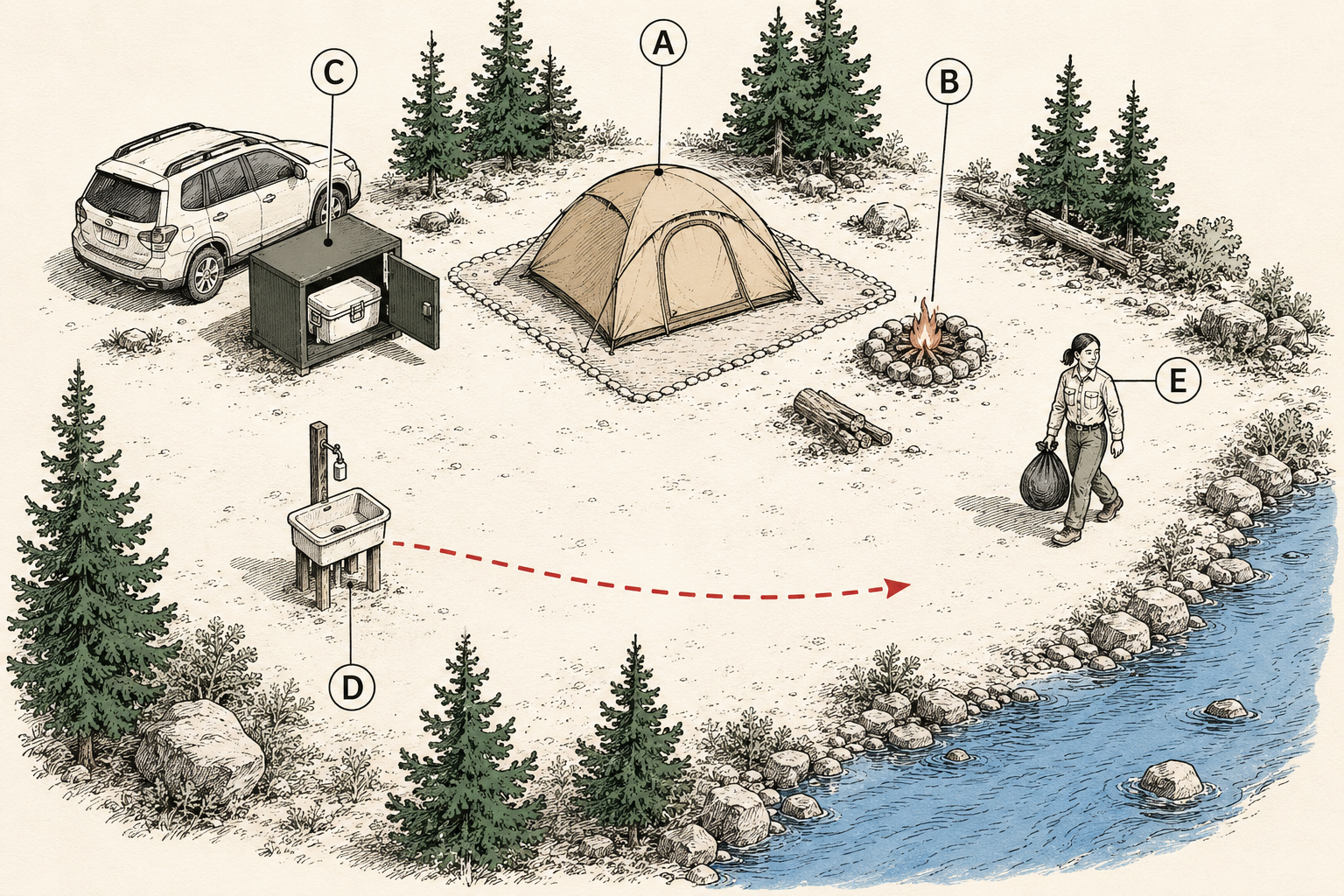
The principle, in its official shorthand: pack it in, pack it out, and it covers everything: trash (all of it, micro-trash included), food waste (orange peels and apple cores are litter with a health-food image: they last months and teach wildlife to beg), gray water (strained, broadcast, 200 feet out), and human waste (the cathole spec or the pack-out zones' WAG bags).
Where this book taught it: the entire Chapter 35 sanitation system, the wash-station and gray-water law (Chapter 15), the strained dishwater and fire rings kept trash-free (Chapters 15, 33), the final sweep and predecessor's-litter habit (Chapters 2, 37), the wipe rule (Chapter 46's never-bury clause), and the dog-bag doctrine (Chapter 54). The one-sentence audit for any departure: if it wasn't here when the land was alone, it leaves with you: and Chapter 37's sweep is the enforcement mechanism, already scheduled.
Leave what you find
The principle: the flower, the antler, the arrowhead, and the weathered board are the experience for everyone who arrives after you, and collection at visitation scale strips places bare (the math again: one pretty rock times a million visitors is a quarry). The rule extends past objects to conditions: sites left unmodified (no trenches, no nail holes, no "improvements": Chapter 37's unbuilt furniture), plants unpicked, and the soundscape unclaimed.
Where this book taught it: look-touch-photograph-return (Chapter 52's museum rule, complete with the ranger-as-curator framing that makes kids its best enforcers), the archaeology clause at federal seriousness (Chapter 59), leave-as-found site conduct (Chapters 30, 37), and the firewood rule's ecological cousin (Chapter 32: dead wood is habitat, not inventory, wherever gathering is prohibited). The one carve-out worth naming: invasive-species rules occasionally ask for removal: the posted exception that proves the rule's actual logic, which was always ecology rather than tidiness.
Minimize campfire impacts
The principle: fire is the most impactful common camp act (scars, sterilized soil, stripped deadwood, smoke, and the megafire tail risk), so the modern doctrine runs: stove first, fire where legal and established, small always, dead out without exception. The principle isn't anti-fire (this book spent three chapters on the craft); it's anti-careless-fire, and the distinction is the whole of Chapters 32 and 33.
Where this book taught it: the stove-first kitchen (Chapter 14), the per-trip legality check (Chapters 5, 33), existing rings and the mound-or-pan dispersed doctrine (Chapter 32), local wood only (Chapter 2's invasive-pest rule), modest flames and the attendance rule (Chapter 33), and the drown-stir-drown-hand-test standard that this book made its least negotiable ritual. The LNT framing adds the summary question worth asking at every camp: does tonight actually need a fire? Sometimes the honest answer is the stove, the puffy, and Chapter 52's stars, and asking is the practice.
Respect wildlife
The principle: wild animals' lives are calorie-margin arithmetic, and human interference (feeding above all, but also chronic disturbance, approach stress, and habituation) breaks the math: the fed animal escalates to destruction (Chapter 45's "fed bear" line generalizes to every species), the repeatedly-flushed bird abandons the nest, and the habituated deer meets the highway. Distance and disinterest are the kindness.
Where this book taught it: the never-feed law (Chapters 45, 53, at every weight class from chipmunk to bear), the storage system that enforces it while you sleep (Chapter 45), the distance law with its thumb test (Chapter 53), the behavior-change-means-too-close standard, dawn-dusk viewing that watches animals being animals (Chapter 53), leashed dogs (Chapter 54), and the water-corridor camping setbacks that keep the commute routes open (Chapter 30). The seasonal amendment: distance rules tighten around young, nests, and winter-stressed animals, when the calorie margins are thinnest.
Be considerate of other visitors
The principle: the resource being protected includes the human experience: quiet, dark, space, and the mutual assumption of goodwill: and it's the principle most often violated at the campground scale, one Bluetooth speaker at a time. The operating test is Chapter 5's: what leaves your site (sound, light, smoke, dogs, kids, generator hum) is the shared space's business.
Where this book taught it: the full etiquette code (Chapter 5: quiet hours as carry-not-volume, music in headphones, lights aimed down), trail right-of-way and the blockade rule (Chapter 39), generator hours and the dark-sky courtesy (Chapter 38), dog manners as gate-keeping for everyone's access (Chapter 54), winter's track etiquette (Chapter 56), and the launch-and-landing patience of shared water (Chapter 57). The disposition underneath, worth stating once in the book's last chapter: the wave, the hello, the offered jump-start: campgrounds run on a neighborliness that's also, per Chapter 39's rescue-network observation, a safety system. Courtesy is infrastructure.
The geotag question
The modern dilemma the seven principles predate: location sharing at internet scale can love places to death (the tagged swimming hole that got a parking crisis, the wildflower slope that became a selfie queue: the crowding mechanics Chapter 3 planned around, now supply-side). The emerging etiquette, adopted by this book: tag the region, not the pin for fragile and little-known places ("Sierra high country," not the lake's name and coordinates), share sturdy, developed places freely (the state park can handle the publicity; that's what it's for), pair any share with the relevant care note when you do name names, and never post the precise locations of dens, nests, archaeology, or anything the land agency asks kept quiet.
The balancing note, because the ethic cuts both ways: public lands survive on public love, gatekeeping has an ugly history, and the goal is more campers who care, not fewer who know. The resolution this book teaches: share the how generously (skills, ethics, this book's whole project) and the exactly-where thoughtfully: which is the same generosity-with-judgment that runs every other principle.
Beyond no trace: leave it better
The step past the seventh principle, and this book's actual closing doctrine: no trace is the floor; better is the practice. The moves are already installed: the predecessor's litter that leaves in your bag (Chapters 2, 37), the fire ring de-trashed (Chapter 33), the found tent stake and the reported washout, the trail-day volunteering and the campground host's thank-you, the kids raised on the museum rule and the job board who will run better camps than yours. Stewardship at the camper's scale is mostly the sweep, done one site wider than your own.
And the last word of the last chapter, earned by sixty chapters of systems: the point of all of it (the checklists, the knots, the coal beds, the bail criteria) was never the gear or even the competence. It was the unhurried evening by the water, the kid asleep mid-sentence in a warm bag, the coffee at the dawn overlook: the reliable production of good hours outside, trip after trip, at costs a family can repeat. Camp lightly, leave it better, and go book the next weekend. The site's waiting, and now you know everything the site requires.
Trailhead Takeaways
- The seven principles are the skills you already built: this book taught the ethics as technique, chapter by chapter.
- Preparation prevents more impact than any other principle: prepared parties never need the damaging choice.
- Concentrate use on durable surfaces; disperse it in pristine ones. The tenth boot makes the trail.
- Pack out everything, orange peels included. The sweep is the enforcement mechanism, already scheduled.
- Look, touch, photograph, return: objects, sites, and soundscapes stay for whoever's next.
- Stove first, fire small where legal and established, dead out by the hand test. Ask if tonight needs a fire at all.
- Feed nothing, ever; distance is the kindness; leash the dog; tighten margins around young and winter-stressed animals.
- What leaves your site is the shared space's business. Tag the region, not the pin. And leave every site one sweep better than found.
Where Trips Go Sideways
- Ethics as improvisation. No fire check, no menu backup, dinner dependent on a ring in a Stage 2 county: the illegal fire wasn't a character flaw; it was a planning failure that arrived on schedule. Principle one exists because the other six depend on it.
- The biodegradable alibi. Orange peels, apple cores, and pistachio shells scattered "for the animals": months of litter and a begging chipmunk curriculum. Food waste is trash with better branding. It packs out with everything else.
- The improved campsite. A drainage trench, a nailed pot-hanger, log furniture hauled from the woods: a weekend's conveniences, a decade's scars, and the next party's cleanup. Leave-as-found isn't nostalgia; it's the difference between a site and a settlement.
- The tagged swimming hole. Forty followers, then forty thousand: a parking crisis, a trash problem, and a closure notice, all downstream of one precise pin on a fragile place. The region tag shared the joy; the coordinates shared the load.
- The purity patrol. A newcomer's small mistake met a stranger's loud lecture, and the newcomer didn't come back: one fewer person who might have loved the place carefully for forty years. The principles recruit; they don't gatekeep. Teach like the camp host, not the hall monitor.
Frequently asked
What are the 7 principles of Leave No Trace?
Plan ahead and prepare; travel and camp on durable surfaces; dispose of waste properly; leave what you find; minimize campfire impacts; respect wildlife; and be considerate of other visitors. They're maintained by the Leave No Trace organization as the outdoor world's shared framework, and every one maps to skills this book already taught, which was the design all along: good technique and good ethics are the same moves.
What does "leave no trace" actually mean?
That the land after your visit reads as if the visit hadn't happened: nothing left (trash, waste, structures), nothing taken (objects, plants, artifacts), nothing taught (no fed animals, no new trails or scars). It's a framework for minimizing impact at millions-of-visitors scale, not a purity test: the goal is more people loving places lightly.
What is the point of Leave No Trace?
Arithmetic: the small harmless-looking act (a peel, a shortcut, a handout, a pin drop) multiplied by millions of annual visitors is what closes swimming holes, bans fires, and turns wild animals into problems. The principles keep beloved places open and wild by keeping each visit's multiplier at zero.
Is a campfire against Leave No Trace?
No: the principle is minimize, not abolish. A legal fire in an established ring, kept small, fed local wood, attended always, and extinguished to the cold-hand standard is Leave No Trace practice. The modern defaults just tilt further: stove for cooking, the fire as a deliberate pleasure, and the honest question of whether tonight needs one.