Part I · Deciding to Go
Is October Too Cold for Tent Camping?
Timing the Great Escape
When is the best time to go camping?
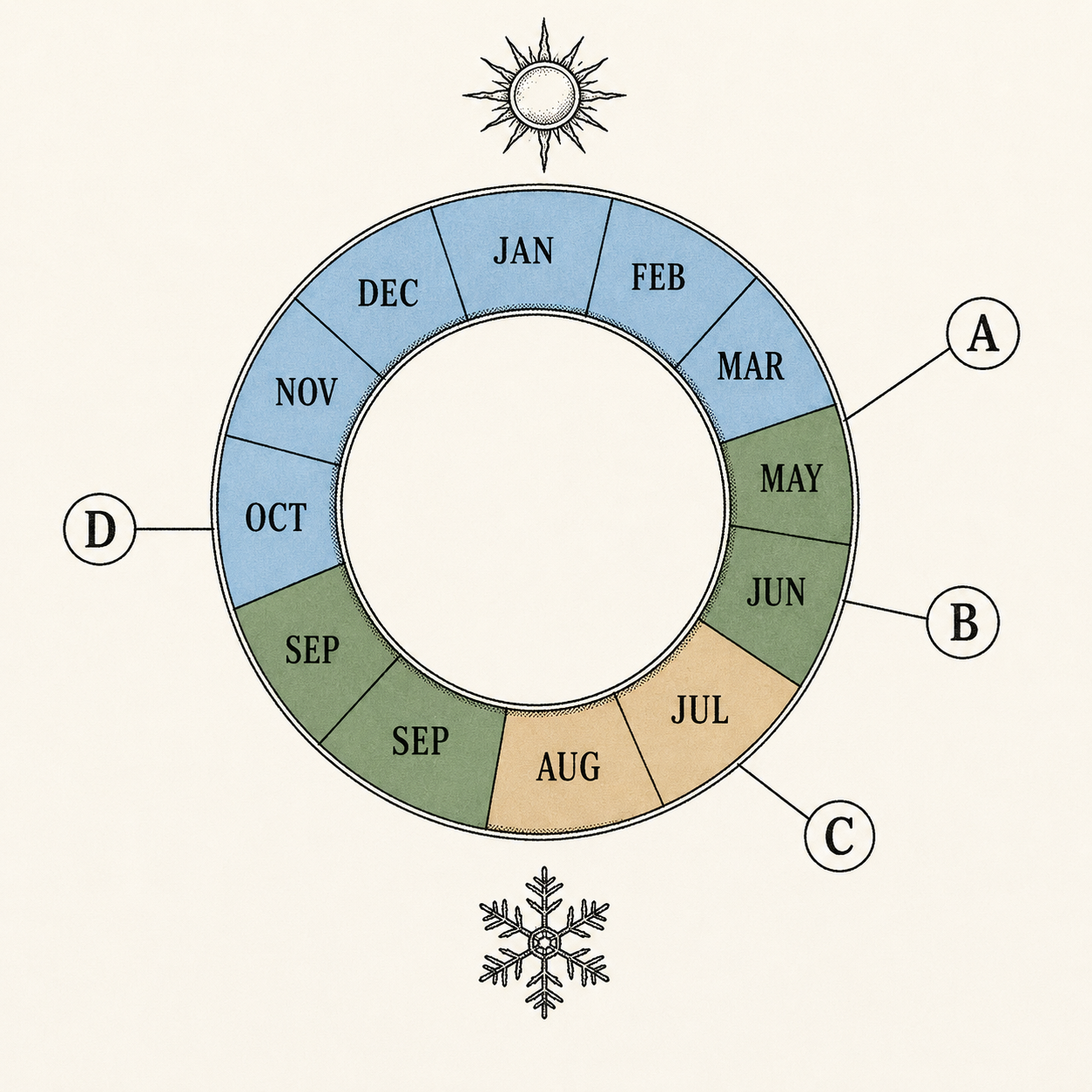
For most of the United States, the best camping falls in the shoulder seasons: mid-May through June and late August through early October. Those windows combine tolerable nights, thinner crowds, and fewer bugs than the July–August peak that everyone books anyway.
Peak summer earns its crowds honestly: school's out, alpine snow is gone, and lakes are warm. Fair enough. But the peak also delivers full campgrounds, afternoon thunderstorms in the mountains, mosquito high season in the north, and fire-restriction season in the West. The shoulders trade a little nighttime warmth for margin on all four. A late-September Saturday at a popular state park can feel like a different, better facility than the same park on the Fourth of July.
The real answer, though, is regional: the "best time" in Arizona is nearly the inverse of the best time in Minnesota. This chapter gives you the national pattern first, then the regional corrections, then the tools to judge any specific week's forecast. Timing is the cheapest gear upgrade there is. The same tent sleeps ten degrees more comfortably on a night you chose well.
Season by season: what you get and what you fight
Every season camps; the question is what you're negotiating with. The table gives the national pattern, and the rest of the book supplies the skills each season assumes.
| Season | What you get | What you fight | Skills assumed |
|---|---|---|---|
| Late spring (May–Jun) | Long days, full waterfalls, wildflowers | Mud, blackflies/mosquitoes rising, cold snaps, high rivers | Layering (Ch. 23), forecast reading |
| Peak summer (Jul–Aug) | Warm nights, swimmable water, everything open | Crowds, booking wars, heat, storms, fire bans, bugs | Booking tactics (Ch. 3), heat sense (Ch. 27, 49) |
| Early fall (Sep–Oct) | Color, cool nights, empty midweeks, no bugs | Short days, first freezes, closing facilities | Warm sleeping (Ch. 36), dark-hour planning |
| Winter (Nov–Mar) | Silence, solitude, no bugs at all | Cold as a full-time job, short light, closed roads | Part IX, honestly (Ch. 55–56) |
| Early spring (Mar–Apr) | First warmth, desert prime time, cheap sites | Mud season, swollen creeks, whiplash forecasts | Bail criteria (this chapter) |
Read the "fight" column as a packing list generator, not a warning label. Blackfly season in the north woods is genuinely miserable without head nets and genuinely fine with them (Chapter 46). Early-fall freezes are a hot-water-bottle trick away from cozy (Chapter 36). The only column entry that should stop a beginner cold is winter's: cold as a full-time job. It is, and Part IX exists for when you want that job.
The crowd calendar
Crowds follow a schedule you can read in advance: three summer holiday weekends at maximum, all summer Saturdays next, then Fridays and Sundays, then everything else. Midweek nights in any season run at a fraction of weekend occupancy, and September weekdays are the quietest good weather of the year.
Memorial Day, July Fourth, and Labor Day deserve their reputation. Everything is booked months out, every first-come campground fills by Thursday, day-use lots overflow, and quiet hours are a rumor. If those weekends are your only option, take them (Chapter 3's tactics still work; book at the release minute), but know what you're buying. If you have any calendar flexibility at all, the weekend after each holiday is dramatically quieter with identical weather. Same lake, half the people.
School calendars run the deeper current. Family campgrounds empty like a drained tub the week local schools reopen in August or September, and that's the moment the best camping of the year begins for anyone without kids in school. Retirees and remote workers already know; Tuesday-to-Thursday in late September is the connoisseur's reservation, bookable a week out at campgrounds that were war zones in July.
Reading a forecast like a camper
Campers read five numbers, in this order: overnight low, wind speed and gusts, precipitation chance by hour, the trend across days, and (in the West, summer) the fire-weather outlook. The daytime high, the number regular life cares about most, matters least.
The overnight low is the verdict. Learn your own line. Most beginners with three-season gear sleep fine to about 45°F (7°C), tolerably to 40°F (4°C), and unhappily below that; you'll refine your own number trip by trip. Wind is the multiplier everyone under-reads: a calm 40°F evening is pleasant, and the same evening at a sustained 20 mph is a coat-and-gloves affair with a stove that won't stay lit. Read the gust figure alongside the sustained speed, and pull both for the campground's elevation, not the valley town's.
Hourly precipitation beats daily. "60% rain Saturday" often resolves to "showers until 10 a.m., then clear," which is a completely campable day you'd otherwise cancel. Look at the hourly graph, plan setup and cooking into the dry blocks, and let the rain have the hours it claimed. For mountain trips, add the standard summer assumption: blue mornings, building afternoon thunderheads, clearing evenings. Hike early, be off ridges by early afternoon (Chapter 44), and dinner usually gets a clean window.
One more source, for when the stakes rise: the National Weather Service "forecast discussion" for your zone, a plain-text explanation written by the forecasters themselves. It tells you how confident they are and why, which the icon forecast never does. Confidence is the number you're really after.
Regional timing: the map is not one season
The national pattern breaks on region, and the corrections are worth memorizing for wherever you camp. Desert Southwest: prime time is March–April and October–November; summer is dangerous, not merely hot (Chapter 59). Pacific Northwest west of the Cascades: the reliable dry window is mid-July through September, and everything earlier is a rain gamble with world-class rewards. Mountain West: true summer runs July–September at elevation, with snow lingering on passes into July and returning in October. Southeast and Gulf: the calendar inverts, with October–April as the comfortable season and high summer as a humidity-and-thunderstorm slog. Northern tier and New England: June's blackflies are a plague with a schedule; late August through leaf season is the payoff window.
Learn your region's correction. It outranks the national chart.
Elevation is the other axis, and it's the one weekend planners forget. The standard lapse rate runs about 5.5°F cooler per 1,000 feet of elevation gain in dry air (3.2°F when saturated), which means the campground 4,000 feet above your house sits roughly 20°F cooler on the same afternoon. In July that arithmetic is a gift: the mountain campground is air conditioning. In late September it's a trap: a mild valley forecast can put the high campground below freezing by dawn. Always pull the forecast for the campground's own elevation; every weather app accepts a pin drop instead of a town name.
Shoulder-season strategy
Shoulder-season trips succeed on three adjustments: sleep warmer than the forecast suggests, plan around short days, and book with a weather-flexible mindset. Make those, and May and October will quietly become your favorite months outside.
Sleeping warmer is mostly Chapter 36 applied in advance: bring the extra pad or blanket, pack the hat and dry sleep socks, and eat a real dinner. The specific shoulder-season trap is the forecast that reads like summer (72°F Saturday afternoon) and camps like fall (38°F at 5 a.m.). Believe the low. Spring and fall air is dry and clear, and clear dry nights radiate heat away hard. When the humidity is low and the sky is cloudless, expect the low end of the forecast range, then subtract a little for the valley floor where cold air pools, which is exactly where many campgrounds sit.
Short days change the timeline math from Chapter 2. Sunset at 6:40 instead of 8:40 pulls your arrival deadline two hours earlier, and evenings run long and dark: bring the lantern, the cards, and the second book. Facilities also start closing: water gets shut off ahead of freezes, loops close, camp stores go quiet midweek, and many campgrounds quietly flip to first-come status for the off season, which works for you if you check and against you if you assume. The campground's official page lists seasonal closures. Check it the week of, not the month before.
Weather windows and when to cancel
Set your bail criteria at home, in writing, before you're emotionally invested in going. Paper doesn't rationalize. The trip cancels or reschedules when the forecast crosses lines like: overnight lows more than 10°F below your gear's comfort, sustained winds above 20 mph, all-day soaking rain on a one-nighter, any severe weather watch, or a red-flag fire warning where you're headed.
Written criteria matter because the alternative is negotiating with yourself Thursday night, when sunk costs (the reservation, the groceries, the group chat) all argue for going. A line you wrote calmly two weeks ago has no stake in the argument. It just says what you already knew: a 30°F night in borrowed summer bags isn't an adventure, it's a preventable bad memory. Cancel, and take the same trip two weekends later.
The mirror skill is recognizing a good window inside a bad-looking forecast. Rain until noon Saturday with a dry, still evening is a fine trip that arrives after lunch. A cold snap with sun and no wind is a hot-drinks-and-big-fire trip, not a cancellation. What you're screening for isn't discomfort, it's the specific combinations that break beginners: cold plus wet, wind plus setup, heat plus no shade. Any one alone is usually manageable. Two together, reschedule.
Trailhead Takeaways
- Shoulder seasons (mid-May–June, late August–early October) are the national sweet spot: fewer people, fewer bugs, fine weather.
- Crowds are schedulable: holiday weekends worst, summer Saturdays next, September weekdays a different sport entirely.
- Read forecasts in camper order: overnight low, wind and gusts, hourly precipitation, trend, fire weather. The daytime high barely matters.
- Pull the forecast for the campground's elevation. Figure roughly 5.5°F cooler per 1,000 feet gained.
- Clear, dry, calm shoulder-season nights run cold; expect the bottom of the forecast range in a valley campground.
- Write bail criteria before booking. Cancel on combinations (cold+wet, wind+setup, heat+no shade) and on any severe weather watch, every time.
Where Trips Go Sideways
- Planning by daytime high. "It says 75 and sunny" books the trip; the 38°F dawn in summer bags ruins it. The overnight low is the only number your sleeping bag ever meets.
- Valley forecast, mountain campground. The town at 2,000 feet forecast 60/45; the campground at 7,000 feet delivered 42/28 and a skin of ice on the water jug. Drop the pin on the campground.
- Holiday-weekend improvisation. No reservation, a Friday 4 p.m. start, and a plan of "we'll find something" on July Fourth weekend. There is nothing to find. Holiday camping is booked camping.
- Refusing to cancel. The forecast degraded all week, everyone watched it happen, and the sunk costs drove anyway, into sideways rain and a 33°F night. The best campers cancel more trips than beginners do. That's part of why their stories are all good ones.
- Ignoring the wind line. Rain gets all the fear, but wind wrecks more shoulder-season trips: tents that won't pitch, stoves that won't boil, fires that can't be lit safely, conversation at a shout. Past 20 mph sustained, reschedule or pick sheltered terrain.
Frequently asked
What months are best for camping?
Nationally, late May–June and late August–early October give the best mix of weather, crowds, and bugs. Regionally it flips: March–April or October–November in the desert Southwest, October–April on the Gulf, and mid-July–September in the high mountains and Pacific Northwest. Chapter 59 explains the desert case.
Is October too cold for tent camping?
Usually not, with the right prep. Much of the country sees October lows between 30°F and 50°F, which three-season gear handles if you sleep on an insulated pad, wear a hat and dry socks to bed, and eat well (Chapter 36). Check the campground's elevation-specific forecast and treat water shutoffs as the season's real closing bell. Frost on the fly wipes off; frozen spigots end trips.
What is shoulder season for camping?
The weeks flanking peak summer: roughly mid-May to late June and late August to mid-October. Campgrounds are open but not full, bugs are down, and nights are cool rather than cold. Prices and booking pressure both drop, and midweek shoulder-season sites can often be reserved days ahead instead of months.
Is camping in the rain worth it?
Showery forecasts, yes: plan setup and cooking into dry hours, bring a tarp for the kitchen, and the campground will be half-empty and lovely. All-day soakers on short trips, no. The dividing line is drying capacity. If nothing can dry before the next wetting, morale drains fast, especially with kids, who tolerate rain far better than parents expect right up until nothing is dry.