Part I · Deciding to Go
How Long Can You Camp on BLM Land?
The Rulebook Nobody Reads
Where can you legally camp?
In the United States you can legally camp in designated campgrounds on almost every kind of public land, and additionally almost anywhere (called dispersed camping) on most national forest and BLM land, subject to local rules. National parks, state parks, and county lands generally restrict camping to designated sites only.
That two-sentence answer sorts most of the confusion, because the question "can I just camp there?" has opposite answers on lands that look identical through a windshield. A pine forest managed by the Forest Service typically welcomes dispersed camping along its roads. The same-looking pines across an invisible boundary in a national park will get you a citation for the same night. Nothing about the trees changes; the agency does, and each agency writes its own rulebook.
The skill this chapter teaches is reading those boundaries before you go. It takes about five minutes per trip once you know where to look, and it converts an anxious "hope this is allowed" into a settled "the map says yes." Rules knowledge is also quietly a money skill: the largest free camping inventory in the country is legal precisely for those who know which roads it lives on.
The land types, decoded
Six kinds of managers run American camping, and each has a personality. Learn the personalities and the individual rules start making sense.
| Land | Typical camping | Dispersed allowed? | Personality |
|---|---|---|---|
| National forests (USFS) | Campgrounds + dispersed | Usually yes | Permissive multi-use; rules by ranger district |
| BLM land | Campgrounds + dispersed | Usually yes | Most permissive; deserts and sagebrush West |
| National parks (NPS) | Designated sites only | No (backcountry by permit) | Strictest; protection first |
| State parks | Designated sites only | Rarely | Family-facility focus; state-by-state quirks |
| County/municipal | Designated sites | No | Local rules, often overlooked gems |
| Private (Hipcamp, commercial) | Host's rules | Host's call | A contract, not a code |
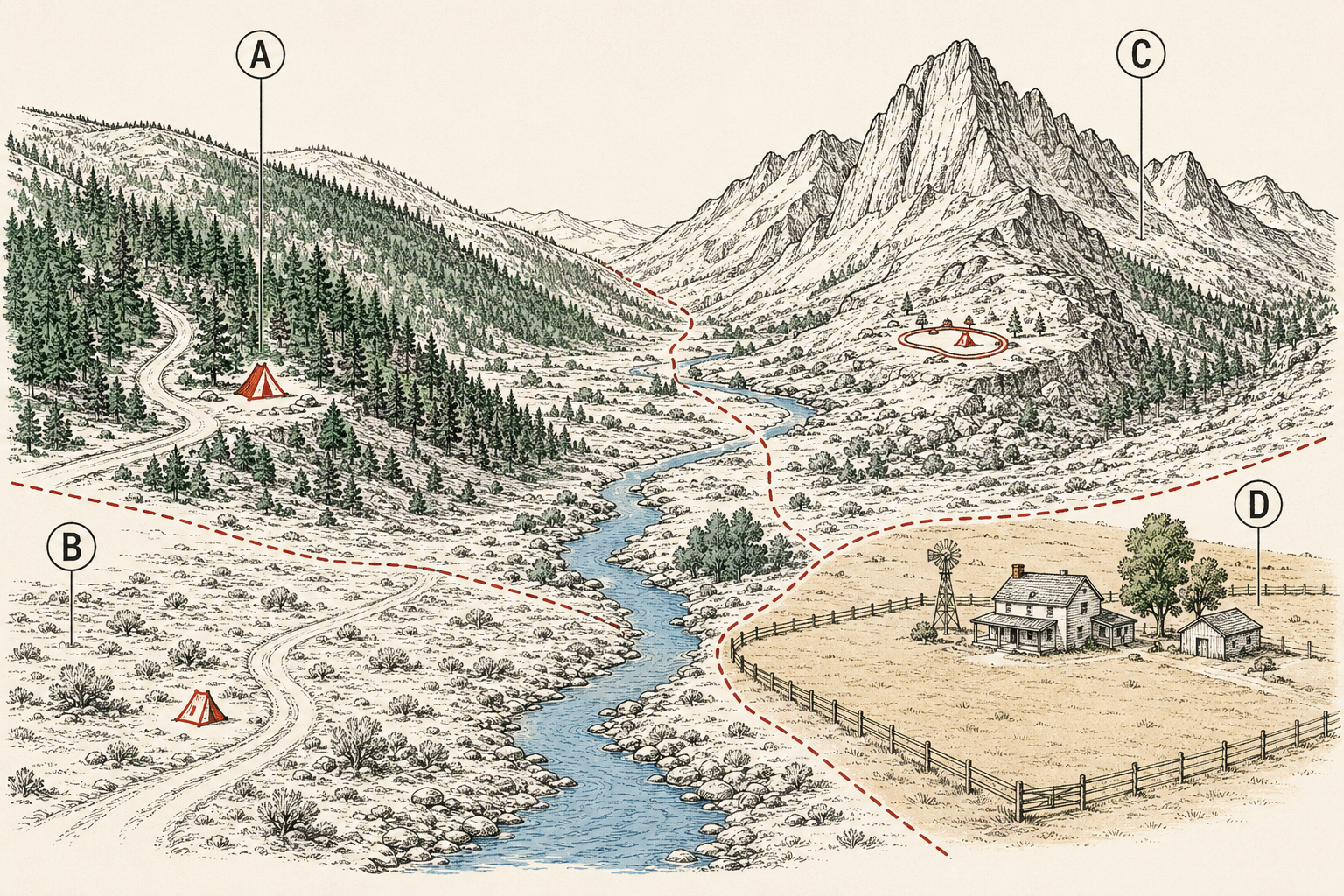
Two of the six deserve immediate elaboration. The Forest Service and BLM together hold the enormous middle of American camping: hundreds of millions of acres where the default answer is yes, camp, free, for up to a stay limit (typically 14 days). Their rules vary by district, which sounds bureaucratic until you realize it means local conditions set local rules: a fire-scarred district bans what a wet one allows. The district office phone number answers in one call what forums argue about for pages. Rangers would rather tell you the rule than write you the ticket, and the ones answering phones are generally delighted someone asked.
Dispersed camping rules that hold almost everywhere
Five rules cover dispersed camping across nearly all forest and BLM districts: camp only along roads shown open on the MVUM, stay within about one vehicle length of the road, keep 100–200 feet from water (the district sets the exact figure), use existing bare-ground sites where they exist, and obey the stay limit, typically 14 days within a 28–30 day window.
The MVUM (Motor Vehicle Use Map) is the load-bearing rule, so here's the practice: download your forest's MVUM into the free Avenza Maps app before leaving cell coverage, and treat roads not shown on it as closed to camping regardless of how driveable they look. The map is the legal document; the road's appearance isn't. BLM travel maps work the same way.
The existing-site rule has a why worth knowing: a bare patch with a rock fire ring is a wound already made, and reusing it costs the land nothing new. Pioneering a fresh site in grass or meadow spreads the wound. So the etiquette hierarchy runs: obvious existing site, then durable bare surface (gravel, slickrock, pine duff), then, ideally never, vegetation. Meadows are off the list entirely: they photograph beautifully, recover terribly, and half the no-camping signs in the mountain West exist because of them.
Wilderness permits and quota trails
Designated wilderness areas, the most protected slice of forest and park land, often require permits for overnight trips, and the famous ones ration access through quotas or lotteries. Day hiking usually needs no permit; sleeping does.
The system sounds forbidding and mostly isn't. For the majority of wilderness areas, the "permit" is a free self-issue form at the trailhead kiosk: fill it out, drop the carbon, tie the tag to your pack, done. Its real function is telling searchers where to look and telling managers how many boots the trail sees. The quota trails (the alpine celebrities you already know by name) are a different sport: reserved months ahead through Recreation.gov, with per-day entry caps and genuine competition, using Chapter 3's release-day tactics.
For a first backpacking season, the practical rule is simply: search "[forest or park name] wilderness permit" while planning, and believe what the official page says over what a two-year-old trip report remembers. Quota systems get retuned yearly. If a permit exists, it's the trip's first reservation, ahead of any campground.
Fire rules: the question you ask every single trip
Fire legality is a condition, not a location, so it's checked before every trip, no exceptions. The same fire ring is legal in May, restricted in July, and a citation in August. Current restrictions live on the forest or park's alerts page, on campground boards, and one phone call away at the district office.
Restriction levels usually step through stages: everything allowed; then campfires only in developed campground rings; then no wood fires anywhere but gas stoves permitted; then, in extremes, full closures where even stoves and entry are barred. Learn to hear the stage names (Stage 1, Stage 2) because that's how the West talks about summer. And note the standing asymmetry: a pressurized-gas stove with an off valve stays legal one stage past wood fires, which is one of several reasons Part III leans stove-first.
Some states add a personal campfire permit (California's is the standard example: free, online, a five-minute video and quiz) for any open flame outside developed campgrounds, including gas stoves. Chapter 33 handles the craft and cleanup; the law here is simple: check every trip, and when in doubt, skip the fire. Nobody's marshmallow is worth a valley.
Campground rules that actually get enforced
Four campground rules generate nearly all the enforcement and all the neighbor conflict: quiet hours (typically 10 p.m.–6 a.m.), generator hours, occupancy limits per site, and food storage where wildlife rules apply. Treat those as hard; most of the rest is posted courtesy.
Quiet hours are the big one, and the standard beginner mistake is thinking they're about volume when they're about carry. A campground at 11 p.m. is acoustically a library: normal conversation at a fire carries three sites in every direction, and a Bluetooth speaker at any volume is a violation of the spirit on arrival. The joy-killing reputation of rangers on this point is earned and correct; they answer more noise complaints than any other kind.
Occupancy and vehicle limits (commonly six to eight people and two vehicles per site) exist because sites are priced and built per-family; the extra-car fee is not a scam, it's the system working. Food-storage rules escalate from "don't leave a mess" to legally binding locker requirements in bear country, and Chapter 45 treats those as the safety rules they are. Pet rules, gray-water rules, and firewood rules round out the postings; the board at the entrance takes ninety seconds to read and answers everything.
Camping etiquette: the unwritten rules, written down
Etiquette compresses to one principle: your site is a room in a shared house, not a private island. Sound, light, dogs, kids, and shortcuts all travel; manage what leaves your site and you're a good neighbor everywhere.
The specifics, blunt and complete. Never walk through another party's site; the loop road is the hallway. Keep voices at fire-level after quiet hours and music inside headphones at all times (truly at all times: the forest's soundtrack is what half your neighbors came for). Aim lanterns and headlamps down, not out; a headlamp on strobe at face height blinds a whole loop. Leash rules are real and so is barking; Chapter 54 makes dogs an asset instead of an incident. Kids roam, that's the point of bringing them, but teach them site boundaries and dusk radius early. Leave the shared stuff (spigots, toilets, dumpsters) cleaner than you found them, and don't monopolize the spigot for dishwashing; carry water back to camp in a jug.
Dispersed etiquette adds two: space out (out of sight and sound of other camps where terrain allows; the person a mile up the road came for the mile) and leave sites better than found, packing out prior visitors' trash when you can carry it. Free camping stays free because users police it themselves. Every trashed site in a district is an argument someone will eventually make for a gate.
Enforcement, fines, and talking to rangers
Camping enforcement is real but overwhelmingly educational first: most encounters end in information or a warning, with citations reserved for the willful stuff (illegal fires during bans, trashed sites, ignored closures, wildlife violations). The way to have good ranger encounters is the obvious one: be findable, be honest, ask questions.
Rangers and camp hosts are the best free resource in the entire hobby, and beginners consistently underuse them. The camp host knows which sites flood, where last night's bear went, and whether the water's been shut off yet. The district ranger knows whether that road on your map washed out in spring. A two-minute conversation at check-in routinely saves trips. Ask.
When you're the one flagged down: it's nearly always about fire, food storage, or parking, and the correct response is compliance first, questions after. The fines for fire violations in particular have real teeth, and negligent-ignition liability can extend to suppression costs, a number with many zeros. The cheap insurance is the theme of this whole chapter: five minutes reading current rules before each trip.
Trailhead Takeaways
- Agencies, not scenery, set the rules. Forest Service and BLM default to yes (dispersed legal, ~14-day limits); parks default to designated sites only.
- The MVUM is the legal map for dispersed camping. Download it to your phone before losing signal; roads not on it are closed to camping.
- Camp 100–200 feet from water, in existing bare-ground sites, never in meadows.
- Fire legality is a condition checked every trip, not a fact about a place. Stove-legal outlasts fire-legal by one restriction stage.
- Hard campground rules: quiet hours, generators, occupancy, food storage. Sound carry, not volume, is the quiet-hours test.
- Rangers and camp hosts are a free planning service. Use them at check-in, before anything needs fixing.
Where Trips Go Sideways
- "It's all just nature, right?" A tent pitched on the pretty side of an invisible national-park boundary, and a 6 a.m. knock from someone with a citation book. The trees don't announce the agency. The map does, and checking it takes two minutes.
- Trusting the road instead of the map. The two-track was smooth and obviously used, so it seemed fine to camp along it. It wasn't on the MVUM, and "obviously used" is how closed roads stay damaged. The map is the law; the ruts aren't.
- The August campfire that was legal in June. Same ring, same site, new restriction stage, real fine. Fire rules are checked per-trip, and the check takes one webpage.
- The Bluetooth speaker. Nobody thinks their music is loud. Every neighbor within three sites disagrees, and the camp host has heard this exact conversation four hundred times. Headphones exist. The forest already has a soundtrack.
- Pioneering the meadow site. The grass flat by the creek made a gorgeous camp and a dead patch that outlives the photos by years. Bare ground, gravel, duff, or an existing site. Meadows are for looking at.
Frequently asked
How long can you camp on BLM land?
Typically 14 days within any 28-day period, after which you must move a specified distance (often 25–30 miles) before the clock resets. Districts vary, and long-term visitor areas in the desert Southwest run different seasonal systems, so check the local field office page.
Do you need a permit for dispersed camping?
Usually no. On most national forest and BLM land, legal dispersed camping requires no permit or fee, just compliance with road, distance, stay-limit, and fire rules. Exceptions cluster around heavily used corridors and designated wilderness, where overnight permits or quotas apply. The permit-free default is exactly why the road, distance, and fire rules carry the weight they do. Search the specific forest's dispersed camping page before you go.
Are campfires allowed at dispersed campsites?
When no restrictions are in effect, generally yes, in an existing ring, with local wood, fully extinguished after. But restrictions are the summer norm across the West, and dispersed fires are typically banned a stage before campground fires. Check the forest's current alerts the day you leave, and default to the stove when in doubt.
What are standard campground quiet hours?
Most campgrounds post 10 p.m. to 6 a.m., with generator hours more restricted. The enforced standard is carry, not volume: if your sound reaches a neighbor's site after ten, it's too loud. Voices low, music off, lights aimed down, and you'll never think about this rule again.