Part I · Deciding to Go
The Most Forgotten Camping Items
Pack Once, Forget Nothing
What do you need for camping?
A comfortable car-camping trip needs gear from seven kits: shelter, sleep, kitchen, clothing, light and tools, health and hygiene, and personal items. Pack by kit rather than by memory and the list stays complete no matter how the trip changes.
The kit system is the entire trick of this chapter, so here's the argument for it up front. A single long checklist works exactly once, on the trip it was written for. Kits scale: a one-nighter takes the same seven kits as a week, just shallower. Kits delegate: hand the kitchen list to one person and the shelter list to another, and nothing falls between them. And kits find gaps fast, because "wait, where's the sleep kit?" is a question you ask in the driveway, while "did anyone bring pillows?" is a question you ask at 9 p.m., 60 miles from your pillows.
This chapter builds each kit with the reasoning attached, flags the items people actually forget, and ends with the packing systems that keep it all findable. The bare printable versions of every list, including the backpacking, winter, and dog variants, live in Appendix A. Print those. Read this.
The master checklist, kit by kit
Here is the full car-camping master list at a glance. Every item earns its place in the sections that follow; anything struck for a given trip should be struck on purpose, not by omission.
Shelter: tent (poles, stakes, fly counted at home), footprint or ground tarp, extra stakes, mallet or rock-substitute awareness, shade tarp or canopy with line, repair sleeve. Sleep: pad or mattress per person, bag or bedding per person, pillows, extra blanket, sleep clothes kept dry and dedicated, earplugs. Kitchen: stove and fuel, lighter plus backup matches, cookpot and pan, utensils and spatula, knife and small cutting board, plates/bowls/mugs, cooler and ice plan, water jug (5+ gallons for a family weekend), wash bin, biodegradable soap, sponge, trash and recycling bags, paper towels, foil, coffee kit. Clothing (per person): one full warm layer beyond the forecast, rain shell, camp shoes, sleep socks, hat for sun and hat for warmth, and Part IV's layering logic for the rest. Light and tools: headlamp per person plus spare batteries or cables, lantern, power bank, duct tape wrap, cordage (50 ft of paracord), multi-tool, work gloves, small broom or brush. Health and hygiene: first-aid kit (Chapter 47's build), prescriptions, sunscreen, insect repellent, hand sanitizer, toothbrush kit, toilet paper in a zip bag, trowel where toilets are absent, any kid- or dog-specific health items. Personal: IDs and reservation confirmation (downloaded to the phone, since email needs signal), navigation apps loaded offline, cash for firewood and iron rangers, sunglasses, camp chairs, games and a book, the stuffed animal that rules bedtime.
That's roughly fifty line items, which sounds heavy until you notice most of them live permanently in bins between trips. That's the endgame of this chapter: a garage where "packing" means carrying four boxes to the car.
The shelter kit: count parts at home
The shelter kit's one commandment: open the tent bag at home and count poles, stakes, and the fly, every trip, even when "nobody touched it since last time." Someone touched it. They always have.
Beyond the count, the kit is short but specific. Pack more stakes than the tent came with, because factory counts assume no guylines and no wind, and because grass eats stakes. Every camper alive is down a few and nobody saw it happen. A footprint (ground cloth cut smaller than the tent floor) extends floor life and cuts morning cleanup; a $10 sheet of builder's tarp works fine folded to size. The shade tarp earns its spot from May to September: it turns a treeless site livable and doubles as the rain kitchen Chapter 4 promised. Rigging it is Chapter 34's ten-minute lesson.
The sleep kit: where comfort actually lives
Pack the sleep kit like the trip depends on it, because it does: sleep quality decides whether anyone wants a second trip. The kit's hierarchy, in order of effect: pad thickness and warmth, bag warmth, dry dedicated sleep clothes, pillow, extra blanket.
Car camping means never suffering on principle. Bring the thick pad or the air mattress, the real pillow from your bed (the single highest comfort-per-dollar item in camping, and it's free), and one blanket beyond what the forecast justifies. The dedicated sleep clothes rule does double duty: the clothes you wore all day carry campfire damp and body moisture into the bag, and a sealed bag of dry sleep layers guarantees a warm start even after a soggy day. Wool or synthetic base layers and clean socks, kept in the bag's stuff sack, never worn by daylight.
The earplugs are in the master list on merit. Campgrounds produce generators, dawn crows, and neighbors; foam earplugs cost almost nothing, weigh nothing, and rescue more sleep than a hundred dollars of gear. Chapter 36 covers the full warm-night playbook; chapters 9 and 10 buy the bag and pad properly.
The kitchen crate: build it once, restock forever
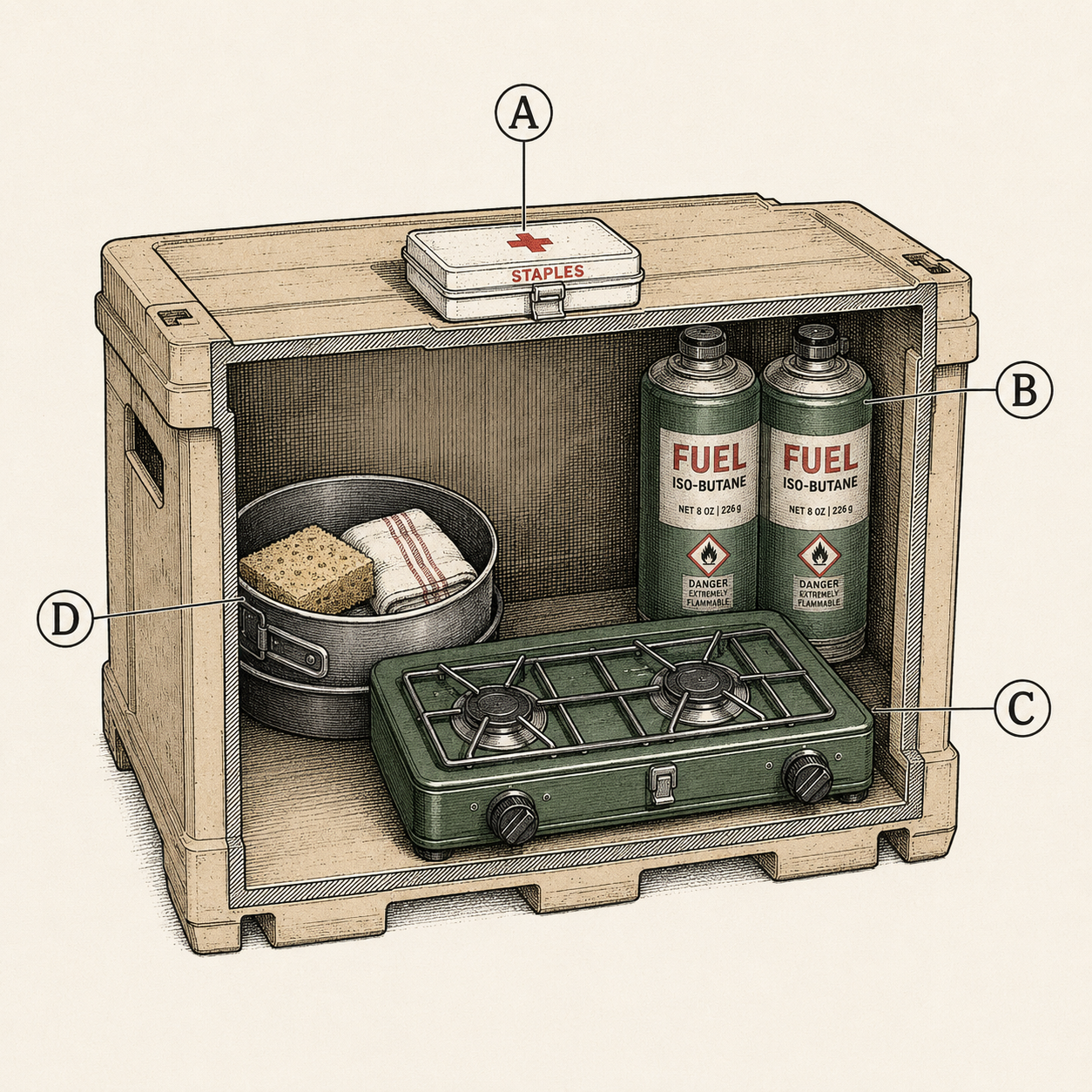
The kitchen kit's endgame is a dedicated crate or bin that lives packed between trips: stove, fuel, lighter, cookware, utensils, wash kit, and staples, always ready. Build it once and camp-kitchen packing becomes "grab the crate, add the cooler."
The crate concept beats per-trip packing for one deep reason: it survives success. After a good trip, gear scatters back into kitchen drawers, and the next trip re-runs the whole hunt. A crate returns to the garage shelf as a unit, gets its fuel and paper towels topped up in five minutes, and waits. Restocking is a habit; repacking is a project. Choose the habit.
What goes in is Chapter 15's business in detail, but the starter crate is: two-burner stove or single canister stove, two fuel units, lighter and waterproof matches, one pot with lid, one pan, spatula and spoon, knife and small board, a stack of plates and mugs, the wash trio (bin, soap, sponge), foil, trash bags, and a sealed staples box (oil, salt, pepper, coffee, sugar). Date the fuel with a marker. Nothing in the crate goes back into the house, ever; that's the rule that keeps it whole.
Clothing: pack layers, not outfits
Clothing packs by layer system, not by day: base layers against skin, an insulating mid-layer, and a shell against wind and rain, plus camp shoes and the two hats. For a weekend, one spare set of base layers covers hygiene; the outer layers repeat daily.
The full physics and fabric guidance is Part IV, but the packing rules stand alone. Rule one: cotton stays home for anything that might get wet or cold (the desert exception is Chapter 59's). Rule two: pack one full warm layer past what the forecast requires, per person; Chapter 2 already made this promise and every shoulder-season night keeps it. Rule three: camp shoes (anything slip-on with a real sole) are not a luxury; feet freed from boots at day's end are a morale event, and midnight bathroom trips need footwear that requires no hands.
Kids get one modifier: double their sock and base-layer count. Children locate water with a reliability adults lose with age, and wet socks end kid trips. Chapter 51 expands the kid kit properly.
Light, power, and tools
Every camper gets a headlamp; the site gets a lantern; the trip gets a power bank sized to recharge every phone twice. That trio covers ninety percent of light-and-power needs, and Chapter 38 covers the rest.
Headlamps per person is a safety rule wearing a convenience costume: the person walking to the toilet at midnight and the person holding the flashlight cannot be sharing one light. Modern LED headlamps run long and charge by USB; keep them staged with the sleep kit so nobody hunts at dusk. The lantern is the social light (table-height, diffuse, aimed at dinner rather than eyes), and the power bank note is specific on purpose: phones running maps, cameras, and no cell signal drain fast, and a dead phone is now a dead map, ticket wallet, and emergency line at once.
Tools stay minimal and honest: a multi-tool, fifty feet of paracord, duct tape (wrapped around a pencil rather than hauled as a roll), work gloves for firewood and hot grates, and the repair patches Chapter 13 details. Skip the hatchet-shovel-saw fantasy loadout for campground trips; you're cooking dinner, not clearing land.
Health, hygiene, and the paper products
The health kit is a real first-aid kit, everyone's prescriptions, sun and bug protection, and the hygiene basics, with two camp-specific additions: toilet paper in its own zip bag, and hand sanitizer used like a religion before every meal.
The sanitizer sentence is not fussiness. Gastrointestinal illness is the most common camping ailment by a distance, and hands-to-food is the route. Vault toilets stock paper unreliably (hence the zip bag) and soap never; the sanitizer bottle clipped to the kitchen crate handles it. The full first-aid build is Chapter 47, but check its two fastest-expiring items when packing: the pain relievers and anyone's epinephrine.
Sunscreen and insect repellent ride in the vehicle door pocket, not buried in a bin, because protection you can't reach at the trailhead is protection that doesn't happen. Chapter 27 and Chapter 46 argue about SPF numbers and DEET-versus-picaridin properly; the packing chapter just insists both bottles exist and are findable.
The forgotten-item hall of fame
The same dozen items get forgotten on every campground loop in the country, and the list is stable enough to print: lighter, can opener, coffee filters, salt, pillow, camp chairs, trash bags, bottle opener, spatula, toilet paper, firewood cash, and phone cables. Notice what unites them: all small, all "obviously someone packed that," all absent from kits assembled by memory.
The fix is structural, not moral. Items forgotten by memory get remembered by kit: the lighter lives in the crate (with a match backup taped to the stove), the salt lives in the staples box, the pillow rides inside the sleeping bag's stuff sack where it can't be left behind. Every hall-of-fame item should have a permanent home in one of the seven kits, and the driveway check becomes counting kits, not items.
Here's the scenario the hall of fame is built from. Saturday, 8:50 p.m., marshmallows out, and the bag of skewers is exactly where it belongs, in the drawer at home, because skewers belong to no kit. The fire's perfect. The kids are staring at you. A pocketknife and a green stick rescue this particular one (Chapter 32), but the lesson generalizes: anything that "belongs to the trip" belongs to a bin, or it belongs to the drawer.
Packing systems: bins, cubes, and the load-out
The system that works is boring: clear or labeled bins per kit, soft duffels or packing cubes for clothing, cooler and water jug loaded last at the tailgate. Aim for a standing load-out where every trip starts from the same garage shelf.
Bins beat bags for camp gear because camp is dusty, dewy, and horizontal: bins stack on a picnic table, shrug off ground moisture, close against raccoons' curiosity, and hold their organization when rummaged by headlamp. Label the ends, not the lids (you'll stack them), and keep bin weight liftable by the household's lightest packer. Clothing does better soft: one duffel or cube per person, packed by layer, stuffed into the car's gaps around the bins.
The load-out order from Chapter 2 gets one upgrade now that the gear list is real: pack the car in reverse-need order (clothes and bedding deepest, kitchen and cooler mid, shelter and lights at the tailgate), and keep a "first hour box" at the very back: headlamps, stakes and mallet, snacks, and the site confirmation. The first hour of camp runs entirely out of that box, and it's the difference between arriving organized and excavating.
Trailhead Takeaways
- Pack by the seven kits (shelter, sleep, kitchen, clothing, light/tools, health, personal), never by memory. Count kits in the driveway.
- Open the tent bag at home. Poles, stakes, fly. Every trip.
- The sleep kit decides the trip: thick pad, real pillow, extra blanket, dedicated dry sleep clothes in a sealed sack.
- Build the kitchen crate once; restock, don't repack. Nothing in the crate returns to the house.
- One warm layer past the forecast, per person. Cotton stays home. Camp shoes are policy.
- Headlamp per person, lantern per site, power bank sized for two full phone charges each.
- Every forgotten-item classic needs a permanent kit home. Memory is not a packing system.
Where Trips Go Sideways
- Packing by vibes on Friday afternoon. The trip assembled from memory in ninety minutes delivers a tent with seven stakes, no spatula, and someone's entire clothing bag still on the bed. Kits, bins, and a list beat every good memory in the household.
- The scattered kitchen. Camp gear that lives in kitchen drawers between trips has to be re-hunted every single time, and the can opener always loses. The crate costs one Saturday to build and repays it monthly.
- Borrowed tent, never opened. Chapter 2 said it and packing day is where it happens: the bag gets tossed in the trunk unopened, and the missing pole section presents itself at the campsite. At home, on the floor, count the parts.
- Everything in one giant bin. Fifty pounds, unliftable, and everything needed is somehow under everything else. Multiple medium bins, labeled on the ends, each liftable by anyone in the crew.
- No first-hour box. Arrival becomes excavation: stakes are under the food, headlamps are in someone's duffel, and the site confirmation is in an email with no signal. One tailgate box runs the whole first hour.
Frequently asked
What are the 10 camping essentials?
The classic Ten Essentials list covers navigation, sun protection, insulation, illumination, first aid, fire, repair tools, food, water, and emergency shelter. It was built for wilderness travel, and Chapter 12 unpacks each item properly. Memorize the categories rather than any brand-name kit, because the categories are what save trips. At a drive-in campground the same ten exist naturally across this chapter's seven kits; the car is your emergency shelter.
What is the most forgotten item when camping?
Lighters top most informal polls, with pillows, coffee gear, salt, trash bags, and toilet paper close behind. The pattern: small items that belong to no bin get left by memory. Give every classic a permanent home in one of the seven kits and the list loses its power.
What's a good checklist for camping?
One organized by kit: shelter, sleep, kitchen, clothing, light and tools, health, personal. Kit lists scale from one night to a week, split cleanly among a group, and reveal gaps in the driveway instead of at the campground. This chapter is the annotated version; Appendix A holds the printable ones.
How do you keep camping gear organized between trips?
Standing bins per kit on one garage or closet shelf, restocked within a week after each trip while the gaps are fresh. The kitchen crate stays packed permanently, sleep and shelter gear returns clean and bone-dry (mildew is the enemy), and a sticky note on the shelf lists anything consumed that needs replacing. Gear you can see is gear you'll actually use.