Part II · Shelter and Sleep
How Much Should a Good Tent Cost?
A Home That Fits in a Bag
How do you choose a tent?
Choose a tent on four decisions, in order: real capacity (rated capacity minus one), season rating (3-season for almost everyone), structure (freestanding for almost everyone), and price tier (the middle one). Everything else is a feature, and features come after the four decisions, never before.
Tents attract more anxious research than any other camping purchase, and most of it is wasted on the wrong questions. Brand debates and spec-sheet hairsplitting won't change your nights much. The four decisions above will. Get them right and a modest tent serves for a decade; get the capacity one wrong and no amount of premium fabric fixes a floor that's smaller than your family.
One framing before the details: a tent is a rain-and-bug enclosure, not a habitat. It holds sleeping people, their bags, and not much else, and the campsite is your living room. Buyers who accept that buy the right size and love their tent. Buyers who imagine standing headroom, gear storage, and rainy-day board games inside are shopping for a different product (it exists, it's heavy, and it's covered under family tents below).
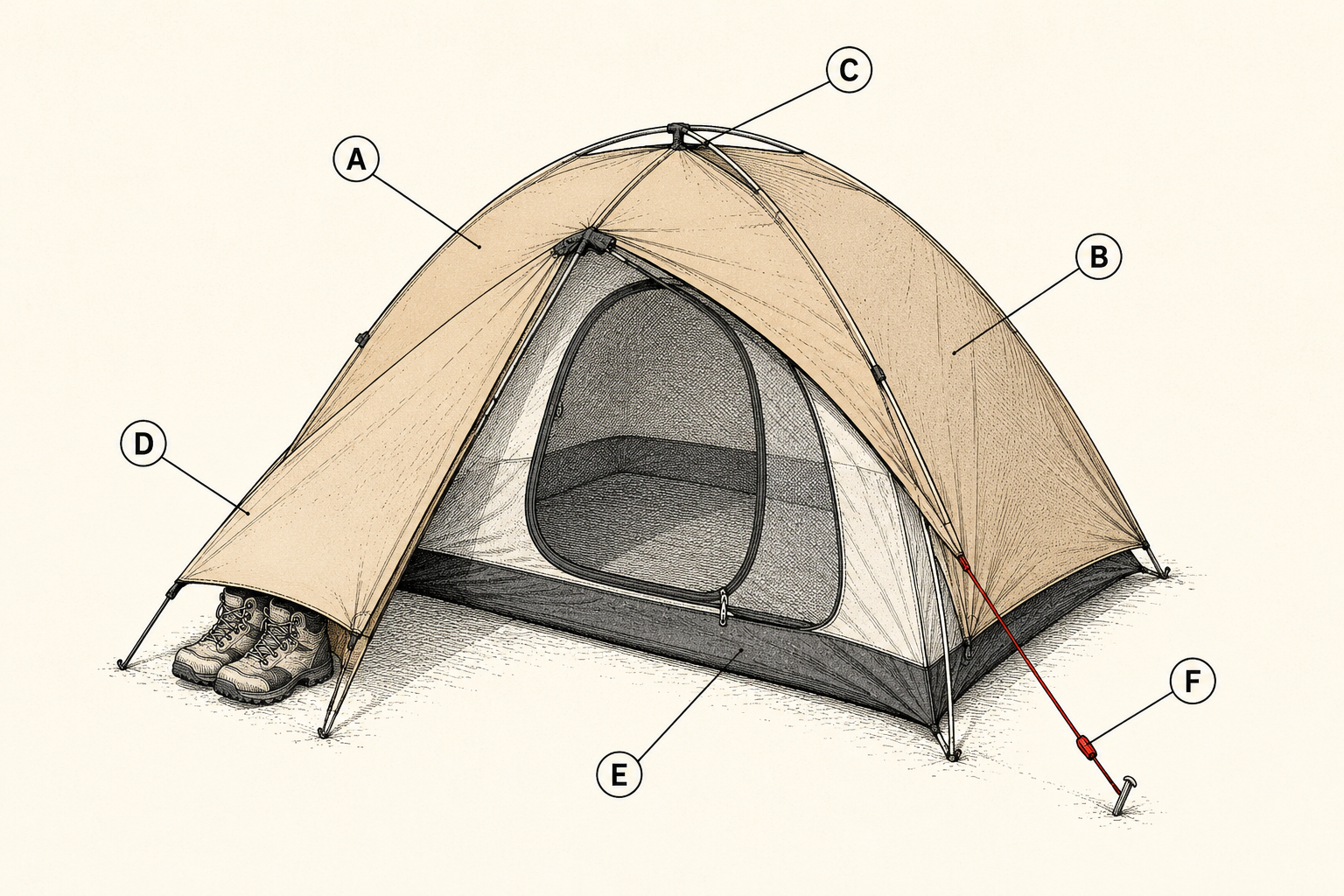
Tent anatomy: the parts and what they do
Every modern tent is the same seven parts: the inner body (mesh and fabric walls), the pole set, the rainfly, the floor (a "bathtub" that wraps up the sides), the vestibule (the fly's covered porch), guylines with tensioners, and stakes. Learn the names once and every product page and repair chapter in this book snaps into focus.
The relationships matter more than the parts. The inner body is barely water-resistant on purpose; the fly does the weather work, and the gap between them is what keeps condensation off your bag. That's why a fly pitched tight (taut, staked, not sagging onto the mesh) is the difference between a dry tent and a mysteriously damp one, and why Chapter 31 spends real time on it. The bathtub floor blocks ground water without a groundsheet's help, though a footprint underneath cheaply extends its life (Chapter 8). Vestibules hold boots and packs outside the sleeping space; two doors with two vestibules turn midnight exits from a crawl across bodies into a slip out your own side.
Tent size: the capacity math nobody prints
Subtract one from the rated capacity: a "4-person" tent sleeps three comfortably, a "6-person" sleeps four adults or two adults and three kids. Ratings count bodies at shoulder-to-shoulder backpacker density with no gear inside, a standard nobody camps at by choice.
The arithmetic behind the rule: capacity ratings allot roughly a 20-inch-wide strip per sleeper, while a standard sleeping pad is 20–25 inches wide and human shoulders prefer air between them. Add the duffel that has to live somewhere when the vestibule is full, the toddler who migrates, the dog. Minus-one restores all of that. Car campers should apply it without exception; backpackers splitting weight across a group can run at rated capacity and know exactly what they're signing up for.
Two more size numbers earn a glance. Floor dimensions beat the person-rating for tall campers: past about 6'2", look for a floor 90 inches or longer so your bag's footbox isn't pressed into the wet fly. Peak height sorts tents into crawl-in (under 45 inches), sit-up (45–60 inches), and stand-up (72 inches and up); car campers who'll dress adults inside should think hard about the stand-up class, and backpackers shouldn't carry it.
3-season vs 4-season: which tent rating do you need?
A 3-season tent covers spring through fall, which is to say it covers almost everyone reading this book. A 4-season tent is a snow-loading, wind-shedding specialist that trades ventilation for strength, and outside winter mountaineering it's a hot, heavy mistake.
The names mislead, so decode them. "3-season" means mesh-heavy walls for airflow, a fly for rain, and poles built for weather up to gusty, not brutal. "4-season" doesn't mean "all seasons plus one": it means fabric walls instead of mesh, more and stronger poles, and geometry that sheds snow, all of which makes July inside one a greenhouse. The winter camping most people actually do (a cold shoulder-season night, an occasional dusting) is 3-season territory with the right sleep system, which is Chapter 36's whole argument. Buy the 4-season tent when you've booked the kind of trip that requires it (Chapter 55), and not a season before.
| 3-season | 4-season | |
|---|---|---|
| Walls | Mostly mesh | Mostly fabric |
| Handles | Rain, wind, bugs, heat | Snow load, sustained high wind |
| Weight | Lighter | Noticeably heavier |
| Summer use | Comfortable | A greenhouse |
| Who needs it | Nearly everyone | Winter mountaineers, deep-snow campers |
Freestanding or not?
A freestanding tent stands on its poles alone and can be pitched, moved, and shaken out like a basket; a non-freestanding tent needs stakes and tension to exist. Buy freestanding unless you're chasing grams, and even then think twice on your first shelter.
Non-freestanding designs (trekking-pole tents chief among them) are how backpackers hit startlingly low weights, and in practiced hands they're excellent. But they demand a good pitch every single night: soil that holds stakes, angles that took practice, and re-tensioning when the fabric relaxes. A freestanding tent forgives all of it. It stands on rock slabs and gravel pads where stakes bounce, it relocates in ten seconds when you discover the root under your hip, and it flips upside down to dump the morning's sand. Forgiveness is worth weight early in your camping life. The gram-counting conversion can come later, when your pitching is automatic (Chapter 31) and your trips justify it.
The family tent: what actually matters
A family tent succeeds on five criteria: minus-one capacity that fits everyone plus a buffer, near-standing peak height, two doors, a full-coverage fly, and a pitch one adult can manage alone while the other adult manages the children. Everything else, including the screened porch in the product photos, is nice.
The one-adult-pitch criterion gets missed most and matters most, so here's the scenario that proves it. You arrive at 5:40 with two kids melting down on schedule. One parent takes snacks and the nature walk; the other takes the tent. If that tent needs two adults to thread a 20-foot pole spine, camp setup and child management are now the same job at the same time, and both go badly. Practice-pitch any family tent in the yard before its first trip, once, and time it. Twenty minutes solo is fine. Forty-five is information.
Beware the "instant" and "pop-up" cabin tents that pitch in two minutes on brilliant hinged frames: the mechanism is real, the fly coverage is usually skimpy, and the folded pole bundle is a duffel-sized commitment in the garage. They're honest fair-weather machines for campground summers, and this book won't sneer at them; just know that what you saved in setup you'll spend the first stormy night, when a partial fly meets sideways rain.
Features worth paying for (and skipping)
Worth it: two doors with two vestibules, a full-coverage fly, color-coded poles and clips, interior pockets at head height, and quality stakes bought separately. Skip: gear lofts you'll never load, footprint upsells (Chapter 8 makes yours for a tenth the price), "UV-resistant" marketing claims, and any tent sold primarily on a mosquito-themed acronym.
Doors are the sleeper feature. One-door tents price well because the second door is real cost, and every night two people share a one-door tent, the far sleeper pays the toll: over the pad, over the legs, onto the boots, everyone awake. Two doors dissolve the whole transaction. Pockets sound trivial until you've hunted a headlamp inside a dark nylon bag the size of a refrigerator box; a pocket at each sleeper's head ends it.
On fabric specs: you'll see denier numbers (fabric thread weight; higher is tougher and heavier) and hydrostatic head ratings in millimeters (water-column pressure the fabric resists before leaking). Useful gauges, weak deciders. A floor around 68–70 denier shrugs off campground gravel that a 15-denier ultralight floor treats as an event, and fly ratings of 1,200 mm and up handle real rain fine when the pitch is taut. But a mid-tier tent from any serious maker clears those bars, which frees you to decide on the four decisions and the doors.
What a good tent costs
The tent market runs three honest tiers: budget (roughly $80–150 for a serviceable campground 2–4 person dome), mid-range (roughly $150–400, where materials, poles, and design quality jump fastest), and premium ($400+, where you pay for low weight and expedition engineering). The mid tier is the recommendation for anyone camping more than twice a year.
The budget tier is better than its reputation and exactly as good as its price. Fiberglass poles instead of aluminum (heavier, and they splinter rather than bend), coatings that peel a few seasons sooner, zippers that get temperamental with sand. For four fair-weather weekends a summer, none of that may ever surface, and a first-year camper spending $110 to find out what they want is spending well. What moves you into mid-range: aluminum poles, a fly that covers the whole tent, taped seams that stay taped, and the two-door layout. What moves you into premium: ounces, and you'll know when ounces start mattering to you.
Buy last year's model. Tent design changes glacially and colorways change annually, which makes the outgoing version of a mid-range tent the best deal in camping every single fall.
Try before you rely
Whatever you buy, pitch it at home the week it arrives, then sleep in it once before it goes anywhere important. You're checking three things: all parts present, no factory defects (it happens), and the real setup time, learned calmly instead of at dusk.
The home pitch doubles as seam-sealing day if your tent needs it (most arrive taped; some budget and ultralight models ship with sealant and an assignment). Hose the pitched tent down for ten minutes and sit inside; finding the drip in the yard converts a bad night to a warranty claim. Register the warranty while the fly dries. Serious tent makers repair honestly and often cheaply, and that relationship outlasts most tents' owners.
Trailhead Takeaways
- Four decisions in order: capacity minus one, 3-season, freestanding, mid-tier price. Features come after.
- The fly does the weather work; the mesh does the bug work; the gap between them keeps you dry. Pitch the fly taut.
- Rated capacity assumes shoulder-to-shoulder sleepers and no gear. Subtract one, always, for car camping.
- 4-season means snow specialist, never "better." Almost everyone wants 3-season.
- Family tents: near-standing height, two doors, full fly, and a pitch one adult can do alone. Time it in the yard.
- Pay for doors, fly coverage, and aluminum poles. Skip lofts, upsold footprints, and acronyms.
- Pitch it at home, hose it down, sleep in it once. Then trust it.
Where Trips Go Sideways
- Believing the capacity number. Four adults enter a "4-person" tent with four pads and four duffels. Geometry declines to cooperate. The gear spends the weekend in the car and the people spend it touching shoulders. Minus one. Every time.
- Buying the 4-season tent "to be safe." It cost double, weighs double, and turns July nights into a sauna because the walls that block spindrift also block breeze. Safe is a 3-season tent plus Chapter 36's sleep system.
- First pitch at the campsite. The instructions are in the bag, the bag is in the dark, and the color-coded clips are a color the headlamp can't distinguish. Every tent's first pitch happens at home. House rule.
- The one-door family tent. It saved $60 and costs one full-tent wake-up per bathroom trip, per night, all season. The second door was the cheapest sleep upgrade on the spec sheet.
- Skipping the hose test. The maiden voyage found the unsealed seam at 2 a.m., forty miles from the receipt. Ten minutes of yard rain finds it for free.
Frequently asked
How much should a good tent cost?
For most campers, $150–400 buys the sweet spot: aluminum poles, full-coverage fly, taped seams, two doors. Under $150 gets honest fair-weather shelter with heavier, weaker parts. Past $400 you're mostly buying lightness for backpacking, which car campers shouldn't pay for. Whatever the tier, last year's colorway is the perennial bargain, because tent design changes glacially and paint changes annually.
What are the 4 types of tents?
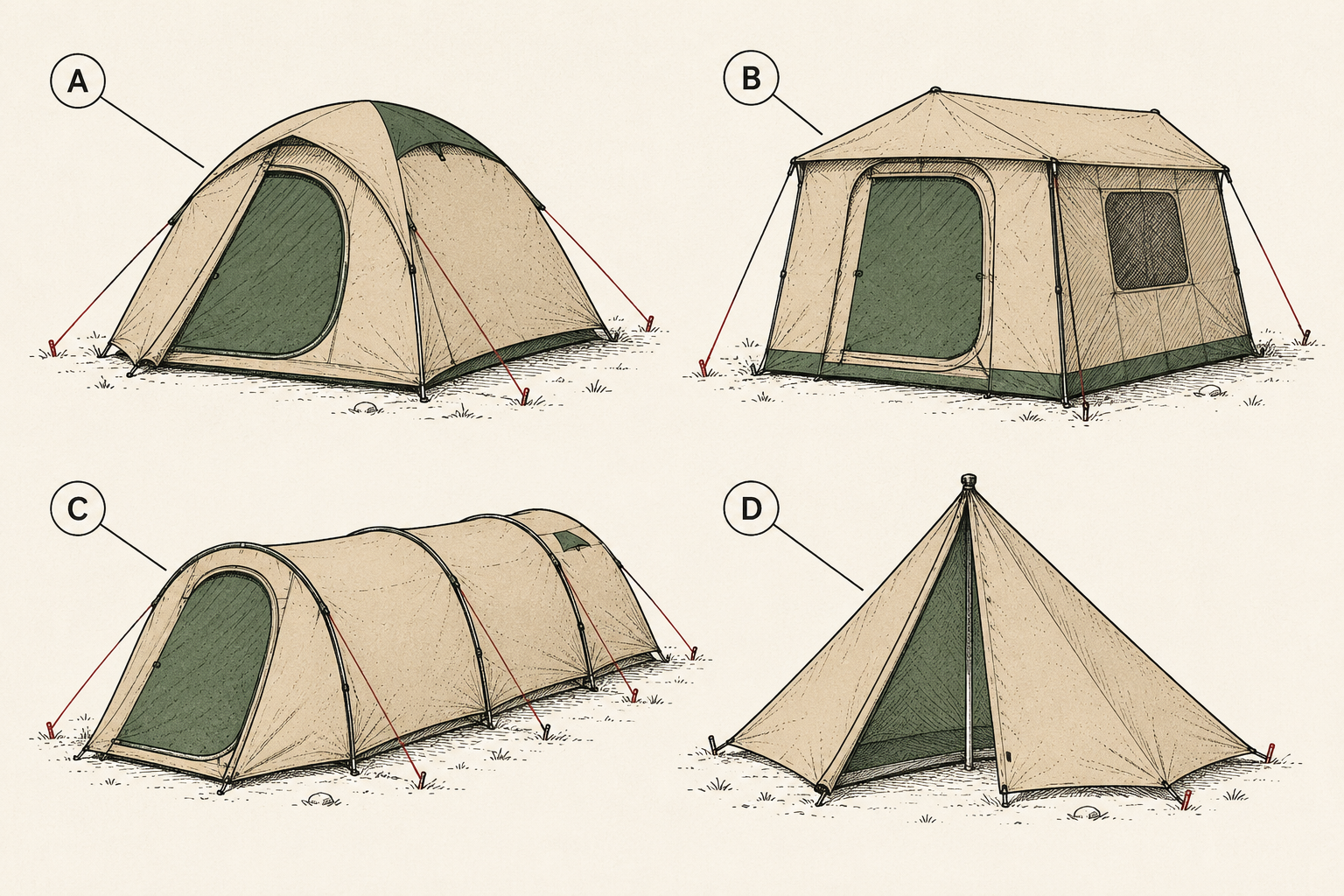
By shape: domes (crossed poles, good wind manners, the default), cabins (vertical walls, standing height), tunnels (arched hoops, stake-dependent), and trekking-pole pyramids (ultralight, skill required). Most buyers want a dome, and families who want to dress standing up want a cabin.
What tent brands are the most reliable?
Reliability tracks tier more than logo. Any maker with a real repair program, taped seams, aluminum poles, and a multi-year warranty is in the trustworthy class; the mid-range lines from the major outdoor brands all qualify. Judge the specific tent (doors, fly coverage, pole material) and the warranty page, then ignore the logo wars.
Do I really need the footprint?
Not the branded one. A ground cloth extends floor life on gravel pads and rocky dispersed sites and can be cut from builder's tarp for a few dollars (Chapter 8 shows how, including the fold-it-smaller-than-the-floor rule that keeps rain from pooling under you). Sandy or grassy sites barely need one at all.