Part II · Shelter and Sleep
What R-Value Do I Need for Camping?
What's Under You Matters Most
What sleeping pad do you need?
For three-season camping, buy a pad with an R-value of 2–4 and as much thickness as your style carries: 2–3 inches inflatable for backpacking, 3–4 inches (or a frank air mattress plus insulation) for car camping. Cold-shoulder-season campers want R 4–6. The pad is half your sleep system, and on cold ground it's the more important half.
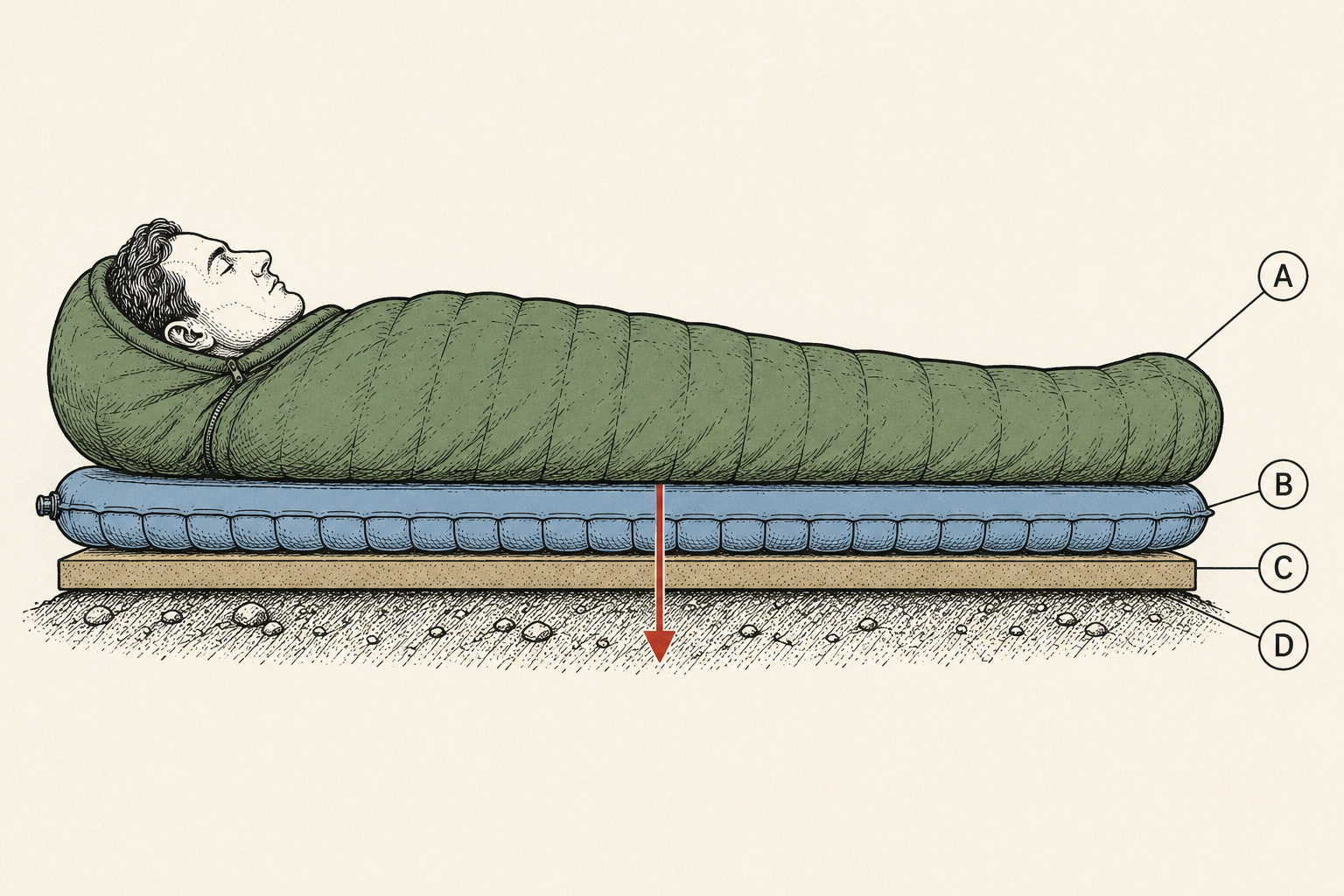
That last sentence is this chapter's thesis, and Chapter 9 already loaded the physics: insulation works by loft, your body crushes the bag's underside flat, so whatever is under you does all the under-you insulating. The ground, meanwhile, is an infinite heat sink. Air cools you by convection, slowly; ground conducts heat away on contact, fast, all night, at whatever temperature the earth is running (chilly even in summer, a few inches down). A magnificent bag on a bad pad sleeps cold. A modest bag on a great pad sleeps fine. Buyers get this backwards approximately always, because bags are glamorous and pads are furniture.
Spend accordingly. If the budget forces a choice, upgrade the pad first.
R-value: the number that means what it says
R-value measures a pad's resistance to conductive heat loss, tested under the ASTM F3340 standard, so numbers compare honestly across brands. The scale is roughly: under 2 for warm-weather only, 2–4 for three-season, 4–6 for cold shoulder seasons, 6+ for snow. And R-values add: a foam pad under an inflatable combines both numbers.
| Conditions | Ground temp feel | R-value target |
|---|---|---|
| Warm summer, lowland | Mild | 1–2 |
| Typical three-season | Cool | 2–4 |
| Late fall, early spring, high elevation | Cold | 4–6 |
| Snow, frozen ground | Brutal | 6+ (often stacked) |
Two practical notes ride along. First, unlike bag ratings, R-value has no comfort-vs-limit games; the standard test is the number. Second, the additive property is the budget cheat code of the whole sleep system: a $25 closed-cell foam pad (roughly R 2) under your existing inflatable turns a summer setup into a shoulder-season one, adds a puncture-proof backup to boot, and costs less than any single "winter pad" on the market.
The three pad types
Closed-cell foam, self-inflating, and inflatable pads split the market, and each is the right answer to a different question. Foam for indestructible cheap backup and summer minimalism; self-inflating for car-camping simplicity; inflatable for the best warmth and comfort per ounce, at the price of care and a repair kit.
Closed-cell foam (the accordion-fold or roll of textured foam) can't puncture, can't fail, weighs little, costs least, and sleeps thin: about R 2 and half an inch of cushion, which young backs tolerate and older ones review poorly. It moonlights brilliantly: sit pad, dog bed, the under-layer in the stacking trick. Self-inflating pads (foam-filled chambers that expand when the valve opens) are the honest middle: quiet, durable, moderately warm, moderately bulky, and the default rental-fleet pad for good reason. Inflatable pads are the modern backpacking standard: 2.5–4 inches of adjustable air, R-values from 1 to 8 depending on internal insulation, packing to a water-bottle size. Their bills: they puncture (Chapter 13 patches them in ten minutes), some crinkle like chip bags (read reviews with ears), and they want the storage habit from Chapter 9 (unrolled, valve open).
Recommendation by style: backpackers buy one good insulated inflatable and strap a foam pad on for cold trips. Car campers skip straight to thickness: a wide self-inflating pad, a luxury 4-inch inflatable, or the air-mattress route below.
Cots: the off-the-ground option
A camp cot lifts you onto a stretched fabric deck: no ground contact, no pressure points from roots, effortless getting up, and glorious summer airflow. That airflow is also the catch: a cot alone is a cold sleep below about 60°F, because moving air replaces the ground as the heat thief. The fix is the same pad you were escaping, laid on the deck.
Cot-plus-pad is arguably the best cold-weather car-camping bed there is: the cot removes ground conduction entirely, the pad blocks the convective underside loss, and the combination outperforms either alone. The costs are bulk (a folded cot is a duffel of its own), weight (car camping only, with rare ultralight exceptions), floor space (measure your tent; a cot plus walking room wants the next tent size up), and point loads (cot feet dimple tent floors; a square of that footprint tarp under each foot spares the bathtub).
Who should jump straight to a cot: side sleepers who fight pads, anyone with a bad back or bad knees, pregnant campers, and everyone who's declared they "can't sleep on the ground." That declaration is usually a pad-thickness complaint wearing a costume, but the cot solves it either way, and getting up at 2 a.m. from knee height instead of floor height converts skeptics fast.
The air mattress, rehabilitated
The household inflatable air mattress is heavy, bulky, pump-dependent, and, for car camping, kind of great: 8–18 inches of adjustable comfort at a friendly price. Its two real flaws are fixable: it's an R-value catastrophe (a giant uninsulated air tank that convects your heat into the night), and it fails without warning (always pack a repair kit and a backup plan).
The insulation fix is cheap and mandatory below about 60°F: a closed-cell foam pad, a folded wool blanket, or even the spare comforter between mattress and sleeper, plus something between mattress and cold ground if the tent floor sits on gravel. Without that layer, campers report the paradox of freezing on a warm bed in a warm bag; the mattress was air-conditioning them from below. The pump fix is planning: a rechargeable pump (topped up with the Chapter 6 power bank) or a 12-volt one that runs off the car. Lung-inflating a queen mattress is a stunt, not a plan.
One honest note on longevity: budget air mattresses live hard, short lives, with slow leaks arriving on their own schedule. The morning sag isn't always a hole; air contracts on cold nights and vinyl stretches when new. Top it up nightly for the first trips before diagnosing a leak (and then Chapter 13's soap-bubble hunt finds it).
Pillows, positions, and the rest of comfort
Once warmth is handled, camp sleep comes down to three adjustables: pillow height, pad firmness, and pre-sleep routine. Car campers solve the pillow by bringing the one off their bed. Backpackers choose between inflatable pillows (light, boaty) and the stuff-sack-of-clothes classic (free, formless); the hybrid, a fleece layered over an inflatable, fixes most complaints.
Pad firmness is the adjustment nobody makes: a rock-hard inflatable is a common self-inflicted wound. Let air out until your hip sinks in without touching ground when side-lying; the pad should hold you the way snow holds a footprint, "full" is for pool floats. Side sleepers want thicker pads and softer settings than back sleepers, and rotators should size up in width (25-inch pads exist because 20-inch ones assume you hold still, which you don't).
The routine is Chapter 2's night section grown up: warm before bed beats warming in bed, dry sleep clothes always, and give yourself the same wind-down you'd want at home. The first night out sleeps light for almost everyone (new sounds, new bed; researchers call it the first-night effect, and it fades with familiarity). Trips two and three sleep better. That's a promise with a mechanism, and it's another argument for camping more often, closer to home.
Building the sleep system: three worked examples
Budget car camper: rectangular synthetic bag (Ch. 9), self-inflating 3-inch pad or air mattress with a blanket under the sleeper, home pillow, earplugs. Modest money total, and it sleeps like a guest room from June to September.
Three-season backpacker: 20°F-comfort down bag or quilt, insulated inflatable pad around R 4, foam pad added for shoulder-season trips (stack math: R 4 + R 2 = snow-adjacent capable), inflatable-plus-fleece pillow. This is the classic kit that a decade of trips refines but never really replaces.
The cold sleeper's rescue kit (applied to whatever you own): foam pad under the current pad, liner in the current bag, hood cinched, hat on, dinner eaten, hot water bottle in the footbox (Chapter 36's trick, previewed). Every item attacks a different loss path, which is why the stack works when any single upgrade didn't.
Trailhead Takeaways
- The ground steals heat by conduction, faster than air does. The pad is half the sleep system and the more urgent upgrade.
- R-value is honest and additive: 2–4 for three-season, 4–6 for cold shoulders, 6+ on snow, stack cheap foam under anything to level up.
- Foam = indestructible backup; self-inflating = simple car comfort; inflatable = backpacking standard with a repair kit.
- Cots kill ground contact but invite airflow: below 60°F, cot plus pad, always.
- Air mattresses are fine car-camping beds once insulated on top and pumped by machine.
- Firmness is adjustable: let air out until your hip floats. Full inflation is a pool-toy setting.
- First nights sleep light everywhere. It fades. Camp again.
Where Trips Go Sideways
- The $400 bag on the $20 pad. All that down, crushed flat, over R 1, on October ground. The receipt insulated nothing. Pad first is the rule precisely because everyone learns it second.
- The air mattress in the cold snap. Warm bag, warm night forecast, 45°F reality, and an uninsulated air tank convecting all of it away. Freezing on top of a mattress feels impossible right up until it's 3 a.m. Blanket under sleeper. Foam under mattress.
- The bare cot in June. Seventy at sunset, mid-50s by dawn, and the breeze that felt heavenly at 9 p.m. spent the night harvesting body heat through the fabric deck. A cot is a bed frame, never a mattress.
- Pool-float inflation. Pumped drum-tight "for support," the pad transmitted every shoulder-point and hip-point straight to the sleeper, who rated ground sleeping unfairly forever after. Vent to a snow-print softness and re-judge.
- No pump plan. A queen mattress, two winded adults taking turns at a valve at dusk, and a toddler asking questions the whole time. The rechargeable pump costs little and charges off the power bank you already packed.
Frequently asked
What R-value do I need for camping?
Match the season: R 2–4 covers typical three-season campground nights, R 4–6 for late fall and early spring or high elevations, R 6+ on snow. Warm-summer-only campers can run under 2. When between sizes, buy warmer or plan to stack; unused R-value costs nothing at night.
Is a cot warmer than sleeping on the ground?
Only above roughly 60°F. A cot removes the ground's conductive theft but exposes your underside to moving air, which below that line steals heat nearly as fast. Cot plus pad beats both alone and makes one of the best cold-weather car-camping beds available.
Why do air mattresses sleep cold?
They're uninsulated air tanks: your body heats the air, the vinyl radiates and convects it to the ground and the night, repeat until dawn. Any insulating layer on top (foam pad, wool blanket, folded comforter) breaks the cycle. Below about 60°F, treat that layer as part of the mattress.
Can you stack sleeping pads?
Yes, and R-values add: foam R 2 under an inflatable R 3 performs like R 5, which is genuine shoulder-season warmth from a $25 add-on. Foam goes on the bottom, where it also shields the inflatable from punctures and gravel. Stacking is the cheapest cold-weather upgrade in the entire sleep system, and it packs a free backup pad into every trip.