Part III · The Camp Kitchen
Non-Toxic Camping Cookware
The Kitchen in a Crate
What cookware do you need for camping?
A car-camping kitchen cooks nearly everything with six pieces: a 3–4 quart pot with lid, a 10–12 inch skillet, a cutting board, one good knife, a spatula, and a stirring spoon. Add a kettle or coffee rig for morale and a 10–12 inch Dutch oven when fire cooking calls. The backpacking version is one pot, one spork, and done.
The six-piece claim isn't minimalism for its own sake; it's how the crate stays carryable and how dishes stay a ten-minute job instead of the evening's second act. Camp cooking multiplies whatever you bring: every pot is also a thing to wash, dry, and repack. The recipe chapters (19–21) were written against exactly this set, on purpose, so nothing in them will ever ask for the fish poacher.
What not to buy first: the 17-piece nesting "camp cookware set" whose pieces exist to fill the box. Half of it duplicates your six, the pots are thin enough to scorch rice at a glance, and the tiny plates blow off tables. Assemble the kit piecewise (thrift stores are camp-kitchen goldmines: heavy old pots and skillets for pocket change) and it'll be better and cheaper than the box.
Materials: what pots are made of and why it matters
Four materials cover camp cookware, each with one honest sentence: aluminum (cheap, light, heats fast and unevenly, fine for boiling), hard-anodized aluminum (the good middle: tougher, more even, easy release), stainless steel (indestructible, scorch-prone, heavy-ish, thrift-store abundant), and cast iron (heavy, immortal, the fire-cooking king). Titanium is the backpacking exception: featherweight, boils fast, sears never.
| Material | Weight | Heat behavior | Best role |
|---|---|---|---|
| Aluminum | Light | Fast, uneven | Budget boiling, pasta water |
| Hard-anodized | Light-mid | Even, forgiving | The do-everything car pot and pan |
| Stainless | Mid-heavy | Slow, hot-spotty | Bombproof pots, thrift builds |
| Cast iron | Heavy | Slow, even, holds heat | Fire and coals, searing, Dutch oven |
| Titanium | Featherweight | Instant, scorchy | Backpacking boil pots |
Nonstick coatings deserve a plain word, since "non-toxic cookware" is a question every camp cook eventually asks. Modern PTFE nonstick is fine at normal cooking temperatures and damaged by campfire-grade overheating and metal spatulas, which are both camp specialties; PFAS-associated manufacturing has pushed many buyers off it regardless. The camp-proof answers are hard-anodized (naturally decent release), well-seasoned cast iron (nonstick that improves with abuse), and stainless plus a little extra oil and humility.
Cast iron and the Dutch oven, demystified
Cast iron earns its weight the moment fire enters the kitchen: it laughs at coals, sears like a restaurant, and a camp Dutch oven (the three-legged, flanged-lid kind) turns a fire ring into an actual oven for bread, stews, and the cobbler that closes Chapter 21. The care ritual that scares people off is genuinely three sentences long.
Here it is. After cooking, scrape and rinse while warm (water is fine; the no-water rule is folklore), dry it completely over residual heat, and wipe the cooking surface with a thin film of neutral oil. That's seasoning maintenance, the whole religion. Rust from a lapse scrubs off with steel wool, after which you re-oil and bake it (upside down, 450–500°F, an hour, at home) and the pan forgives you completely. Soap in moderation is fine on modern seasoning; what actually kills cast iron is storage while damp, same as every other thing in this book.
Dutch oven specifics, since the flanged lid is the trick: heat comes from coals below and on the lid, and the starting ratio is the rule of threes: for a target around 350°F, take the oven's diameter in inches, subtract three for the coals underneath, add three for the coals on top (a 12-inch oven: 9 under, 15 on top). Rotate oven and lid a quarter turn opposite ways every 10–15 minutes to erase hot spots. Chapter 19 cooks with it; here, just buy the 10 or 12 inch with legs, and buy the lid lifter, which is not optional the first time you're holding a 500°F lid of coals over dessert.
The three-station camp kitchen
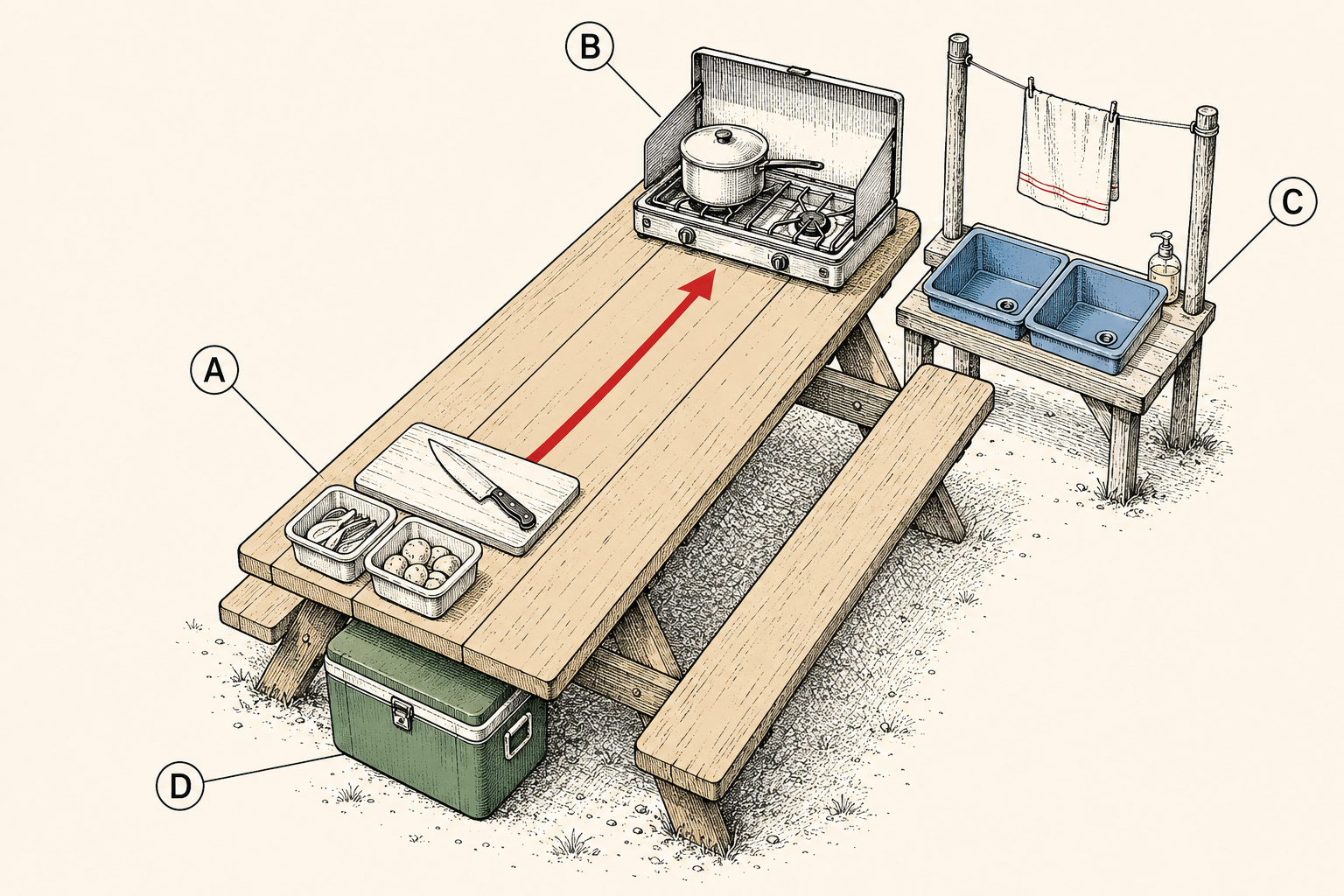
A camp kitchen that works is three stations in a row: prep (cutting board and bins), cook (stove, fuel, pans), and wash (the bins and drying line of the next section), arranged so raw food flows one direction and nobody crosses behind the cook. It sets up in five minutes on any picnic table and it's the difference between cooking dinner and performing crowd control.
The layout rules, portable to any site: stove downwind end of the table, never at the center where every reach crosses the flame; prep upwind with the cooler under the table's end in shade; wash station off the table's far corner, because splash and food scraps want distance from the kitchen; lantern hung high at center, lighting everything and blinding no one (Chapter 38). The under-table cooler placement isn't casual: it shades the ice, keeps the lid closable with a knee, and leaves the whole table surface for humans.
Two habits complete the kitchen. The crate (Chapter 6) opens once and becomes the pantry shelf at the table's end, not a scavenger hunt in the trunk. And the kitchen closes at night: everything scented (Chapter 2's rule) back to the car or locker, table wiped, gray water dealt with, so morning-you inherits a kitchen instead of a raccoon crime scene.
The wash station: dishes without drama
Camp dishes run the two-bin system: one basin of hot soapy water (heated on the stove while dinner's eaten), one of rinse water, a scraper, and a line or mesh bag for air drying. Ten minutes, start to finish, every meal, and the system's real product is a camp that never accumulates the crusted-pot backlog that ruins Sunday.
The order of operations: scrape every plate and pot into the trash first (scraping is 80% of washing; food scraps in the basin turn wash water into soup), wash from cleanest to dirtiest (cups, plates, pots, the greasy skillet dead last), rinse, hang or rack. Biodegradable camp soap, used sparingly, and the one disposal law: even biodegradable soap never goes in a lake or stream. Gray water gets strained (a scrap of window screen over a cup catches the noodles, scraps to trash) and then broadcast wide over ground 200 feet (about 70 adult paces) from water, or poured down the campground's utility drain where one exists.
Hot water is the luxury that makes the whole system pleasant: put the wash pot on the stove as you sit down to eat, and by dishes time it's steaming. Wear the crate's gloves for the greasy skillet. Morale around a camp kitchen tracks the wash station almost as closely as the menu.
The backpacking kitchen
The trail kitchen is one 750 ml–1 liter pot, one long-handled spoon, a mug if coffee matters, and the canister stove from Chapter 14; meals rehydrate in their own bags and the pot only ever boils water. This isn't deprivation, it's specialization, and it washes with a splash of hot water and a swallow.
The one-pot logic runs on Chapter 18's menu design: boil-only meals mean no scrubbing, no grease, no residue attracting Chapter 45's subject matter to your camp. The long spoon reaches the freeze-dried bag's corners without knuckle sacrifice. Upgrades that survive contact with actual miles: a fold-flat cutting mat and a real small knife for the cheese-and-salami school of trail lunch, and a second mug for the partner whose morning personality also matters.
What doesn't survive: the trail skillet dream, for most people. Fresh eggs at 9,000 feet are a lovely stunt, and Chapter 22's fish are the honest exception (a foil packet handles them without the pan). Carry the skillet when the trip is short and the fish are likely; otherwise the pot rules alone.
Utensils, extras, and the earn-your-spot test
Beyond the core six, every item passes one test to enter the crate: does it do a job the core six can't, at least once per trip? Passes: long tongs (fire and grill work), a lighter tethered to the crate, foil (Chapter 19 makes it cookware), a small whisk if pancakes are policy, the coffee rig, a corkscrew/bottle opener, and the collapsible water jug spout. Fails, usually: the egg holder, the marshmallow gun, matching everything, and any unitasker sold in the camping aisle's impulse zone.
The plates-and-cups question settles on enamelware or hard plastic: both survive drops, stack tight, and hold a decade. Insulated mugs are the one splurge with daily payoff, keeping coffee drinkable through a cold morning's tent teardown. Paper plates are honest for big-group weekends (they end dishes) and hypocritical for anyone lecturing about pack-it-out; whichever you choose, choose on purpose.
Knife note, because it's the kitchen's one safety-relevant tool: a $10 plastic-handled chef's knife with a blade guard cooks better than any folding camp knife, and it stays in the crate, in its guard, always. Chapter 34's knife skills apply at the cutting board too: cut away from yourself, claw grip, and a board on a stable table, not a plate on a knee.
Trailhead Takeaways
- Six pieces cook everything: 3–4 qt pot, 10–12 in skillet, board, knife, spatula, spoon. Build piecewise; skip the 17-piece box.
- Hard-anodized for the daily pot and pan; cast iron the moment fire cooking starts; titanium only on your back.
- Cast iron care is three sentences: rinse warm, dry completely, wipe with oil. Damp storage is the only real killer.
- Dutch oven heat: diameter minus three coals under, plus three on top ≈ 350°F. Rotate quarter turns. Buy the lid lifter.
- Kitchen = three stations in a row: prep upwind, cook downwind, wash off the corner, cooler shaded under the table.
- Dishes: scrape first, two bins, cleanest to dirtiest, strain the gray water and broadcast it 200 feet from water.
- Everything new to the crate passes the earn-your-spot test. The core six vote no on most of it.
Where Trips Go Sideways
- The 17-piece set. It looked complete in the box and cooked like foil: scorched rice, warped lids, plates airborne by noon. One heavy thrift-store pot outperforms the whole clamshell.
- Cast iron stored damp. One October rinse, one lid closed on moisture, one orange constellation by spring. Dry it over the stove's last heat and wipe it with oil; the ritual is shorter than this paragraph.
- The stove at center table. Every plate, kid, and elbow crossed the flame all weekend, and the near-miss count hit double digits by Saturday dinner. Downwind end. Traffic flows one way.
- Dishes deferred. "We'll do them in the morning" turned the skillet into a raccoon buffet and the morning into an archaeology project. The two-bin system runs while the coffee-water heats. Ten minutes. Every meal.
- Soap in the lake. Biodegradable on the label, algae bloom in the cove. Biodegradable means soil microbes can break it down, on land, dispersed. No soap touches open water, ever.
Frequently asked
What is the best cookware for camping?
For car camping: a hard-anodized aluminum pot and skillet as the daily drivers, cast iron when fire cooking calls, and stainless where budget rules (thrift stores overflow with it). For backpacking: one titanium or aluminum pot. The best set is the smallest one that cooks your actual menu.
What are non-toxic camping pots and pans?
Well-seasoned cast iron, stainless steel, and uncoated hard-anodized aluminum are the camp-proof answers: no coating to overheat or scratch, which matters over fires where temperatures run past what nonstick tolerates. If you keep a nonstick pan, reserve it for the stove and wooden or silicone tools.
What is the best pan for campfire cooking?
Cast iron, without much argument: a 10–12 inch skillet for searing and frying, or the flange-lidded camp Dutch oven for baking and stews with coals above and below. It shrugs off flames that destroy everything else, holds steady heat over uneven coals, and its seasoning improves with every trip.
How do you clean a Dutch oven at camp?
While it's warm: scrape it out, add water, bring it to a brief simmer to lift the stuck bits, scrub with a brush or scraper (no need for soap in a seasoned oven; a little is fine if used), then dry it fully over the fire's edge and wipe the inside with a thin oil film. Store it with the lid cracked so air circulates.