Part III · The Camp Kitchen
What Temperature Are Campfire Coals?
Cooking Where There's No Counter
How do you cook over a campfire?
Cook over coals, never flames. Flames deposit soot and scorch; a bed of glowing coals delivers steady, adjustable, oven-grade heat. The method is always the same: burn a hardwood fire down for 45–60 minutes, rake coals into a cooking zone, keep the fire alive next door as a coal factory, and cook beside the fire rather than in it.
That paragraph deletes 90% of campfire cooking failures, which are all the same failure: impatience. The marshmallow-blackening flame stage of a fire is for atmosphere; the cooking stage arrives when flames die back and the wood collapses into orange-and-gray embers that shimmer instead of flicker. Everything in this chapter (grates, foil, skewers, Dutch ovens) assumes coals, and everything rewards the two-zone layout: an active flame zone feeding fresh coals, and a cooking zone you rake them into, refreshed as they fade.
Legal preamble, standing: fire cooking exists only where fires currently do (Chapter 5's per-trip check), and the stove (Chapter 14) remains the primary kitchen. This chapter is the second stove, the delicious one.
Building the cooking fire
The cooking fire wants hardwood, time, and a keyhole layout: a round fire area with a rectangular cooking bay raked off to one side (the campground's fire ring with its swing-grate does the same job with furniture). Start the fire (Chapter 32's craft) about an hour before you want to cook, which in practice means lighting it as afternoon snacks appear.
Wood choice does real work: dense hardwoods (oak, hickory, maple, mesquite in its region) burn to long-lasting, high-heat coals, while softwoods (pine, fir, spruce) burn fast to fluffy ash that dies before dinner and spit resin at your food along the way. Camp-store bundles are usually decent mixed hardwood; whatever you buy, buy local per the firewood rule. Split pieces coal faster than rounds, and wrist-thick splits make coals in half the time of thigh-width logs.
The rhythm at cook time: rake a coal layer 2–3 inches deep into the cooking zone, judge heat (next section), cook, and every 15–20 minutes rake fresh coals across from the factory side as the working bed grays out. That rhythm is the whole skill of long cooks, and it's why the fire stays lit next door instead of burning down all at once.
Reading coal heat: the hand test
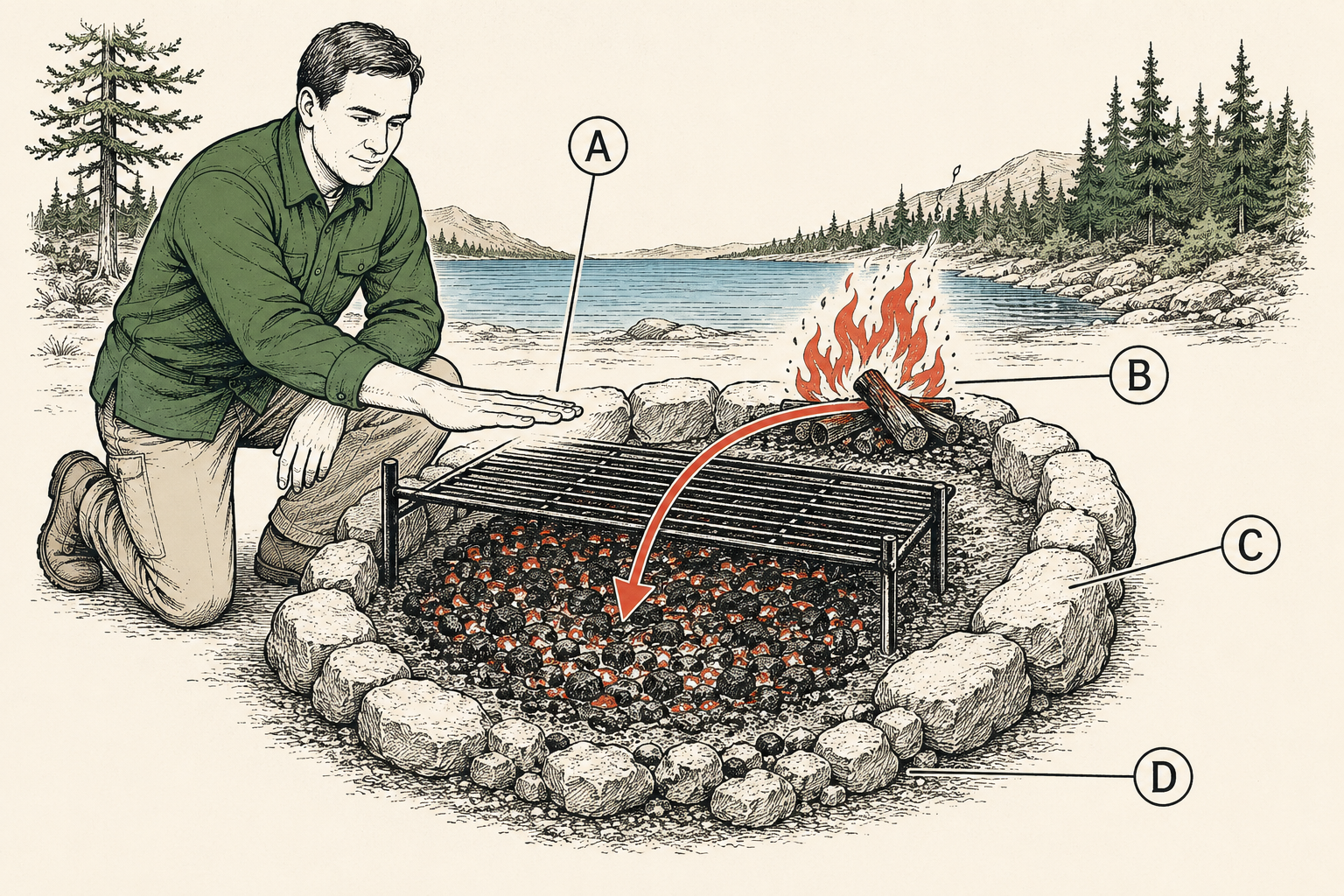
Camp coals are metered with the hand test: hold a palm at grate height over the coals and count seconds until you must pull away. 2–3 seconds is high heat (searing, boiling), 4–5 is medium (the workhorse: foil packets, grilling most things), 6–7 is low (warming, gentle bakes). It's the same test grill cooks have used forever, and it beats every gadget at camp.
Adjustments run three directions. Hotter: rake in fresh coals, knock ash off the bed (gray coat insulates), or lower the grate. Cooler: spread the bed thinner, wait for ash coat, raise the grate, or slide food toward the zone's edge, which brings up the most useful fact in fire cooking: the coal bed is a gradient, hot at center and gentle at the rim, so a single bed offers every temperature at once to the cook who uses its geography. Nothing in a home kitchen offers that; it's the fire's one genuine advantage over the stove, and expert camp cooks arrange dinner across the gradient like chess pieces.
Grate cooking: the campfire grill
The campground ring's swing grate (or your packed folding grate) turns the coal bed into a grill, and grill rules apply: oil the food not the grate, preheat it over the coals, and give everything 30% longer than home timing with a lid or foil tent to hold heat in the breeze. Brats, burgers, chicken thighs, corn, halved peppers, and thick fish all belong here.
The camp-specific adjustments: campground grates sit high (often 8–12 inches over the bed), so build the coal bed generous or pile it under the grate's cooking corner; wind steals heat sideways, so the foil tent earns its keep; and grate real estate is the two-zone principle again in miniature: proteins over the hot center, vegetables at the edges, finished food parked at the rim where "low" keeps it warm without cooking it further.
The meat thermometer from Chapter 16 referees doneness, because coals and dusk both lie to the eye: 165°F poultry, 160°F ground meats, 145°F whole cuts with a rest. Fire cooks who skip the thermometer serve confident pink chicken about once a career, and once is plenty.
Foil packets: the no-cookware dinner
The foil packet is camp cooking's best trick: protein, quick-cooking vegetables, fat, and seasoning sealed in a double-folded foil envelope, cooked 15–25 minutes on medium coals (the 4–5 second bed), no pot, no pan, no dishes. It scales from solo dinners to a family assembly line where everyone builds their own.
The build, step by step:
- Double the foil. Two sheets of heavy-duty foil, roughly 18 inches, shiny side in. Single-sheet packets tear and leak; leaks become flare-ups.
- Oil the center and stack: sliced potatoes or onions as the base heat-shield layer, protein on top of that, quick vegetables above, butter or oil over everything, seasoning generously (foil mutes flavor; overdo it slightly).
- Fold the drugstore wrap: bring long edges together and crease-fold three times, then triple-fold each end. You want a sealed envelope with a little steam headroom, not a tight ball.
- Cook on coals, not flames , at the bed's medium zone: 15–25 minutes for most builds, flipped once at halfway with tongs. Thick potatoes run longer; shrimp and fish shorter.
- Open away from your face (the escaping steam is the burn hazard) and check the protein with the thermometer through the opened top.
The repertoire is endless once the layer logic clicks: sausage-pepper-potato, chicken fajita, shrimp-corn-andouille, the salmon-lemon-asparagus that makes converts, and the banana-chocolate dessert packet from Chapter 21. Root vegetables slice thin; delicate things ride high in the stack; and a splash of broth or beer in the packet steams everything friendlier.
Sticks, skewers, and pie irons
The oldest methods hold their place. Skewers (metal, or green sticks per the Chapter 32 knife-craft sidebar) handle kebabs, dogs, and the marshmallow arts, with one technique note that fixes most kebab failures: group ingredients by cook time (all-meat skewers, all-vegetable skewers) instead of alternating, so nothing is raw while its neighbor is ash. Roast over coals with steady rotation; flames are for drama and carbon.
The cast-iron pie iron (two hinged plates on long handles) is the campground's cult appliance: buttered bread plus filling, clamped and toasted in the coals for 3–5 minutes a side, yields the "hobo pie" in sweet (pie filling) and savory (pizza, ham and cheese) denominations. It's kid-safe cooking with adult-grade results, and it earns its crate spot the first rainy lunch.
Both methods share the fire's universal timing truth: coals, patience, rotation. Anything cooked in actual flame is being painted with soot and gambled on.
Dutch oven baking: the fire's oven
The Chapter 15 Dutch oven turns coals into a real oven: cobblers, biscuits, cinnamon rolls, whole chickens, deep-dish breakfast bakes. The heat comes from counted coals below and on the flanged lid, per the rule of threes (diameter minus three under, plus three on top for ~350°F), rotated quarter-turns every 10–15 minutes.
Briquettes versus wood coals, honestly: charcoal briquettes are the Dutch oven's precision fuel (uniform size makes the counting rule actually count) and packing a small bag just for baking is standard practice, fire ban rules permitting (briquettes usually class with wood fires; check). Wood coals work with judgment: substitute "a coal bed that passes the 5-second test below, a generous shovel of coals on the lid" and peek early.
The starter recipe every camp baker begins with, because it forgives everything: dump-cake cobbler. Two cans of pie filling in the oiled oven, a boxed cake mix scattered dry on top, half a stick of butter sliced over it, lid on, 9 coals under and 15 on top for a 12-inch oven, 35–45 minutes until bubbling at the edges. It has never once failed anyone who kept the bottom heat modest, and it converts a campground loop into friends.
Camp coffee, ranked
For most camps, the ranking is: insulated French press (best ratio of quality to fuss for groups), pour-over cone (best solo cup), AeroPress-style press (best single cup that travels), good instant (best backpacking default, no longer an apology), and cowboy coffee (best story, worst cup). Espresso-adjacent gadgets exist for those who need them; they know who they are.
Method notes that matter: grind at home (pre-ground in a labeled jar; nobody grinds at 6:40 a.m.), water just off the boil (the stove's rolling boil rested 30 seconds), and for the press, a coarse grind and a four-minute wait that doubles as fire-starting time. Cowboy coffee, for the record and the romance: grounds straight in the pot, off heat to steep four minutes, a splash of cold water to settle the grounds, pour gently and accept your fate.
The infrastructure point outranks the method point: coffee is the first thing camp produces each day and the mood it produces it in matters. Whatever your method, it lives in the crate fully kitted (filters, grounds, the mug towel), tested at home, ready before the first trip. Chapter 2 made this a rule; every cold morning since has agreed.
Trailhead Takeaways
- Coals cook; flames decorate. Burn hardwood down 45–60 minutes, run two zones, rake fresh coals as you go.
- The hand test at grate height: 2–3 seconds high, 4–5 medium, 6–7 low. The bed's center-to-rim gradient is every temperature at once.
- Foil packets: double heavy-duty foil, potatoes as heat shield, drugstore fold, medium coals 15–25 minutes, open away from the face.
- Kebabs group by cook time; nothing alternates. Pie irons are kid-safe magic.
- Dutch oven: diameter −3 coals under, +3 on top ≈ 350°F; briquettes make the counting honest; dump cobbler is the gateway.
- Thermometer referees all fire-cooked meat: 165 poultry / 160 ground / 145 whole cuts.
- Gloves, long tongs, closed shoes. Grates stay burn-hot an hour past the glow.
Where Trips Go Sideways
- Cooking in the bonfire. Dinner went on at peak flame, came off in two colors (raw and carbon), and the cook blamed the method. The fire needed forty-five more minutes of becoming coals. Light it at snack time.
- Softwood dinner plans. A pile of pine burned bright, coaled briefly, and died before the packets were half done. Hardwood or briquettes for anything longer than a marshmallow.
- The single-sheet packet. It tore on the flip, leaked butter, flared, and delivered smoked charcoal salmon. Two sheets, heavy-duty, folded like the pharmacy taught the drugstore wrap.
- Confident pink chicken. Dusk light, gray coals, "it looks done." The thermometer weighs an ounce and knows things eyeballs don't. 165 or it goes back on.
- The grate handshake. Coals dead twenty minutes, grate grabbed bare-handed to swing it clear, weekend rearranged around a palm burn. Hot metal doesn't glow. Gloves live on the crate handle for exactly this.
Frequently asked
Can you cook over any campfire?
Any legal one, once it's ready: the cooking stage is a mature coal bed, not the flame show, which means hardwood and a 45–60 minute head start. Where fires are banned or wood is poor, the stove and a bag of briquettes (rules permitting) reproduce everything this chapter does.
What temperature are campfire coals?
A fresh coal bed radiates in the 700–900°F range at its surface, far hotter than any cooking calls for, which is why food cooks at grate height above it and why the hand test matters: 2–3 seconds of tolerance means searing heat, 4–5 medium (most cooking), 6–7 low.
What's the best way to make coffee while camping?
Groups: an insulated French press with home-ground coffee, water just off the boil, four minutes. Solo: a pour-over cone or press-style single-cup. Backpacking: quality instant, which stopped being a punchline years ago. Cold-brew concentrate made at home is the zero-skill backup: mix with hot water and nobody asks questions. Whatever you pick, kit it in the crate and test it at home first.
What can you cook in a foil packet?
Nearly any protein-plus-vegetables dinner: sausage with peppers and potatoes, fajita chicken, shrimp with corn, salmon with lemon and asparagus, plus dessert (banana, chocolate, marshmallow). The pattern is constant: sliced starch on the bottom as a heat shield, protein mid, quick vegetables high, fat and seasoning over all.