Part III · The Camp Kitchen
The Easiest Fish to Catch for Beginners
Dinner on the Line
How do you start fishing at camp?
Buy a fishing license for the state you're camping in, rig a basic spinning rod with a small spinner or a worm under a bobber, and fish the first and last hours of daylight near structure (rocks, logs, weed edges, drop-offs). That sentence contains the whole beginner method; everything else is refinement.
Camp fishing deserves its place in a camping book because it's the rare camp activity that's simultaneously entertainment, food production, and the thing that teaches kids patience without anyone calling it that. It's also gloriously cheap to try: a serviceable spinning combo, a small tackle box of proven lures, and a license cost less than one family restaurant dinner, and the kit lives in the car trunk for years.
Expectations, calibrated: panfish (bluegill, sunfish, perch) and stocked trout are the beginner's honest targets, abundant in exactly the lakes and streams campgrounds sit beside. Bass are the step up; everything else is a hobby. A camp angler who can reliably catch panfish for the skillet has completed this chapter's curriculum.
The minimal kit
One medium-light spinning combo (rod and reel sold as a pair, 6–7 feet), 6-pound monofilament line, and a pocket tackle box: hook assortment (sizes 6–10 for panfish), a few split-shot sinkers, two bobbers, a couple of small inline spinners, a jar of salmon eggs or a tub of worms, needle-nose pliers, nail clippers for line, and a small ruler for the legal-size question. Total spend lands near $60 and covers 90% of camp fishing in America.
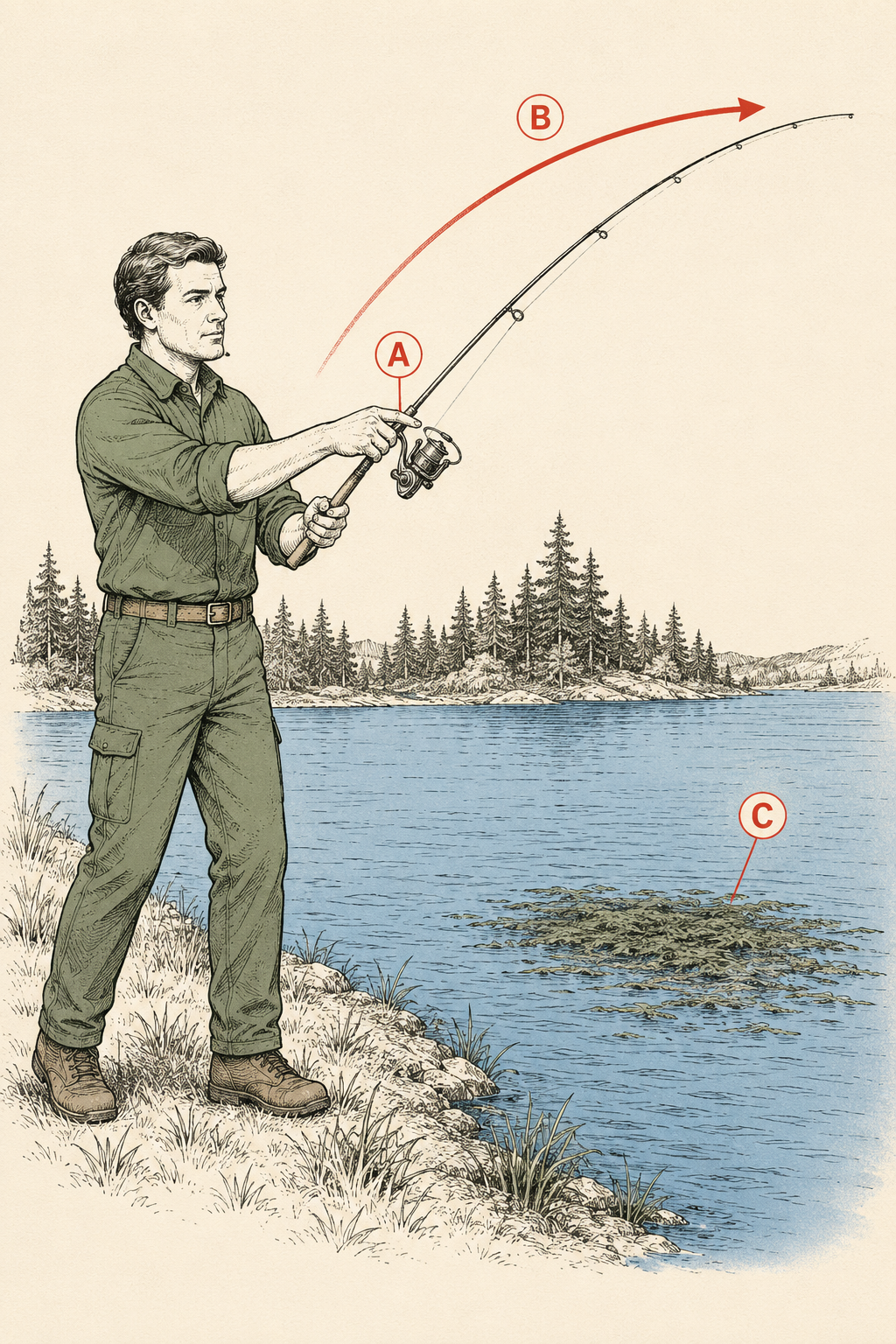
The spinning reel earns its beginner-default status on one property: it casts light lures without the backlash tangles that end fishing careers at minute ten. Open the bail, pin the line with a fingertip, swing the rod tip forward, release. Ten practice casts in the campsite (hook removed, a rubber practice plug or bare swivel tied on) and a kid is operational.
Two kit notes that outrank gear upgrades: pliers are non-negotiable (hook removal from fish, and occasionally from humans, wants tools, not fingers), and the barbless option (pinch the hook's barb flat with those pliers) makes every removal easier and every release cleaner, at a trivially small cost in landed fish.
Where the fish are (and when)
Fish concentrate where food and cover meet: weed edges, submerged logs, rock piles, dock pilings, creek mouths, and the drop-off where shallow water tips into deep. Fish the edges of things, never the featureless middle. Timing multiplies everything: the first two hours of light and the last two are the feeding windows, and midday under a bright sun is the slowest water of the day.
Reading a lake from a campsite takes one slow lap of looking: where does a creek enter (food conveyor), where does the bank steepen (drop-off), where are the weeds and the shade? Cast so the lure works along those edges rather than across empty water. In streams, fish hold facing the current in the slower seams beside faster water (behind rocks, under cut banks, at pool tails) and eat what drifts to them; cast upstream of the seam and let the offering swing through.
The camp-schedule alignment is the happy accident: the evening feeding window is exactly the hour dinner's coals are burning down (Chapter 19's timeline), and the morning window belongs to whoever's up with the coffee. Fishing slots into camp's natural gaps.
Catching: the three-skill loop
The catching loop is three skills: present (bobber-and-worm sits in the strike zone; a spinner is cast past the target and retrieved through it at a slow, steady pace), detect (the bobber dips or the line ticks; a spinner strike announces itself), and set-and-land (a firm upward sweep of the rod tip, then steady reeling with the rod bent, no slack, no pump-and-crank drama for panfish-sized fish).
Beginner calibrations for each. Presentation: depth matters more than lure choice for bobber fishing; adjust the bobber until the bait hangs just above the weeds or bottom, and change depth before changing bait. Detection: watch the bobber like television and do nothing on the first tap (that's a nibble); strike when it dives or travels. Landing: keep the rod up and let its bend absorb the fight; the classic loss is pointing the rod at the fish, which hands the fish a straight pull against the hook.
The pace discipline that separates catchers from casters: give a spot 15–20 minutes of honest work, then move. Fish are where they are; stubbornness at an empty spot is a scenery subscription, which is also fine, but call it what it is.
Handling, releasing, and keeping
Decide keep-or-release before the fish is in hand, and handle accordingly. Releasing: wet your hands first (dry hands strip the mucus coat that protects fish skin), keep the fish in or over water, back the hook out with pliers, and support it upright in the water until it swims off. Keeping: check the ruler against the regulations, then dispatch promptly and humanely (a firm rap to the top of the head with a rock or knife butt), and get it cool: on a stringer in the water, or cleaned early and into the cooler.
The regulations check is not optional ceremony. Size limits (measured nose to tail tip, the ruler's whole job), bag limits, and species closures exist per water and per season, and wardens check campground lakes precisely because that's where casual violations cluster. When a fish is borderline on the ruler, it goes back; the margin call always goes to the fish.
Kid protocol, since kids catch half of camp's fish: adults handle hooks until the pliers skills are demonstrated, the wet-hands rule is taught as respect rather than rule, and a kid's first keeper gets photographed exactly once before the cooler, because the eleventh photo is where fish welfare goes to die.
How to clean a fish
Pan-dressing (gut and gill, cook whole) is the beginner method for panfish and trout, five steps with a small sharp knife on a flat surface away from camp:
- Set up at the water's edge or a cleaning station , never the picnic table: a board, the knife, a bag for guts, cold water handy.
- Open the belly: insert the knife tip at the vent and cut shallow forward to the gills, blade angled out so nothing inside is pierced.
- Remove gills and guts in one motion: cut the gill arches free where they meet the jaw, hook a finger behind them, and pull down and back; everything comes with them.
- Clean the cavity: run a thumbnail or spoon along the spine to strip the dark kidney line, then rinse the cavity cold and brief.
- Done. Scaling (scrape tail-to-head with a spoon) only if you'll eat the skin on scaled species; trout skin cooks fine unscaled.
Filleting is the graduate course, worth learning at home from a video with a cheap flexible fillet knife and an unhurried fish; camp is a bad classroom for new knife work. Either way, the knife rules are Chapter 15's: away from yourself, on a stable surface, with full attention.
Waste disposal is a rules question with local answers: many waters say deep water for fish remains, bear country says pack them out or use the cleaning station, and nothing ever goes in the fire ring or the shallows where it greets tomorrow's swimmers. The campground's posted rules or the ranger settle it in one ask.
Cooking the catch
Fresh panfish and trout want the simplest cooking in this book: hot cast iron, oil and butter, salt, 3–4 minutes a side for a pan-dressed trout, until the flesh flakes at a fork. Or the foil route (Chapter 19's method with lemon slices and butter in the cavity, 12–15 minutes on medium coals, turned once). The fish is the recipe; restraint is the technique.
The skillet method in full: dry the fish (wet skin steams instead of crisps), dust with seasoned flour if the crate offers it, and lay it away from you into genuinely hot fat. Resist moving it; the skin releases when it's ready. Same-day fish needs nothing else, which is the entire culinary argument for catching dinner forty feet from where you'll eat it.
Bear-country addendum, because fish is the smelliest food a camp can produce: cooking gear and clothes that wore the splatter get washed promptly, and every scrap of the operation (guts bagged, foil, the wash water strained per Chapter 15) obeys food-storage law with extra devotion. Chapter 45 considers fried trout a special exhibit.
Trailhead Takeaways
- License first, always: online, minutes, cheap. The state's rules per water ride along in the same app.
- The $60 kit catches 90% of camp fish: medium-light spinning combo, 6 lb mono, small hooks, bobbers, spinners, worms, pliers.
- Fish the edges of things at the edges of the day. Featureless midday water is a scenery subscription.
- Bobber tap is a nibble; the dive is the strike. Rod up to land; slack loses fish.
- Wet hands for releases, ruler before the cooler, borderline calls go to the fish.
- Pan-dress in five steps at the water, never the picnic table. Guts follow local rules, never the fire ring.
- Cook it simple and same-day: hot iron, butter, salt, 3–4 minutes a side. The fish is the recipe.
Where Trips Go Sideways
- Fishing without the license. Twenty minutes of fun, a warden's afternoon, and a fine that out-priced a decade of licenses. It sells on a phone in five minutes. Buy it with the campsite.
- The noon safari. Full sun, dead calm, hours of casting at the lake's empty middle, verdict: "no fish in here." The same water at 7 p.m. along the weed edge was boiling. Edges, mornings, evenings.
- Hook set on the first tap. The bobber twitched, the rod swept, the worm returned un-eaten, forty times. The tap is a question; the dive is the answer. Strike the answer.
- Dry-hands catch-and-release. Well-meaning, slow, photographed at length on hot rocks: that fish's release was a formality. Wet hands, water-adjacent handling, one photo, upright until it kicks.
- Fish-fry residue at the bear-country site. The skillet "soaking overnight," the splatter shirt on a chair: by 3 a.m. camp had a visitor with opinions. Fish smell is Chapter 45's siren. Wash it all, promptly, and lock the rest.
Frequently asked
What is the easiest fish to catch for beginners?
Panfish: bluegill, sunfish, and perch. They're abundant in campground lakes, aggressive toward worms under a bobber, active most of the day, and forgiving of imperfect technique. Stocked trout are a close second. Both cook beautifully, which makes them the complete beginner curriculum.
What do I need to start fishing?
A license for the state you're in, a 6–7 foot medium-light spinning combo with 6-pound line, hooks (sizes 6–10), split shot, bobbers, a couple of small spinners, bait, needle-nose pliers, and a ruler. About $60 total plus the license, and it all lives in one small box.
How do you clean a fish for cooking?
Pan-dress it: at the water's edge, cut shallow from vent to gills with the blade angled outward, cut the gill arches free at the jaw, pull gills and guts out together, strip the dark line along the spine, rinse cold. Five steps, two minutes with practice, and the fish is skillet-ready. Take the first one slowly; the fiftieth takes ninety seconds.
What's the best way to cook fish while camping?
Hot cast-iron skillet, oil and butter, salt, 3–4 minutes per side until the flesh flakes, or foil-wrapped with lemon and butter on medium coals for 12–15 minutes. Same-day fish needs nothing fancier; the freshness is the dish. Clean up thoroughly, especially anywhere bears keep accounts.