Part IV · Dressing for Outside
The 3-Layer Rule for Hiking
Dress Like an Onion
How do you layer clothes for hiking and camping?
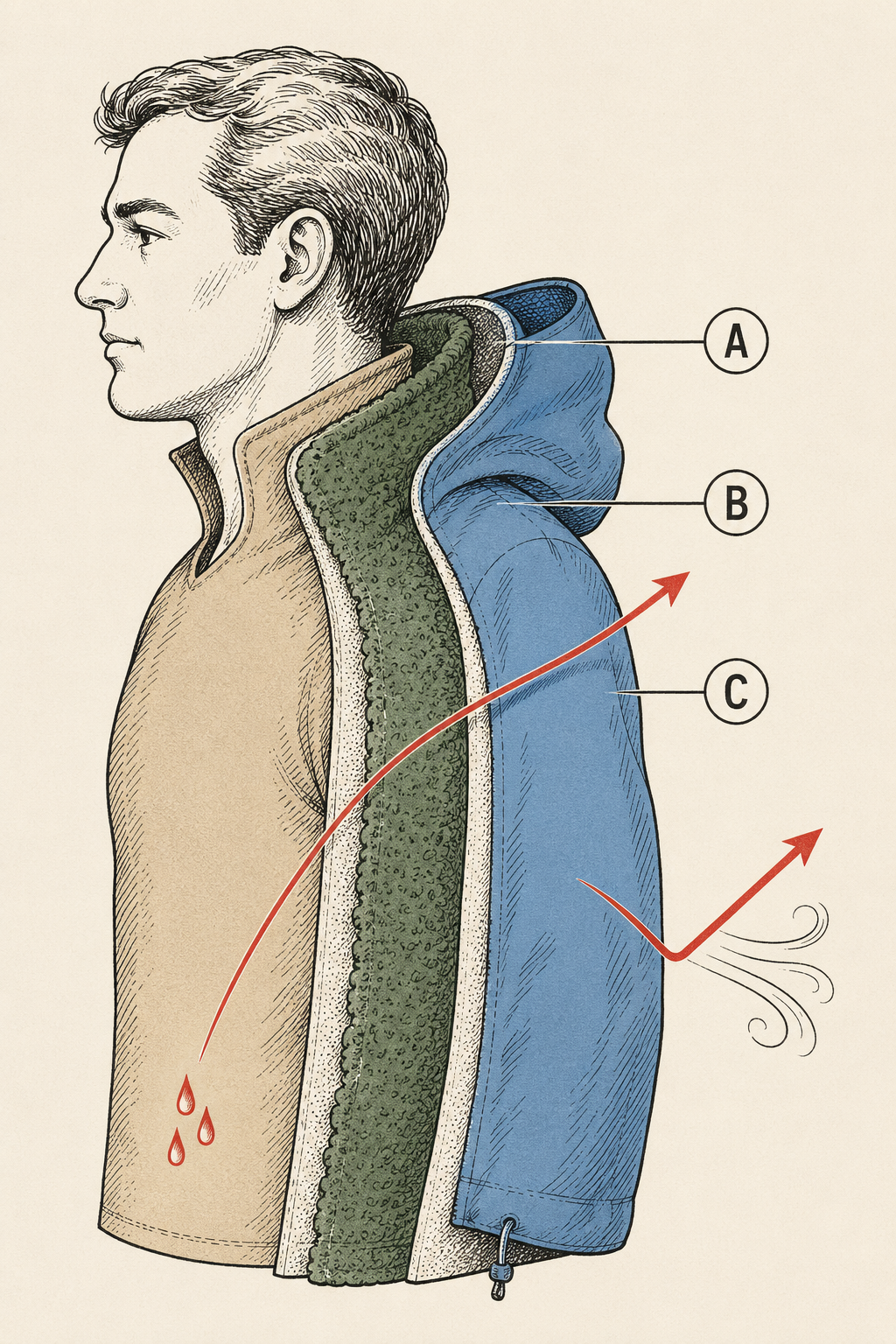
Three layers, three jobs: a base layer against your skin that moves sweat outward (wool or synthetic, never cotton), a mid-layer that traps warm air (fleece or puffy), and a shell that blocks wind and rain. Warmth comes from adding and shedding layers as conditions change, never from one heavy garment.
The system's whole point is adjustability, and the physics behind it is the same loft story as Chapter 9: clothing warms you by trapping still air your body has heated, and it stops warming you the moment it's wet or wind-scoured. A single heavy coat is all-or-nothing: sweat-soaked on the climb, clammy at the top, useless tied around your waist. Three thin layers offer eight combinations, and the skill of dressing outdoors is shuffling them before your body forces the issue.
The operating rule that makes the system work: start cold, adjust early. Begin a hike slightly underdressed (you'll warm in ten minutes), shed before you sweat, add before you chill. Ten minutes. Trust it. The camper working zippers and stuffing layers into the daypack all day isn't fussing; they're driving the machine as designed. That's the job.
The base layer: sweat is the enemy
The base layer's job is moving sweat off your skin and out, because wet skin loses heat roughly 25 times faster than dry skin, and everything else you're wearing works only as well as this layer lets it. Materials that do the job: merino wool and synthetics (polyester blends). Material that does the opposite: cotton.
What "moisture-wicking" actually means: wool and polyester fibers absorb little water and move it along their surface toward evaporation, so the fabric dries from the inside out while you wear it. Fit matters as much as fiber: base layers work in contact with skin (snug, not compression), because the wicking happens at the touch points. Weights run light (summer, high-output), midweight (three-season default), and heavy (winter camp); own the midweight first.
Top and bottom both count, and the bottoms get forgotten: sleeping in dry base layers is Chapter 6's sleep-clothes rule, and hiking in the same bottoms you'll sleep in is the classic way to import the day's damp into the night's bag. The wardrobe minimum for a weekend: two tops, one bottom, worn in rotation with the sleep set sealed dry.
Why cotton kills (and where it doesn't)
Cotton absorbs many times its weight in water, dries slowly, and collapses against your skin when wet, which flips its insulation negative: a wet cotton T-shirt actively pumps heat out of you. In cool, wet, or windy conditions that's a hypothermia accelerant, and "cotton kills" earned its bluntness from real incident reports, most of them in weather that read as mild from the trailhead. Mild is the trap.
The mechanism deserves one careful paragraph, because 50°F (10°C) and drizzle is where it happens, not blizzards. Cotton jeans and a cotton hoodie soak through, wind hits, evaporative and conductive losses run together, and core temperature slides while the hiker is still walking and still saying they're fine (Chapter 49 picks up that story at "the umbles"). Wool and synthetics in identical conditions stay lofted and keep insulating while damp. Same trail, same weather, different fibers, different afternoon.
The honest exceptions: dry desert heat, where cotton's slow evaporation becomes air conditioning (Chapter 59 endorses it deliberately), and camp lounging in settled fair weather, where the cotton camp hoodie by the fire harms no one. The rule that survives all cases: cotton is a comfort fabric for conditions that can't turn on you, and the mountains' conditions always can.
Mid-layers: fleece, down, and synthetic fill
The mid-layer traps the heat your body makes, and three families do it: fleece (cheap, breathes hard, warm even damp, bulky), down puffies (best warmth-per-ounce, packs to nothing, sulks when wet), and synthetic puffies (down's understudy that keeps working damp, at more bulk). The default kit carries two: a light fleece for moving, a puffy for stopping.
That two-mid-layer pattern solves the actual problem of an outdoor day, which is that hiking-you and standing-around-you are two different climates. Moving bodies want breathable, modest insulation (the fleece, often as the outer layer in dry chill); stopped bodies at lunch or in camp want the big trapped-air blanket (the puffy, thrown over everything, per Chapter 12's stopped-body doctrine). Fleece goes. Puffy stops. Down versus synthetic follows Chapter 9's bag logic exactly: down for dry cold and weight-critical packs, synthetic for damp climates, campfire spark zones, and budgets.
Fit note that beats a spec sheet: mid-layers need room to loft inside the shell without compression, and sleeves that stay put when you reach. A puffy crushed flat by a too-small shell is paying for warmth it can't deliver.
The shell: your weather roof
The shell blocks wind and rain so the layers beneath can do their jobs; without it, wind strips heat from even the best insulation (the cot lesson of Chapter 10, standing up). The choice is between hard shells (waterproof-breathable rain jackets, Chapter 24's whole subject) and wind shells (feather-light wind-only layers), and the three-season answer for most people is one real rain shell, worn as the wind layer too.
What the shell changes is dramatic and worth feeling once: a 40°F (4°C) day at 15 mph wind bites through a fleece in minutes, and the same day inside a shell over that fleece is comfortable. Same day, new season. Wind is invisible insulation theft, and the shell is the countermeasure that weighs 10 ounces and lives in every daypack forever (Chapter 12 already packed it).
Pants complete the roof for real weather: rain pants ride along shoulder-season and beyond, and wind pants or soft-shell pants replace them for dry cold. Legs tolerate more than torsos, which is why this paragraph is short and Chapter 24's jacket coverage isn't.
Merino vs synthetic: the base-layer debate settled
Merino wool insulates when damp, resists odor for days, and feels like civilization; synthetics dry faster, cost half, and shrug off abuse. The settled answer: synthetics for high-sweat activities and tight budgets, merino for multi-day trips where odor and versatility rule, and blends (merino cores, nylon wrap) increasingly beat both pure camps. Blends hedge the bet.
| Merino | Synthetic | |
|---|---|---|
| Damp performance | Insulates wet | Dries fastest |
| Odor after day 3 | Barely | Assertive |
| Durability | Delicate (holes happen) | Tough |
| Price | High | Friendly |
| Feel | Soft, temperature-flexible | Athletic, sometimes clammy |
| Best at | Multi-day, camp-to-town, sleep sets | Sweat sports, budgets, kids |
The odor line is the one that changes trips: polyester's microbiome announces day two loudly (washing helps, sunlight helps, nothing cures), while merino runs quiet through a long weekend, which is why through-hikers pay merino prices. Kids get synthetics without ceremony: they outgrow clothing faster than they wear it out, and merino priced for growth spurts stings.
Weight classes and layering strategy cross both fibers: a light synthetic tee for the sweaty climb with a midweight merino in the pack covers more conditions than either alone. This is the layering system's fractal quality: even the base layer is a system.
Hats, gloves, and the small stuff that runs the thermostat
Extremities are the system's control knobs: a warm hat, a sun hat, glove liners, and dry socks tune comfort faster than any torso change, pack to nothing, and cost little. The warm-hat effect is the famous one (your head is well-perfused and hates insulating itself), and "put on the hat" fixes more evening chill than another log on the fire. Hats first. Logs second.
The standing kit, per person, all seasons: beanie (sleep-and-evening warmth; Chapter 36 makes it bedtime equipment), brimmed sun hat (Chapter 27's first tool), light gloves shoulder-season and up, and the neck gaiter, the most versatile fabric ounce in camping (neck warmth, sun shield, dust mask, beanie substitute, pot holder in extremis). Socks are Chapter 25's serious business; the layering chapter just notes the rule: wool or synthetic always, and the day's socks never sleep in the bag.
The scenario that shows the knobs working: dusk at the campground, 52°F (11°C) and settling, and the crew starts drifting toward the tents complaining of cold in perfectly adequate jackets. Hats and dry socks all around, and the same evening lasts two more hours by the fire. Nothing else changed. The knobs did it.
Putting it together: worked wardrobes
Summer weekend, car camping: synthetic tee + light fleece + rain shell riding in the car; shorts and one long pant; beanie, sun hat, camp shoes; two pairs wool-blend socks; sealed sleep set. That's the whole list, and half of it stays in the duffel.
Shoulder-season backpacking: midweight merino top and bottom + light fleece + puffy + rain shell and rain pants; hiking pants; beanie, liner gloves, gaiter; three socks (hike two in rotation, sleep one); sleep set doubling as the spare base. Everything fits in a third of the Chapter 11 pack.
The kid version of anything: the same system one notch warmer (kids run cold at rest and won't say so until the meltdown), in synthetics, with doubles of socks and base layers per Chapter 6's law, and layers they can operate themselves: zippers over buttons, pullovers over toggles. A kid who can shed their own layer on the climb is running the system; that's the goal.
Notice what's absent from all three: the heavy parka, the "just in case" fourth jacket, denim of any kind. The system's efficiency is the point: more combinations from fewer, lighter pieces, chosen by job.
Trailhead Takeaways
- Three layers, three jobs: base moves sweat, mid traps heat, shell blocks weather. Adjustability is the product.
- Start cold, adjust early: shed before sweating, add before chilling.
- Wet skin dumps heat ~25× faster than dry. The base layer is the system's foundation, snug and never cotton.
- Cotton kills at 50°F and drizzle, not in blizzards. Deserts and settled camp evenings are its parole.
- Carry two mid-layers: fleece for moving, puffy for stopping. Down dry, synthetic damp, per bag logic.
- The shell is the wind's off-switch and lives in every daypack. One real rain shell covers both jobs.
- Hats, gloves, gaiter, dry socks: the thermostat's knobs. "Put on the hat" fixes most evenings.
Where Trips Go Sideways
- The one big coat. Sweated through on the climb, clammy at the overlook, a damp regret by dusk. Eight combinations of three thin layers beat one heavy answer every time the weather moves.
- Jeans and a hoodie at 50 and drizzling. The forecast said mild, the cotton said fine, the shivering started at mile three and nobody connected it to the fabric. It's never the blizzard that writes these reports.
- Dressed warm at the trailhead. Cozy for the first eight minutes, soaked by minute twenty, cold at every stop after. Start cold. The furnace lights fast once you're walking.
- The puffy worn on the climb. The best insulation in the pack, marinated in sweat by the saddle, useless at the summit lunch it was carried for. The puffy is for stopping. The fleece is for going.
- Hiking socks into the sleeping bag. They felt dry. They weren't, and the bag spent the night fighting yesterday's moisture. The sleep set is sealed, sacred, and never walks anywhere.
Frequently asked
What is the 3-layer rule?
Base, mid, shell: a wicking layer against skin (wool or synthetic), an insulating layer over it (fleece or puffy), and a wind-and-rain barrier outside. Each does one job; warmth comes from combinations, and comfort comes from adjusting them early rather than sweating first.
What is the 3-layer system for hiking?
The same three layers run actively: hike in the base (plus fleece in chill), shed before sweating on climbs, add the puffy the moment you stop, and deploy the shell when wind or rain arrives. The pack carries whatever your body isn't currently using; that's its job.
What should you not wear while hiking?
Cotton anything in conditions that can turn cool or wet (jeans, hoodies, gym tees), plus new unbroken boots (Chapter 26), and anything that compresses your mid-layer's loft. In dry desert heat cotton earns a specific pardon; everywhere else, wool and synthetics.
Is merino wool worth it over synthetic?
For multi-day trips, sleep layers, and anyone bothered by day-two polyester funk: yes, it stays civil for days and insulates damp. For high-sweat efforts, kids, and budgets: synthetics dry faster at half the price and take abuse better. Blends split the difference well; owning one of each beats a pure wardrobe of either. Start with a merino sleep set, where the price stings least and the payoff shows first.