Part V · Getting There and Making Camp
Can You Sleep in Your Car at a Campsite?
Load Up
How do you pack a car for camping?
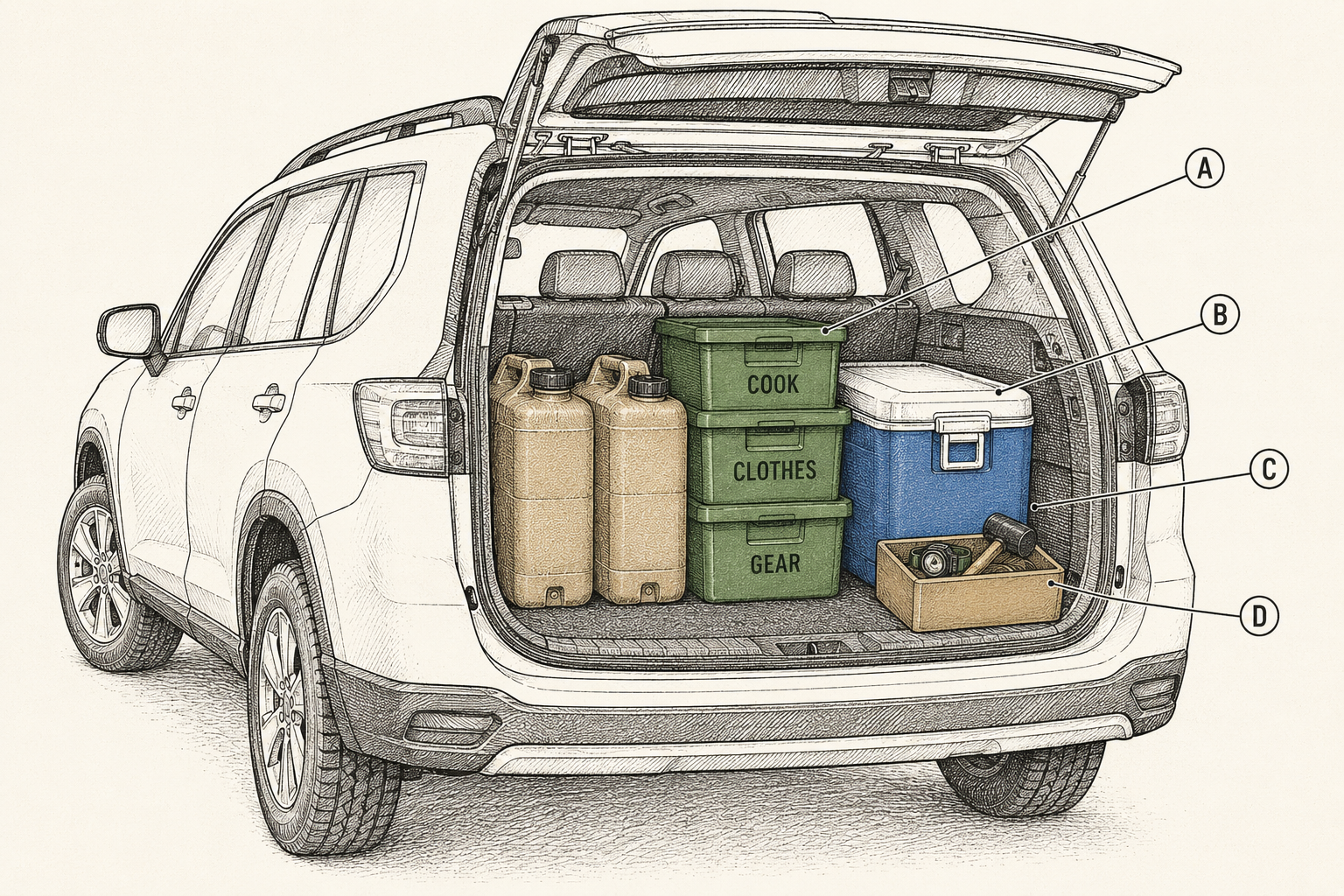
Reverse-need order with clear sightlines: bedding and clothes deepest, kitchen and cooler mid-cabin and reachable, shelter and the first-hour box at the tailgate, nothing stacked above the window line, and the heaviest items low and forward of the rear axle. The Chapter 6 bins make it Tetris with labeled pieces.
The car is the trip's biggest piece of gear, and this chapter treats it that way: prep before, load smart, drive the last dirt miles like they're part of the trip (they are), and park it secured. None of it is glamorous, and all of it is trip-deciding: an overheated engine, an unfindable headlamp, or a roof box meeting a parking garage each cancel more fun than any forgotten spatula ever did.
The packing scenario that sells the sightline rule: merging onto the interstate with a rearview mirror full of sleeping bags is a white-knuckle way to start a relaxing weekend. Pack to the window line, use the mirror, and let the roof (rules below) take the bulk if the trunk can't.
Vehicle prep: the 20-minute check
A week out, run the boring seven: oil and coolant levels, tire pressure and tread (the spare too, the one check everyone skips), wipers and washer fluid, lights, brakes that feel right, the jack-and-tools inventory, and any due service actually done. Camping drives add heat, load, and dirt roads to a vehicle's ordinary life, and each stresses whatever was marginal.
The spare-tire paragraph, because it's the one that strands people: confirm the spare holds air (they leak down over years), confirm the jack and lug wrench exist and match, and confirm you know where the jack points are on this vehicle (the manual, two minutes, at home). Dirt roads eat sidewalls at a rate pavement never taught you, and a flat 12 miles up a forest road with no spare knowledge is a very long afternoon.
Fuel discipline rides along: top off at the last real town, and in remote country keep the tank above half as a standing rule. Backcountry miles burn more (low gears, washboard, detours), gas stations space out fast past the interstate, and the half-tank rule costs one extra stop while covering every "the station in town was closed" story ever told.
The load: weight low, access ordered
Loading rules in priority order: heavy low and forward (water jugs, coolers, bins of cans ride on the floor ahead of the axle where they help handling instead of hurting it), nothing hard-and-loose in the cabin (a cast-iron skillet at 60 mph is cargo until the braking event makes it a projectile; bins with lids, cargo nets, or the trunk), sightlines sacred (window line is the ceiling), and access in reverse-need order per Chapter 2: first-hour box at the tailgate, kitchen mid, bedding deep.
The first-hour box earns its second mention because it's the difference between an arrival and an excavation: headlamps, stakes and mallet, the site confirmation, snacks, and the kid entertainment (Chapter 29) live in one grab. Its sibling, the "last-hour box," loads last on the way home: whatever must surface first at the house (perishables, the dog's dinner, tomorrow's work laptop someone brought against advice).
Passengers finish the plan: kids' seats get a seat-back organizer and a within-reach snack cache (Chapter 29 runs that program), the dog gets a harness anchor or barrier (Chapter 54, and it's a safety item, not a preference), and every passenger's personal layer rides in the cabin, not the deep stack, because the mountain pass will be 20 degrees colder than the driveway (Chapter 4 said so).
Roof loads: the rules that keep it up there
Roof cargo obeys four rules: respect the dynamic weight rating (the rack's AND the car's roof limit, both in the manuals; the lower number wins), heavy stays in the car (the roof gets bulk: bags, pads, chairs; never the water and cast iron), strap with cam buckles or proper ratchets at four points minimum with the load unable to shift in any direction, and re-check straps at the first stop, then every fuel stop (loads settle; straps relax).
The strap tutorial the highway demands: cam buckles for soft loads (gentle, sufficient, can't crush), ratchet straps for boxes and rigid loads (tighten until the load is part of the car, then stop; ratchets can crush a cooler), tails tied off so they don't machine-gun the paint at speed, and the tug test before every departure: grab the load and try to move it hard. Any movement is a redo, not a note.
Two roof-cargo classics to dodge: the height amnesia incident (a roof box adds real inches; the parking garage, the drive-through, and your own garage door have all met someone's box) and the aerodynamic surprise (roof loads cost real fuel and change crosswind behavior; drive like the taller, heavier vehicle you've become). A note in the phone with the loaded height ends the first; the first windy overpass teaches the second.
Dirt roads: the last five miles
Forest and BLM roads reward three adjustments: slow down (washboard and potholes at 15–25 mph, not highway habits), soften your line (walk the sketchy spots; straddle nothing you can't see the bottom of; cross water only when you can see the bottom and know the depth), and know your vehicle's honest clearance (the plastic under-spoiler of a commuter sedan negotiates differently than a truck; both get people to thousands of campsites when driven like what they are).
Washboard technique in one paragraph: those ripples are worst at the speed that formed them; slightly slower usually smooths the ride, tires slightly softened help (a few PSI, re-inflated at pavement), and braking mid-washboard is skittish, so slow before the corners. Mud and sand get one shared rule for two-wheel-drive campers: momentum is your friend and stopping to think in the middle is not, so read it, commit or don't, and remember that the walk-and-look costs five minutes while the stuck costs the evening.
The turnaround discipline caps the section: when the road degrades past your vehicle or your nerve, turn around at the next wide spot, not the next disaster. Chapter 3's daylight-margin rule was written for exactly this road.
Trailhead and campsite vehicle security
Vehicle break-ins at trailheads are crimes of visible opportunity: the standard defense is nothing visible, period (empty cabin, bags in the trunk before you arrive, not in the lot while watched), plus doors locked, valuables actually with you or actually hidden (spare key in a magnetic box or pocket, never the gas-cap cliché), and the glove box conspicuously open-and-empty at high-theft trailheads, an old ranger trick that tells the window-breaker there's nothing to earn.
At the campsite the vehicle relaxes but doesn't retire: it's the food locker where bears aren't the concern (Chapter 45 rules where they are), the valuables safe during swims, and the weather refuge during the squall. Keys get a fixed home (a specific pocket of a specific bag, announced to the household) because the campground key hunt is a genre, and the one-key trip is a gamble; the second driver carries the spare.
Home security while you're gone is Chapter 29's business, along with the drive itself, which the next chapter argues is part of the vacation rather than its price.
The permanent car kit
Some gear never unpacks, living in the vehicle year-round in one flat bin: jumper cables or a jump pack, tire gauge and a 12-volt inflator, headlamp, first-aid kit, water (a gallon, rotated), a blanket, basic tools and duct tape, work gloves, paper towels, trash bags, and the region's seasonal add-ons (ice scraper and traction aids in winter country, extra water in desert country). It's the Chapter 12 essentials philosophy at automotive scale: assembled once, restocked after use, present by default.
The kit doubles as daily-life insurance, which is the argument that gets it built: the jump pack that saves a camping trip saves a grocery run the same way. Audit it twice a year (daylight-saving weekends are the classic prompt) alongside the Chapter 6 bins, and the whole household system stays trip-ready with two calendar entries.
Trailhead Takeaways
- Prep the boring seven a week out; the spare tire and its tools are the check that strands people when skipped.
- Top off at the last town; keep remote-country tanks above half.
- Load heavy low and forward, bins to the window line, nothing hard loose in the cabin, first-hour box at the tailgate.
- Roof rules: lower of rack/roof ratings wins, bulk up top and weight inside, four-point straps, tug test, re-check at every fuel stop.
- Dirt roads: 15–25 mph on washboard, walk what you can't read, turn around at the wide spot, not the disaster.
- Trailheads: nothing visible, everything locked, spare key on the other driver.
- The permanent car kit lives in the vehicle year-round and pays for itself at a grocery store eventually.
Where Trips Go Sideways
- The spare that was also flat. Two flats of a sort: one tire, one plan. Sidewall met rock at mile 9 of forest road, and the spare had quietly lost its air over three years. Check it with the gauge, at home, where fixing it is a chore instead of an expedition.
- Mirror full of sleeping bags. Packed to the ceiling, merged blind, and the near-miss on the on-ramp set the weekend's tone before the first pine. The window line is a safety spec wearing an organizing costume.
- The ratchet-strapped cooler. Cranked down hard like the internet said: the lid never sealed right again. Cam buckles for anything that can crush; ratchets are for lumber and boxes, tightened to snug, not to victory.
- Garage door, meet roof box. Four hundred dollars of box and one weekend of gear introduced to the header beam at 5 mph. The loaded height lives in a phone note titled CLEARANCE, consulted like it matters, because it does.
- The visible duffel at the trailhead. Windows don't argue. It was the only car in the lot with anything showing, and it was the only car with glass on the ground at 4 p.m. Empty cabin, trunk loaded before arrival, nothing to earn.
Frequently asked
What are the basic things you need for car camping?
The seven kits from Chapter 6 (shelter, sleep, kitchen, clothing, light and tools, health, personal), a prepped vehicle, and this chapter's load order. If you're starting from nothing: borrow the big items, buy the sleep gear first, and let the master checklist in Appendix A drive the cart.
Am I allowed to sleep in my car at a campsite?
At almost every developed campground, yes: your paid site includes your parked vehicle, and car-sleepers are ordinary campers. The rules that bite live elsewhere (trailheads, rest areas, and town streets often prohibit overnighting), so the campsite is the easy case. Crack windows for ventilation, never idle the engine for climate control while sleeping, and note that some parks cap vehicles per site.
How much weight can I put on my roof rack?
The lower of two numbers printed in the manuals: the rack's dynamic rating and the vehicle's roof limit, commonly 100–165 pounds combined for cars and crossovers. That's bulk territory (bags, pads, boxes), not water-and-cooler territory. Heavy rides low inside; the roof takes volume, and the loaded height goes in a phone note before the first parking garage.
How do you drive on washboard roads?
Slow to 15–25 mph, where the ripples stop launching the suspension; drop a few PSI of tire pressure if it's miles of it (re-inflate at pavement); brake before corners, not in them; and straddle or walk anything you can't read. The last five miles are part of the trip, driven like it.