Part I · Deciding to Go
The 7 C’s of Camping and Every Camping Type
Why Sleep Outside?
What are the main types of camping?
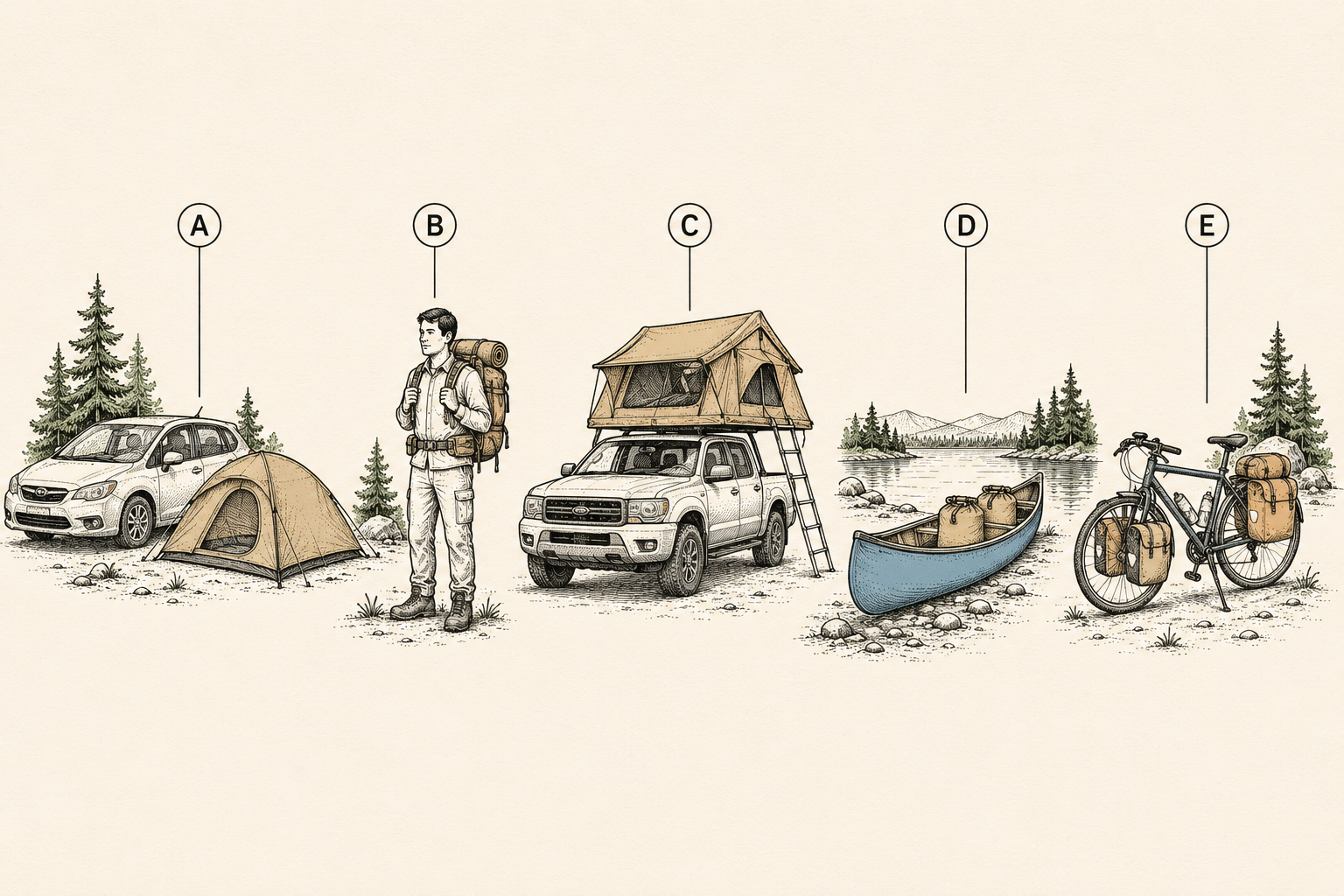
Camping breaks into six broad styles: car camping, backpacking, glamping, vehicle-based camping (rooftop tents, vans, RVs), paddle camping, and bike camping. The styles differ mainly in how your gear travels: by trunk, on your back, on a boat, or on a rack.
That's the whole taxonomy, and it's worth keeping this simple because the labels scare off more beginners than the weather does. Every style is the same activity at its core. You bring shelter, food, and warmth to a pretty place, and you stay past dark. What changes is the delivery system.
The delivery system matters more than it sounds, though, because it sets your constraints. A car camper measures gear in bins. A backpacker measures it in ounces. A canoe camper gets a strange middle deal: huge capacity on the water, brutal carries around it. Pick the constraint you can live with and the rest of your decisions get easier. Chapters 2 through 6 assume you'll start where most people should, with a car and an established campground, but nothing in this book locks you there.
Car camping: the style to start with
Car camping means driving to a site and camping beside your vehicle. It's the recommended starting style because the car removes the two hardest beginner constraints: weight and consequence.
Weight first. When the trunk does the carrying, you can bring the thick sleeping pad, the roomy tent, the real pillow, the cast-iron pan, and the second blanket you weren't sure about. Comfort is mostly a cargo problem. Cars solve cargo.
Consequence second. At a drive-in site, a forgotten headlamp is an inconvenience, and a soaked sleeping bag is a drive home with the heater on. Nothing teaches like a night out where mistakes stay cheap. You will make several. At a campground with your car ten feet away, every one of them is a story instead of a problem.
Don't let anyone tell you car camping is training wheels. Plenty of skilled campers with backcountry résumés spend most of their nights at drive-in sites, because that's where the big cooler and the ten-year-old's bike both fit. It scales from a solo weeknight to a three-family reunion. It's a style, and a good one, and it's yours starting now.
Backpacking: carrying your camp
Backpacking means walking your shelter, food, and water into places vehicles can't reach, usually 3–15 miles at a stretch. It trades comfort and capacity for solitude and better real estate.
The trade is real and you should price it honestly. On your back, every item fights for its spot. The pad gets thinner, the tent gets smaller, dinner gets simpler, and the margin for forgotten gear drops to zero. In exchange you camp at the alpine lake instead of looking at pictures of it, and you'll hear exactly none of your neighbors, because you won't have any.
Backpacking is not the graduation ceremony of camping, and treating it that way ruins first trips. It's a parallel style with its own skills: pack fitting (Chapter 11), water treatment (Chapter 17), and navigation (Chapters 40–42) stop being optional. The right on-ramp is two or three car-camping trips first, then a one-night backpack of under five miles on a trail you know. This book builds you toward that in order.
Glamping vs camping: what you're actually paying for
Glamping is camping with the logistics outsourced: a fixed tent or cabin, a real bed, and usually power, at 3–10 times the nightly cost of a standard campsite. You're paying for someone else to own, haul, and pitch the gear.
That's not an insult. It's a perfectly rational product, and it answers a question a lot of hesitant campers have: can I find out whether I like sleeping outside before buying anything? A glamping night tells you how you feel about tent walls, campfire smoke, and morning birdsong, with none of the setup. As a trial run or an anniversary, it earns its price.
What it can't do is teach you camping, because the skills are the parts that were removed. Here's the comparison laid flat:
| Campground camping | Glamping | |
|---|---|---|
| Nightly cost | Low; a fee per site, not per person | High; resort pricing per stay |
| Gear needed | Yours: roughly a carload | None beyond clothes |
| Skills built | Pitching, fire, camp cooking, weather | None, by design |
| Booking | Reservation systems, some competition | Like a hotel |
| Weather exposure | Yours to manage | Mostly managed for you |
| Repeatability | Cheap to do monthly | Priced like an occasion |
If the money is there and the doubt is real, glamp once, take notes on what you liked, then come back to Chapter 2 and build the real version of it.
Rooftop tents, vans, and RVs: camping on wheels
Vehicle-based camping moves the bedroom onto or into the vehicle: a fold-out tent on roof rails, a built-out van, a towed trailer, or a motorhome. Setup time drops to minutes, and the sleeping platform leaves the ground entirely.
The rooftop tent is the style's gateway drug, and it deserves its popularity. The mattress stays inside, the pitch takes about two minutes, and sloped or rocky ground stops mattering because your floor is the roof rack. The costs are equally concrete: the tent lives on your car (with a real fuel-economy penalty), your bedroom leaves camp every time you drive somewhere, and climbing a ladder at 3 a.m. is nobody's favorite. Chapter 8 covers the buying decision properly.
Vans and RVs push further along the same axis: more comfort bolted permanently to more vehicle. They shine for long trips, mobility-limited campers, and anyone camping dozens of nights a year. This book stays useful to RV travelers (the kitchen, weather, wildlife, and kid chapters don't care where you sleep), but its shelter chapters assume you're pitching something.
Paddle and pedal: camping that moves
Canoe, kayak, and bike camping attach your camp to a route instead of a site. The boat or the bike carries the load, you cover distance every day, and camp is wherever the day ends.
Paddle camping is the sleeper pick for families ready for a step past the campground. A canoe swallows coolers and comfort gear like a rolling trunk, flat water is a beginner-friendly medium, and portages keep you honest. Chapter 57 covers boats, loading, and first routes.
Bike camping (and its dirt-road cousin, bikepacking) is the lightest of the mobile styles and the easiest to start from your own front door. Load two panniers, ride 20 miles to a campground, ride home after coffee. Chapter 58 builds that first overnight.
Both styles borrow almost everything from backpacking's gear logic, so they slot naturally after Parts II and III. What they add is route planning and the discipline of a camp that packs up and moves every morning.
What does it cost to start camping?
A first car-camping trip runs from nearly free (borrow everything, split a site fee) to a few hundred dollars for a starter kit of tent, pads, and bags that will last years. The gear industry would prefer you budget more. Resist.
The honest cost curve looks like this. Night one should cost you a campsite fee and groceries, because your first tent should be borrowed or rented; outdoor shops and some university programs rent complete kits, and almost everyone knows one household with a tent gathering garage dust. Trips two through five are where modest buying makes sense, starting with sleep gear, since sleeping badly is what actually ends camping careers. The full spend framework, with real 2026 prices at three budget levels, lives in Appendix B.
The trap to dodge is buying for an imagined future self. You do not need an ultralight tent for a campground fifty feet from your car, and the four-season tent "just in case" will cook you in July. Buy for the next three trips, not the fantasy expedition. Your preferences after five nights out will surprise you, and they'll be worth ten times more than any gear review.
How to pick your first style
Pick car camping unless a specific, concrete reason points elsewhere. It has the lowest cost, the widest comfort margin, and the cheapest mistakes, and every skill it teaches transfers up the chain.
Concrete reasons do exist. If you live somewhere with strong transit and no car, bike camping from your doorstep may beat renting one. If your household includes a paddler with a canoe already on the wall, the water route makes sense sooner. If a bad back rules out ground sleeping entirely, a cot at a drive-in site (Chapter 10) or a rooftop tent solves it. Match the style to a fact about your life, not to a feed full of alpine sunrise photos taken by people on day fourteen of a thru-hike.
And if you're stuck between two styles, run the tiebreaker: which one can you actually do this month? Momentum beats optimization every time. The camper who takes three ordinary trips this season learns more than the one still comparing tent specs in October.
When camping is the wrong call
Some trips shouldn't happen, and knowing which ones is a camping skill. Skip the trip when the forecast shows sustained storms or a heat emergency, when a fire ban region is smoked in, or when the trip only works if nothing goes wrong.
That last one deserves a sentence more. A plan with no slack (arrive at dark, no cell coverage, first-time gear, forecast "iffy") isn't bold, it's brittle. Chapter 2 builds slack in from the start, and Chapter 44 covers the weather calls in detail.
There's also a quieter version of the wrong call: going out resentful. If half the household is being dragged, a one-night trip close to home with good food converts more skeptics than a week of ambitious misery ever will. Camping sells itself when the first night is easy. Stack that deck shamelessly.
Trailhead Takeaways
- Camping styles are delivery systems: trunk, back, boat, rack, or wheels. The activity underneath is the same.
- Start with car camping. It makes comfort a cargo problem and keeps mistakes cheap while you learn.
- Backpacking is a parallel style, not a promotion. Take the on-ramp: a few car trips, then one short overnight.
- Glamping is a fine trial run and a poor teacher; the skills are exactly what's been removed.
- Borrow or rent for night one. Buy for the next three trips, never the fantasy trip.
- The best first style is the one you can do this month.
Where Trips Go Sideways
- Buying a full kit before the first night out. The classic. Several hundred dollars of gear chosen by review scores, half of it wrong for how you actually camp, discovered only after the return window closes. Borrow first. Your second trip's shopping list writes itself.
- Starting with a backpacking trip because it seemed more "real." Five miles in with a badly fitted pack, a too-thin pad, and no way to bail, camping gets one chance to make a first impression and loses it. The backcountry rewards skills you don't have yet. Get them at a campground first.
- Letting the gear feed set the standard. Social media camping is a highlight reel shot by people with sponsors. Comparing your first weekend to it is how a perfectly good trip gets remembered as a failure. Your benchmark is one comfortable night, not content.
- Booking a week for a first trip. Day four of a bad week is much worse than day one of a bad night. One or two nights, close to home, then scale what worked.
Frequently asked
What are the 7 C's of camping?
The 7 C's are a planning memory aid: cost, campsite, clothing, cooking, comfort, cleanliness, and courtesy. Nobody enforces one canonical version, so you'll meet variants that swap in campfire or conservation. Cover seven C-shaped bases and you've covered the trip. They map onto this book neatly: costs here, sites in Chapter 3, clothing in Part IV, cooking in Part III, courtesy in Chapters 5 and 60.
Is glamping real camping?
It's real lodging outdoors and a fair way to test whether you enjoy sleeping outside. It just isn't practice. The skills that make camping cheap and repeatable (pitching, fire, camp cooking) are the parts glamping removes, so treat it as a trial, never as training.
What's the most popular type of camping?
Car camping at established campgrounds, by a wide margin. Most campers in the United States camp within a short walk of their vehicle, which is why reservation demand at drive-in campgrounds is so fierce (Chapter 3 covers how to win that game).
Do you have to hike to go camping?
No. Thousands of drive-in campgrounds put your car beside your tent, and accessible sites with paved pads and nearby facilities exist across public lands. Hiking is one optional add-on among many, and plenty of lifelong campers log hundreds of happy nights without walking farther than the toilets. If walking distance matters for your group, filter for "drive-in" or "accessible" when booking; Chapter 3 shows where those filters live.